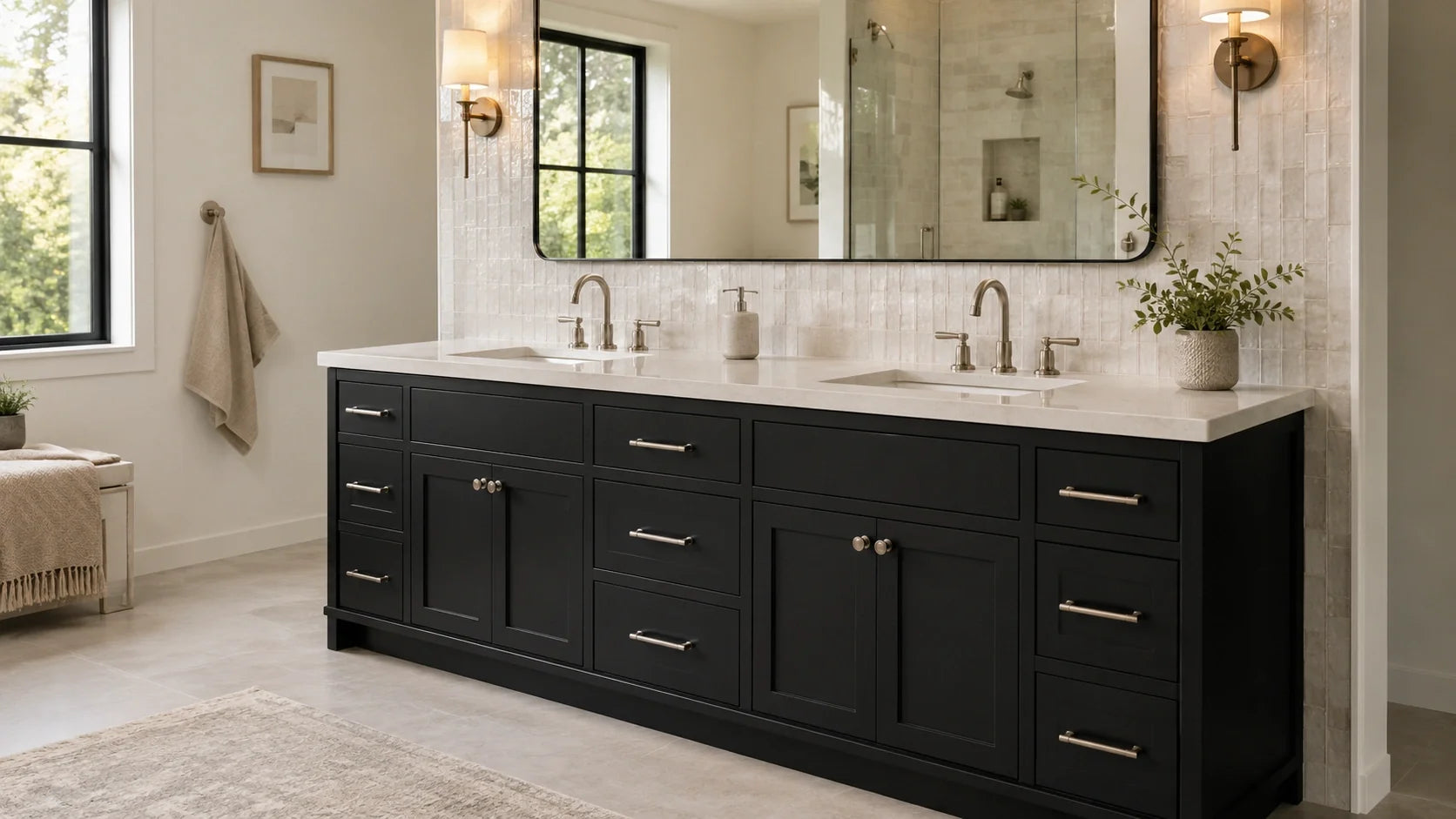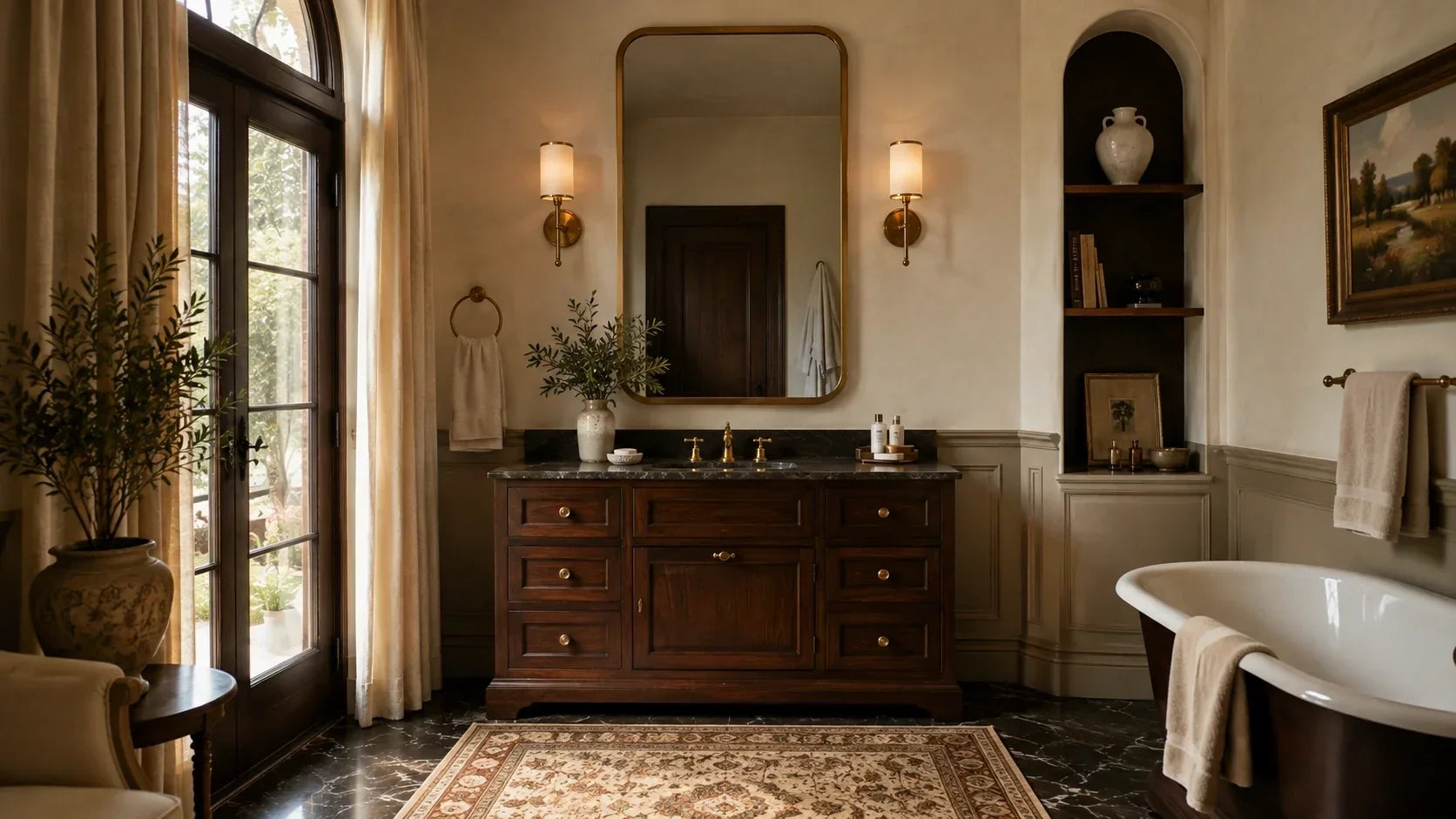
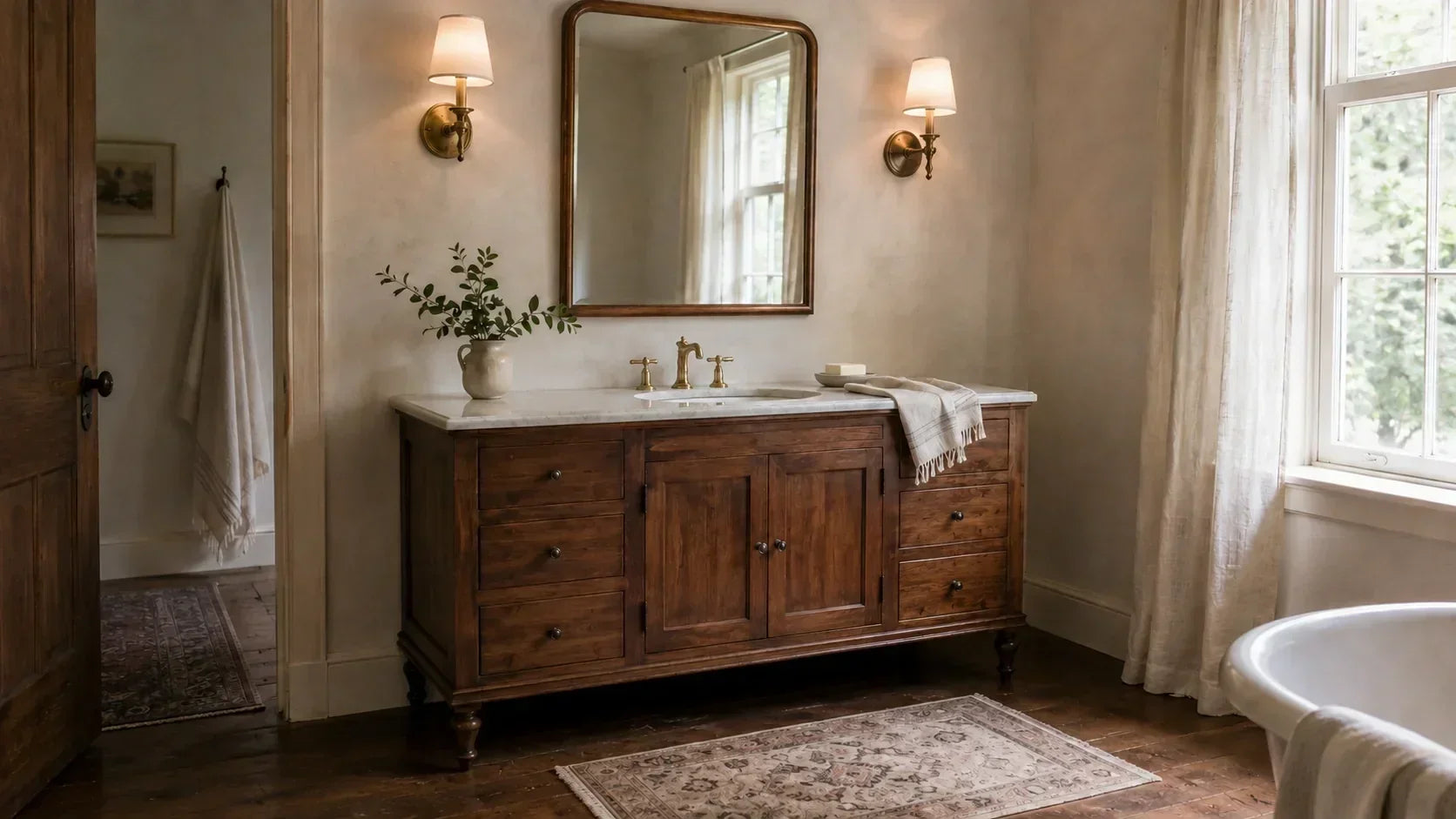
Antique vs. Vintage Bathroom Vanities: How to Tell the Difference
Walk into a showroom or scroll a marketplace listing and you'll see antique and vintage used as if they mean the same thing. They don't, and the difference changes what you're buying. Sorting out an antique vs vintage bathroom vanity starts with age, but it should end with harder questions about construction, plumbing, moisture, originality, and whether the piece can handle your daily routine.
The BathGems Brief
Treat the label as a lead, not proof. U.S. customs classifies an antique under heading 9706 as more than 100 years old. Vintage has no comparable universal cutoff for furniture, so the seller still needs to tell you when the piece was made.
- For a busy primary bath, we recommend a bathroom-ready antique-style vanity.
- For a genuine period piece, verify age and value before anyone cuts the top, back, or drawers.
- For either one, judge the finish, drain route, finished sink height, and ventilation before you judge the carving.
Antique vs vintage bathroom vanity: what the labels actually prove

Antique is the firmer term, but it still needs careful wording. The current U.S. Harmonized Tariff Schedule places antiques under heading 9706 when they're “of an age exceeding 100 years.” That's an import-classification standard, not a rule that forces every furniture seller to use the word correctly.
The threshold moves every day. As of August 6, 2026, a piece made before August 6, 1926, is more than 100 years old. If a seller can only document the year 1926, ask for the month, a maker's record, or other evidence before treating the customs benchmark as settled.
Vintage is less exact. There's no single legal age line that governs vintage furniture listings, and seller conventions vary. The smart move is to ask for the claimed decade, then look for construction and provenance that support it.
Retro, reproduction, and antique-style describe a different idea. A retro piece borrows the visual language of an earlier era. A reproduction or antique-style vanity is newly made to echo an old form, which can give you turned legs, raised panels, aged brass, and a furniture-like silhouette without asking a century-old cabinet to manage plumbing and steam.
| Antique | Vintage | Antique-style | |
|---|---|---|---|
| Age | Trade shorthand is 100 years or older; U.S. customs uses more than 100 years | No universal legal cutoff for furniture listings | Newly made |
| What the label proves | A claimed age category, not authenticity or value | An older-period claim that still needs a date and evidence | Design intent, not historical age |
| Bathroom readiness | Must be assessed and adapted piece by piece | Varies with construction, finish, and prior repairs | Often planned for wet-room use, but the finish and cutouts still need checking |
| Plumbing | Usually requires cutting unless it's already converted | Often requires a custom drain path | Usually planned around modern rough-in locations |
| Value | Depends on maker, rarity, provenance, condition, and originality | Depends on design significance, demand, condition, and attribution | Resells as contemporary furniture, not as a period object |
| Our recommendation | Use only after careful inspection and a conversion plan | Choose for character when the dimensions, finish, and plumbing path work | Best fit for an everyday primary or family bath |
For the federal classification itself, review heading 9706 in the U.S. Harmonized Tariff Schedule. It supports the over-100-year benchmark, but it doesn't authenticate a seller's cabinet.
Antique-style is a look, not an age claim

An antique-style vanity usually announces itself through furniture details: a carved apron, turned or reeded legs, bun feet, raised-panel doors, and hardware in aged brass or oil-rubbed bronze. Walnut, mahogany, oak, and painted finishes carry the look well. A honed marble top softens the whole piece because it returns less glare than polished stone under sconces.
The finish decides how gracefully that look lives in your room. A distressed or low-sheen surface disguises small nicks and dried splash marks better than dark gloss, which shows dust and water spots under direct bathroom lighting. Unlacquered brass darkens where wet hands touch it, while honed marble can etch from acidic cleaners even after it's sealed.
Most buyers get this wrong by treating every old-looking detail as evidence of age. Factory-applied wear, antiqued hardware, wormhole marks, and rubbed edges can all be new. If you want the character without the authentication project, our antique bathroom vanity collection focuses on period-inspired pieces built for current bathrooms.
For the practical comparison between an original period cabinet and a newly made version, read our guide to antique vs. antique-style bathroom vanities. The right call here is simple: preserve the original when its history is the point, and choose the reproduction when daily use is the point.
How to tell what you're actually looking at

Start with the parts a maker never expected you to admire. Pull a drawer, inspect the back, look under the case, and photograph any label, stamp, pencil notation, or maker's mark. Those quiet surfaces show tool marks, repairs, replaced boards, and hardware changes more honestly than the front.
Dovetails are useful evidence, but they aren't a birth certificate. Slightly irregular spacing, saw kerfs, and layout marks can support a hand-cut construction story, while highly repeatable profiles can point to machine production. Reproductions can be hand-cut, old drawers can be replaced, and machine work appears on furniture that's now genuinely antique.
Patina needs the same restraint. Real wear often builds at handles, drawer edges, feet, and other touch points, but convincing wear can be added later. Compare the finish in protected areas with exposed areas, then check whether screw heads, hardware, and drawer wear tell the same age story.
Don't use veneer as a fake test.
Fine furniture makers have used decorative veneer for centuries. A veneered surface may be old, valuable, and well made, while a solid-wood piece may be recent and ordinary. Judge the substrate, joinery, tool marks, maker, condition, and provenance together.
If the price depends on rarity or authorship, pause before you buy. Authentication is a pattern of evidence, and a qualified appraiser or furniture conservator can assess an original surface, later repairs, and attribution more reliably than any single drawer-joint test.
Explore our Antique Bathroom Vanities in Vintage Styles


Before you convert old furniture into a vanity

The sink is where a charming dresser becomes a construction problem. Measure the finished rim height, not the cabinet height alone. A vessel basin adds its full profile above the top and can leave you reaching over an awkwardly tall bowl, while an undermount sink sits lower but drops into the cabinet and can consume more drawer space.
Depth matters just as much. A shallow case may leave too little room between the backsplash, faucet body, and basin, especially with a widespread faucet. Before you buy stone or drill a hole, mock up the top, sink, and faucet in plan view so the handle can turn without hitting the wall or mirror.
Plumbing takes more space than it appears to on paper. The drain, trap, supply lines, and shutoff valves often land directly behind the deepest drawer. Avoid the mistake of cutting first and discovering later that three useful drawers have become shallow false fronts.
| Finished sink height | Add the top, basin, and any mounting ring to the cabinet height. Build a quick cardboard mock-up and test the reach with the person who'll use it most. |
|---|---|
| Depth and clear floor space | Tape the full footprint on the floor, including top overhang, and open the bathroom, shower, and cabinet doors completely. Many U.S. residential codes use 21 inches as the minimum clear space in front of a lavatory, but local rules control. |
| Drain route and service access | Map the wall rough-in against every drawer, rail, and shelf. Keep shutoff valves and trap connections reachable after the top is installed. |
| Top and sink support | Have the fabricator confirm the cabinet can carry the selected top and that the sink cutout won't remove a critical rail or weaken a veneered edge. |
| Water protection | Seal exposed cut edges, the sink opening, the back, the underside of the top, and the feet or plinth. Leave a way to inspect plumbing instead of sealing the cabinet permanently to the wall. |
| Historical value | Check maker's marks, provenance, inlay, veneer, and original hardware before changing the piece permanently. |
Alteration doesn't automatically erase all value, but it can reduce collector interest when originality is part of the appeal. We recommend an appraisal before cutting a signed, rare, finely inlaid, or unusually intact piece. For an ordinary dresser with sound construction and no special attribution, a careful conversion can still make sense.
Ventilation belongs in the conversion plan too. Sealers slow moisture entry, but they don't make old wood waterproof, and a failed sink bead or slow supply-line leak can damage the cabinet from the inside before you see it. The smart move is a working exhaust fan, accessible shutoff valves, and enough clearance to inspect the back after installation.
Wood, veneer, and finish: what survives bathroom use

Age alone doesn't make a cabinet fragile, and new construction isn't automatically moisture-ready. Old solid wood may move with seasonal humidity, veneer can lift where adhesive has failed, and repaired joints may loosen under the weight of a stone top. A new cabinet can have the same problems if the finish stops at the visible faces and leaves cut edges exposed.
Inspect the finish as a system. You want continuous coverage around doors, drawer edges, sink openings, the back of the splash zone, and the lower parts that meet mop water or a damp floor. A tiny lifted veneer edge beside the sink is more urgent than a broad patch of harmless color variation because it gives water a path under the surface.
On an older piece, ask what was used to refinish it and whether the interior surfaces were protected after the plumbing cuts were made. On a newly made piece, read the specifications for the cabinet box, drawer construction, countertop, sink cutout, and warranty instead of relying on a single “solid wood” label.
A bathroom-ready solid wood bathroom vanity can give you the weight and grain people love in period furniture without asking you to engineer every wet-area detail yourself. The material description still isn't a performance guarantee, so confirm the finish coverage and plumbing layout before installation.
Stone adds another maintenance decision. Marble is calcium-based and can dull or etch when it meets acidic cleaners. An impregnating sealer improves stain resistance, but it doesn't make the stone stain-proof or stop acid etching, so keep a pH-neutral cleaner beside the vanity and follow the Natural Stone Institute care guidance.
An era cheat sheet that doesn't overpromise

Style can narrow the search, but it can't authenticate the object. Makers repeated older forms, regional workshops adopted styles at different speeds, and later reproductions copied the details closely. Use the silhouette to form a hypothesis, then test it against construction, labels, and provenance.
| Style | Approximate period | Useful clues | Bathroom reality |
|---|---|---|---|
| Victorian | 1837 to 1901 | Dark woods, carved fronts, turned details, marble | Furniture proportions may produce an awkward finished sink height, and stone adds substantial weight |
| Arts and Crafts | About 1880 to 1920 | Oak, straight lines, visible joinery, restrained hardware | Thick rails and casework can block the drain route even when the cabinet looks roomy |
| Art Deco | 1920s to 1930s | Geometric fronts, rounded corners, figured veneers | Veneer edges and curved substrates need close inspection before wet-room use |
| Mid-century modern | About 1945 to the late 1960s | Tapered legs, walnut or teak tones, clean drawer fronts | Slim legs look light but may need reinforcement for a heavy stone top |
A claw foot, carved apron, or dark walnut finish can point you toward Victorian design, but it doesn't prove Victorian manufacture. Tapered legs and a low horizontal case suggest mid-century influence, not necessarily a 1950s production date. Style dates the idea more easily than it dates the object.
Which one belongs in your bathroom

For a primary bath used every morning, we recommend a modern antique-style vanity with a documented finish, planned plumbing voids, and serviceable drawers. You get the warmth of turned legs, aged metal, and a furniture silhouette without sacrificing shutoff access or asking old glue joints to carry a new stone top.
A genuine antique or vintage conversion makes more sense when the piece itself is the reason for the room. Give it a powder room or lightly used guest bath, keep the sink configuration simple, and accept that storage may shrink once the drain is routed. An original piece deserves a measured installation, not a rushed weekend cut.
Cost the whole conversion before you fall for the cabinet price. Add the stone top, basin, faucet drilling, reinforcement, finish repair, plumbing changes, delivery, and the value of any drawers you'll lose. In many daily-use bathrooms, that total is the moment an antique-style piece becomes the smarter buy.
The antique vs vintage bathroom vanity decision gets easier once you compare the broader range of bathroom vanity styles and look at proportion as carefully as period detail. A vanity can be historically convincing and still be wrong for the door swing, mirror width, or way you use the sink.
Explore our Bathroom Vanity Styles

30" Beckett Single Bathroom Vanity in Whitewashed Oak with Brushed Nickel Trim by Wyndham


72" Double Sink Bathroom Vanity with Top in Chestnut - James Martin Marcello

66" Strada Double Bathroom Vanity in White with Brushed Nickel Trim by Wyndham


Pairs well with a measured plan.
Photograph the maker's marks, tape the cabinet footprint on the floor, and map the drain against the drawers before you fall for the finish. Then compare the full conversion cost with a bathroom-ready antique-style piece. The better choice preserves what you value without making the sink harder to use.
Frequently Asked Questions

Todd Harmon
Todd believes an old cabinet only earns a place at the sink when its proportions, structure, and finish can live with water. The right decision protects the piece and the way you use the room. With over two decades in e-commerce and product curation, Todd built BathGems on a simple idea: a bathroom should feel as collected and considered as the rest of the home. He sources every vanity and fixture in the BathGems catalog the way a designer pulls samples, weighing material, proportion, finish quality, and how a piece actually lives in a real room over time.