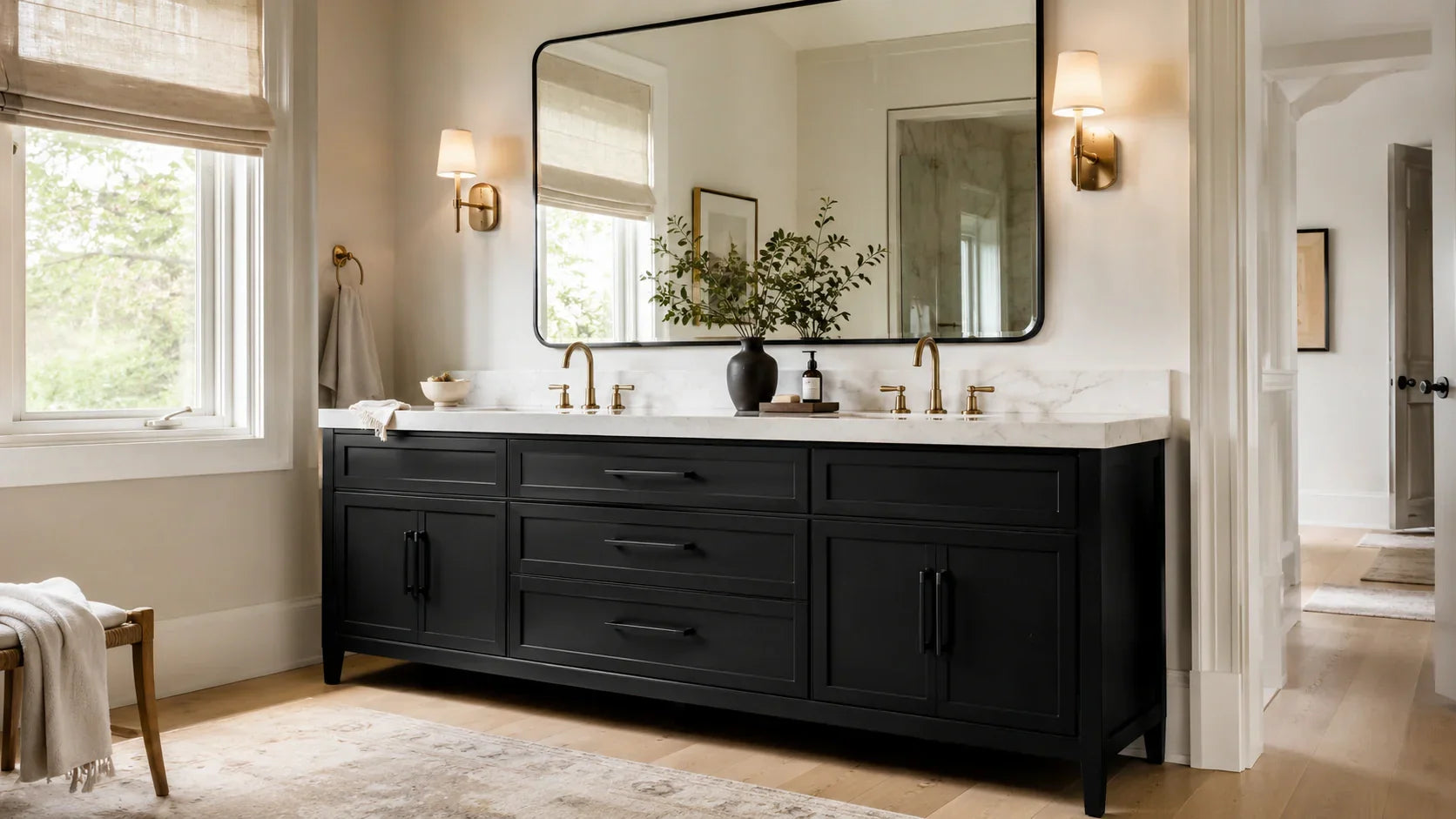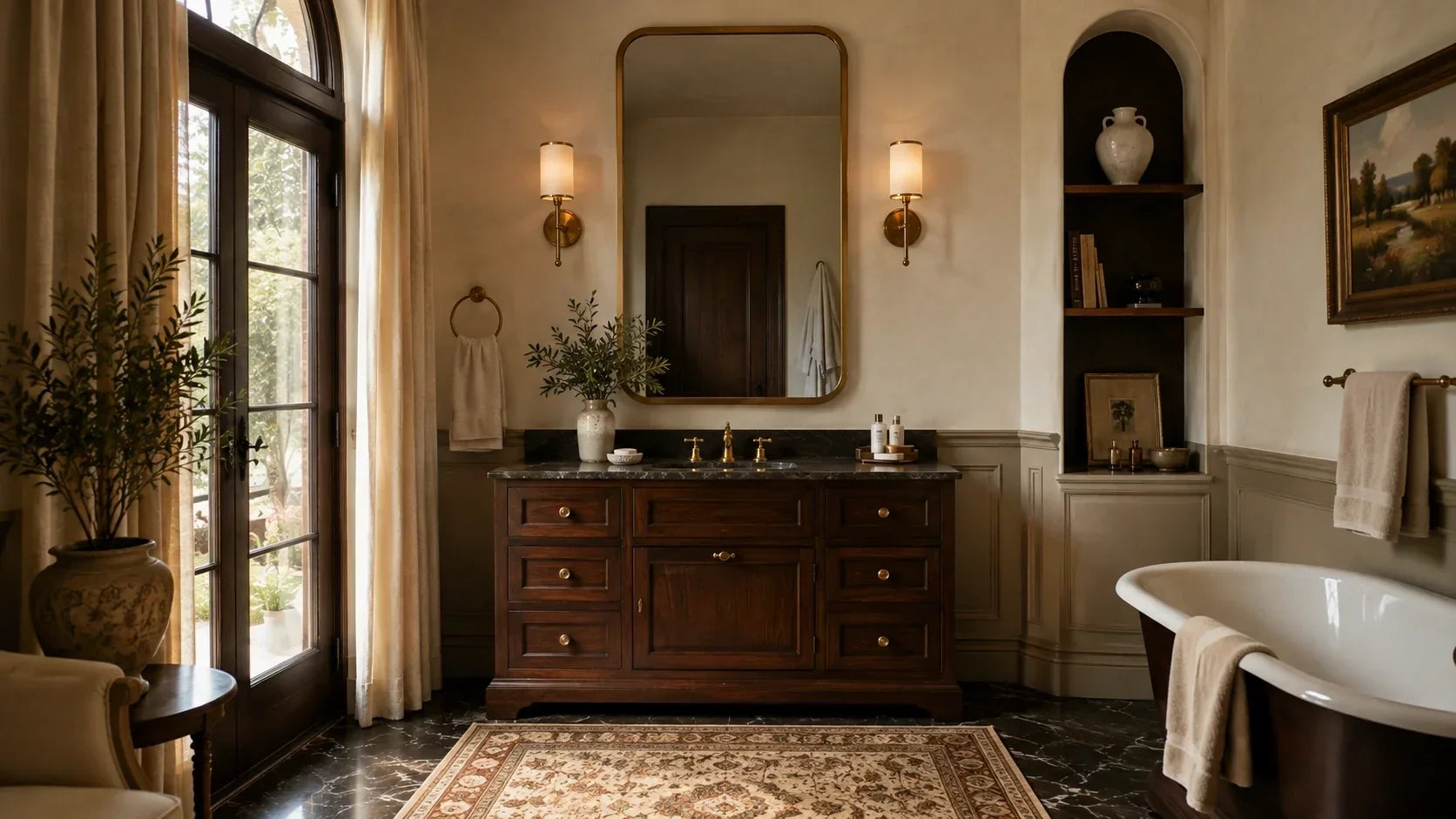
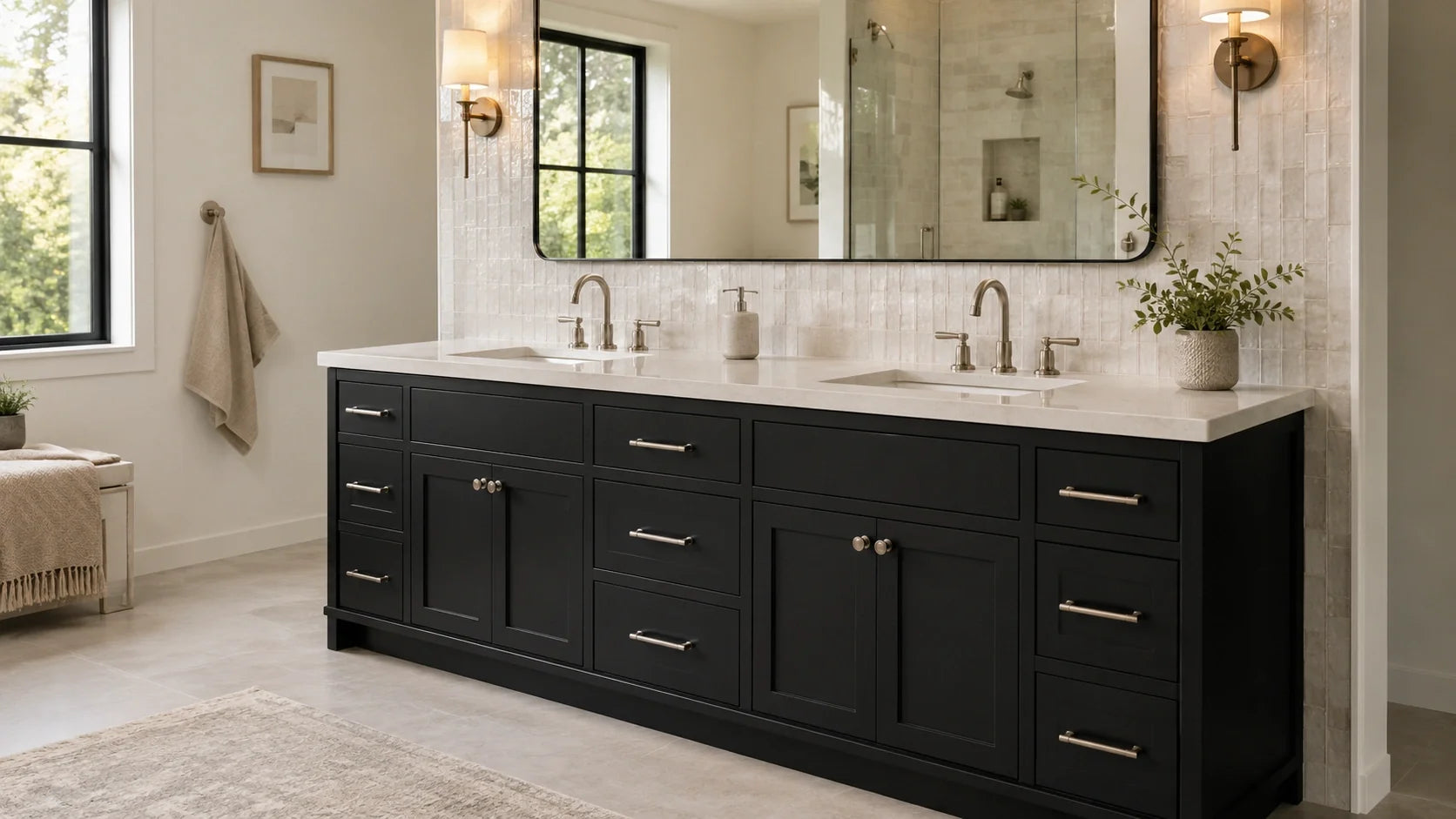
Black Bathroom Vanity Sizes: From 24-Inch Singles to 72-Inch Doubles
Size and finish usually get chosen on separate days. Black doesn't let you get away with that. A 30-inch vanity in white reads as tidy; the same 30 inches in black reads as a statement, and that changes the lighting, sheen, and clearance decisions tied to each width, not just what the tape measure says.
The BathGems Brief
Black carries more visual weight than a lighter finish at the same width, so the size you'd pick in white isn't automatically the size you should pick in black.
- Single-sink range: 24 and 30 inches suit powder rooms and compact guest baths, 36 inches is the safest default, and 42 to 48 inches buy more counter and storage.
- Double-sink range: 60 inches is the practical starting point, but 72 inches is the better choice when two people share the sink every day.
- Typical proportions: Most full-depth vanities run about 21 to 22 inches deep and finish near 34 to 36 inches high, but always check the assembled product dimensions.
- Our finish call: We recommend matte or satin black below 36 inches. Gloss concentrates reflections, fingerprints, and water spots in the smallest rooms.
Why Black Changes the Size Equation

Black reflects less light than white, pale wood, or gray, so the cabinet reads visually heavier even when the footprint is identical. A width that feels quiet in white can feel dominant in black, especially beside a narrow doorway, a small mirror, or a single overhead light.
The effect shows up in scale and sheen. A 72-inch black double needs enough pale surface, face-level lighting, and open floor around it to keep the room balanced. At the smaller end, a glossy 24-inch vanity can become a maintenance trap because the mirror and lighting sit close enough to spotlight every toothpaste fleck and dried splash.
Black Bathroom Vanity Sizes at a Glance

Here's how the standard black bathroom vanity range breaks down, from a compact powder-room single to a primary-bath double that earns its footprint.
| Width | Sink Config | Typical Depth | Typical Height | Best For |
|---|---|---|---|---|
| 24" | Single | 18"–21" | 34"–36" | Powder room, tight guest bath |
| 30" | Single | 18"–21" | 34"–36" | Small guest bath with storage |
| 36" | Single | 20"–22" | 34"–36" | Standard guest or secondary bath |
| 42" | Single | 21"–22" | 34"–36" | Guest bath needing extra counter |
| 48" | Single | 21"–22" | 34"–36" | Larger secondary or single-user primary |
| 60" | Double | 21"–22" | 34"–36" | Shared bath, tighter primary layout |
| 72" | Double | 21"–22" | 34"–36" | Primary bath, two daily users |
These heights describe the cabinet and counter assembly. If you're using a vessel sink, add the sink height and check the finished rim before you order.
Measuring the wall, plumbing rough-in, and clearances works the same way for every finish. Our full bathroom vanity size guide covers the fit math and mirror-width rule in more depth. What follows here is specific to how black behaves at each width.
Single-Sink Sizing, 24 to 48 Inches

A 24-inch black vanity is the smallest standard option in this range and the one that does the most work in a powder room or tight guest bath. At this width, stay matte or satin. Before you buy, tape the cabinet depth on the floor and open the bathroom door fully. A vanity can fit the wall and still make the doorway feel like a daily negotiation.
Thirty inches adds real drawer space without taking over the room, and it's where black often starts to feel deliberate rather than compressed. A floating install helps because the visible floor breaks up the dark mass. Check the plumbing diagram before falling for a drawer-heavy front, since a centered P-trap can turn the top drawer into a shallow cutout.
Thirty-six inches is the safest default across finishes. You get useful counter space, a wider sink cabinet, and enough width for black to read as an anchor instead of a block. If you're choosing between 30 and 36 inches and the door swing clears both, we recommend 36.
Move to 42 or 48 inches when the room can support more landing space and a wider drawer plan. Furniture-style legs, framed doors, or reeded fronts help break up the black surface. The 48" Brittany Single in Black Onyx shows how detailing keeps a larger black vanity from reading like one flat slab. Browse the full range of single-sink vanities to compare widths side by side.
Double-Sink Sizing, 60 to 72 Inches

Double-sink vanities exist below 60 inches, but most shared bathrooms work better once you reach 60. Common planning guidance calls for at least 15 inches from a sink centerline to a side wall or obstruction, and your local code, sink dimensions, and faucet layout govern the final placement.
At 60 inches, two bowls, two drain assemblies, and two sets of supply lines consume most of the cabinet. The vanity may look generous from the doorway while offering less usable center storage than you expect. The smart move is to inspect the interior diagram, not just count the doors and drawers on the front.
Black makes the shared zone feel tighter because the finish carries more visual weight. If your wall and plumbing allow it, size up to 72 inches for double bathroom vanities. The extra foot creates a useful landing strip between users and gives the center of the cabinet room for real storage. The 60" Brittany Double in Black Onyx keeps a furniture-like profile when the room can't take 72.
Explore our Double Sink Bathroom Vanities

72" Double Sink Bathroom Vanity with Top in Chestnut - James Martin Marcello

84" Beckett Double Bathroom Vanity with Toe Kick Rift Oak Brushed Nickel Trim by wyndham

84" Beckett Double Bathroom Vanity with Toe Kick Rift Oak Brushed Gold Trim by wyndham

84" Beckett Double Bathroom Vanity with Toe Kick Rift Oak Matte Black Trim by wyndham


For two adults using the room at the same time, we plan on roughly 30 to 36 inches of vanity width per person. Sixty inches gives each user a compact zone. Seventy-two inches lets both people set down a toothbrush, skincare, or a hot tool without negotiating the same strip of counter.
Will a Black Vanity Make a Small Bathroom Feel Smaller?

Not if you keep the floor perimeter visible and give the cabinet enough contrast. The mistake isn't choosing black. It's choosing a deep, floor-heavy cabinet, a dark countertop, and ceiling-only light in the same small room.
Keep the width around 24 to 30 inches, choose a wall-mounted or leggy profile so the floor continues underneath, and pair black cabinetry with a pale quartz or marble top. A mirror that reaches close to the vanity width will return more light than a small decorative mirror. Explore our small bathroom vanity range for compact proportions that leave more room around the piece.
Measure the Parts That Move

Wall width is only the first measurement. A black vanity feels most oversized when a door clips the corner, a drawer can't clear the casing, or the cabinet sits hard against a side wall and the door won't open past its hardware.
- Door swing: Mark the full vanity depth with painter's tape, then open the bathroom door and shower door through their complete arcs.
- Drawer projection: Check how far the deepest drawer extends and leave yourself enough standing room to open it without stepping sideways.
- Plumbing rough-in: Compare the drain and supply locations with the cabinet's interior cutouts. Moving plumbing after the vanity arrives is rarely the easy fix.
- Side clearance: Leave enough room for doors, pulls, and uneven walls. A furniture-style vanity jammed into a corner can lose access to its outer drawer.
- Wall support: A floating vanity needs suitable structure at the mounting height. Confirm the blocking or stud plan before tile goes up.
- Finished sink height: A vessel sink adds height above the counter. Pairing one with a comfort-height cabinet can put the rim higher than you expect.
Do this before choosing the mirror. A wider black vanity often needs a wider mirror or paired mirrors to keep the wall from looking top-light.
Finish and Lighting by Size

The smaller the vanity, the more a glossy finish advertises daily wear. A very flat black hides water spots but can burnish at the pulls and drawer edges where hands touch it every day. Satin is the easiest all-around choice because it wipes clean without throwing a hard reflection back at the mirror.
Lighting should reach the face and the cabinet front, not just the floor. Side sconces, a well-lit mirror, or a combination of both keeps black from turning into a flat silhouette. Ceiling-only light often leaves the drawer fronts dark while making every mark on the countertop more obvious.
Ventilation matters too. Humidity doesn't care what color the vanity is, but repeated moisture can make dust cling to dark surfaces and expose swelling at poorly sealed joints. Run the exhaust fan during showers and until the mirror clears, then wipe standing water from the top and cabinet edges.
For countertop pairings, hardware finish, and sconce placement, our black bathroom vanity styling guide takes the next step. Our standing recommendation is simple: give black contrast, face-level light, and one warm material so the room feels grounded rather than severe.
Not sure how black will read under your bathroom's lighting?
Order a finish sample and hold it against your tile, paint, countertop, and hardware in morning and evening light. A sample tells you more than a screen ever will, especially with black, where undertone and sheen change as the room gets darker. Then use your final wall, door, and plumbing measurements to choose the width.
Frequently Asked Questions

Todd Harmon
Todd's rule for black vanities is simple: choose the finish and the width together, because the same cabinet can feel quiet or commanding depending on the room around it. He looks first at proportion, light, and the parts that have to move every morning. With over two decades in e-commerce and product curation, Todd built BathGems on a simple idea: a bathroom should feel as collected and considered as the rest of the home. He sources every vanity and fixture in the BathGems catalog the way a designer pulls samples, weighing material, proportion, finish quality, and how a piece actually lives in a real room over time.