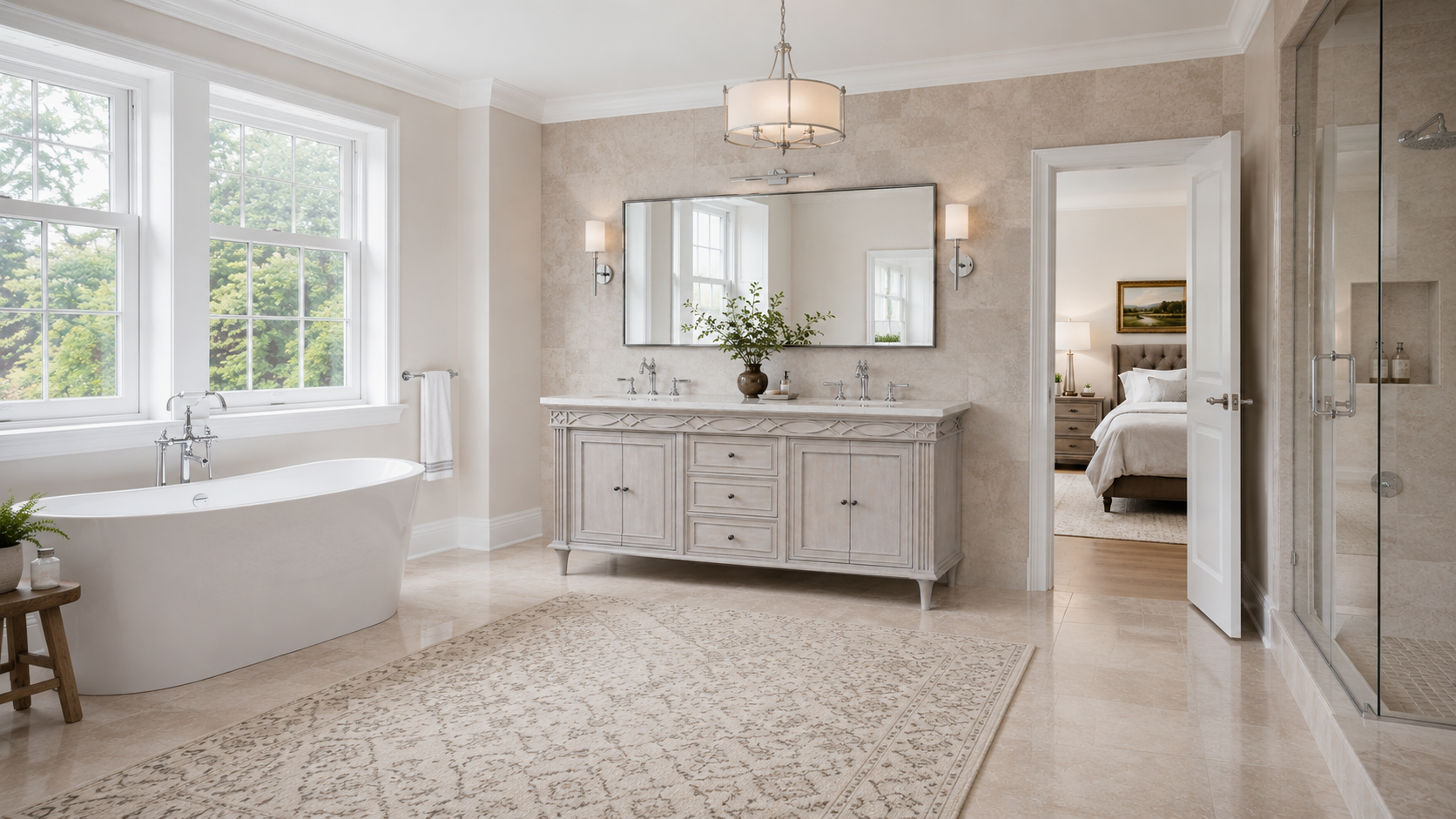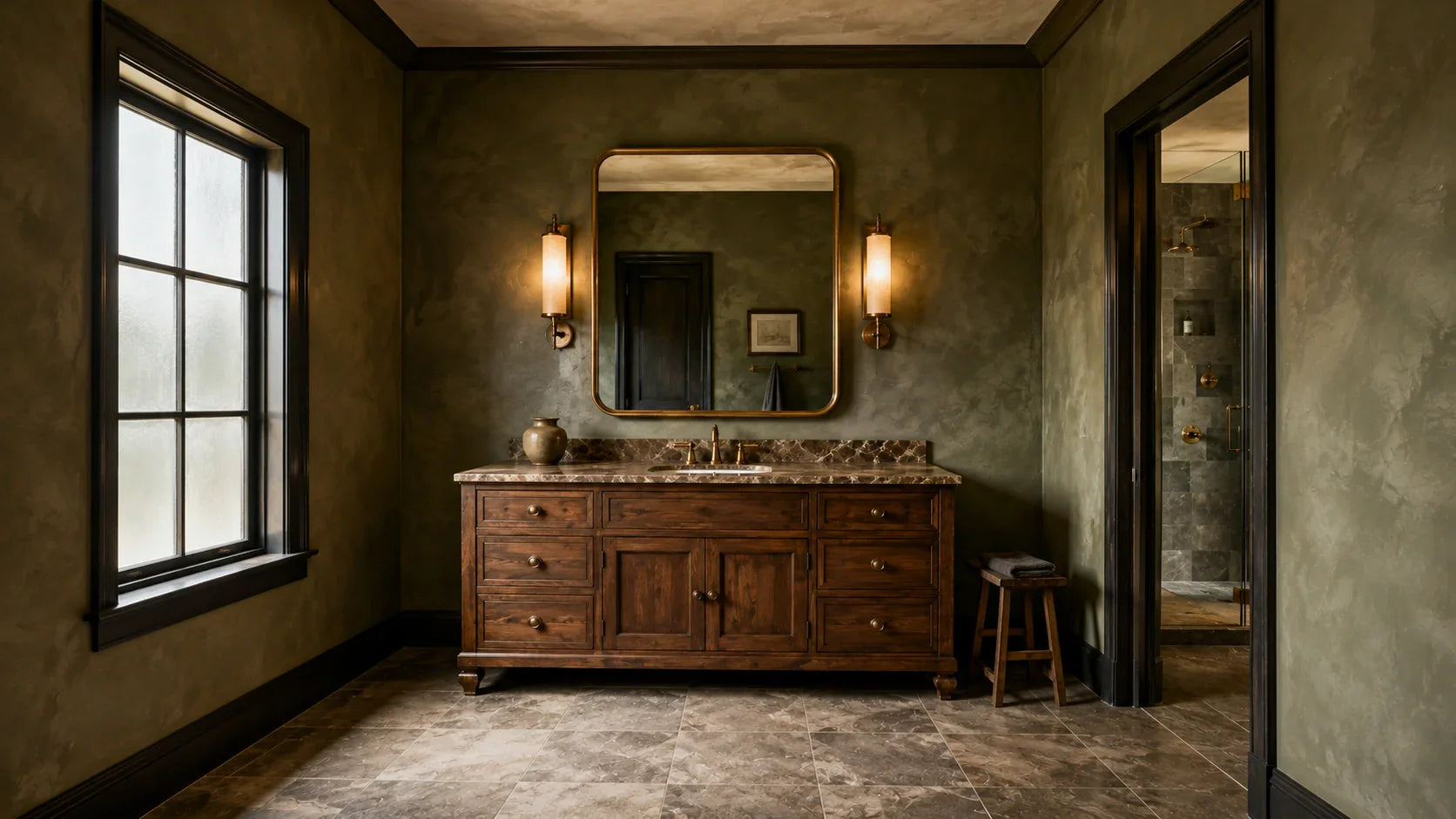
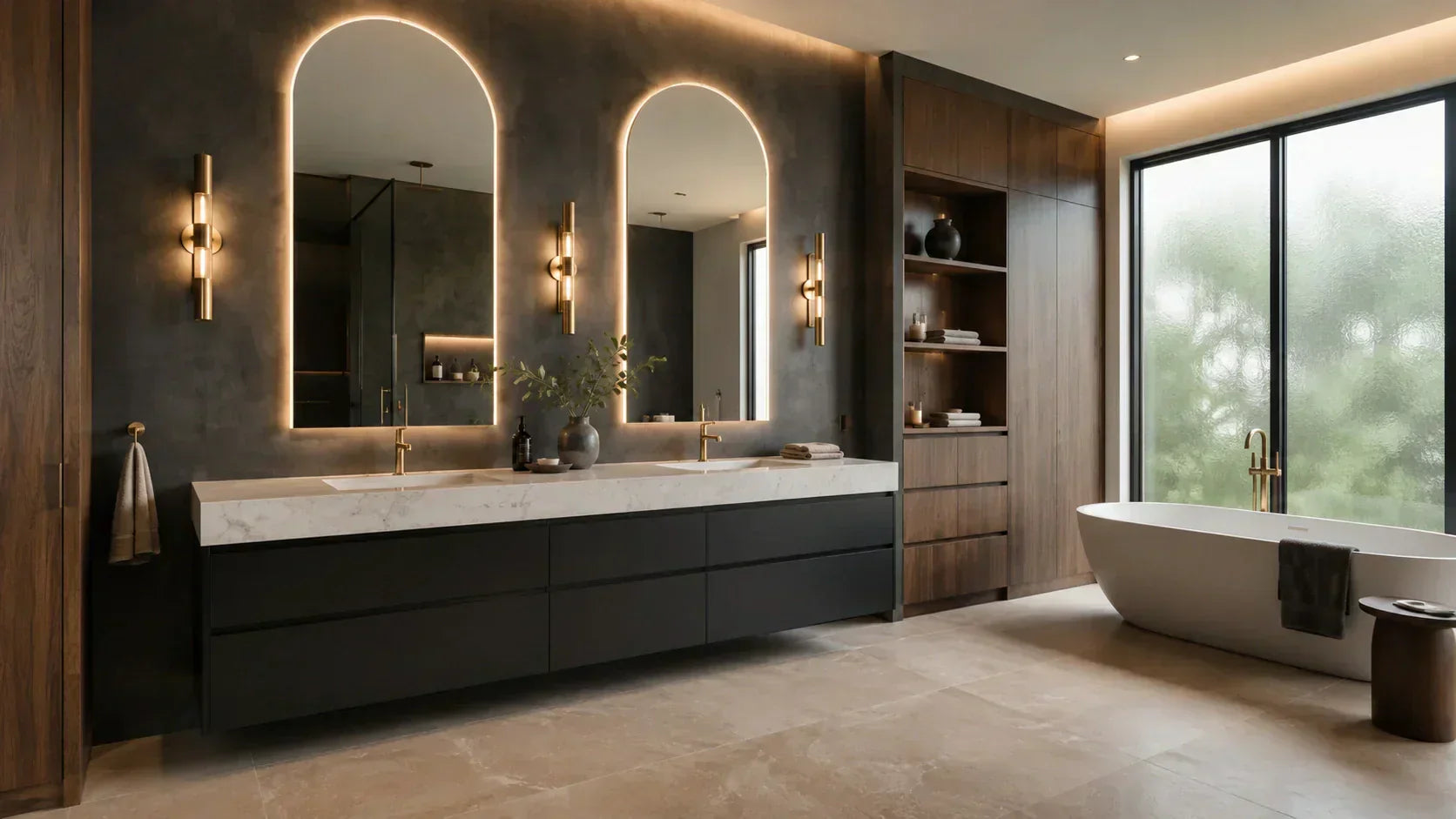
Black Bathroom Vanity Styling for a Bold, Modern Bath
Paint a bathroom white and nobody notices. Put a black vanity in it and the whole room snaps to attention. Black grounds a bath the way a walnut credenza grounds a living room: it gives the eye a place to land, makes pale counters look brighter, and reads modern or traditional depending entirely on the hardware you hang on it.
The BathGems Brief
The best black bathroom vanity ideas give the cabinet contrast, warmth, and enough light to return some depth to the finish.
- Start with a white quartz or softly veined stone top. It brightens the mirror zone and keeps the cabinet from reading as a dark block.
- Choose one metal family for the faucet, pulls, and sconces. Brass warms the room, matte black sharpens it, and brushed nickel keeps it quiet.
- Use warm light at 2700K to 3000K from more than one direction. A lone ceiling fixture leaves a black finish flat.
- In a tight bath, float the vanity and confirm wall blocking, plumbing height, door swing, and drawer clearance before ordering.
That flexibility is why black bathroom vanity ideas are worth collecting before you commit. The cabinet is the easy part. What makes or breaks the room is everything around it: the counter, the metal, the tile, and above all the light.
Black Bathroom Vanity Ideas Start With the Countertop

Powered by AURA Modern Home Hotspot Builder
The counter decides how loud the vanity gets to be. A bright white quartz top on a black cabinet is the clearest contrast, and the crisp line where counter meets cabinet does most of the styling for you. If that feels too graphic for your house, choose Carrara marble or a marble-look quartz with soft gray veining so the eye steps down gradually instead of jumping from black to white.
A pale top also does practical work. It returns more light toward your face at the mirror, and it gives toothpaste, soap residue, and standing water fewer places to disappear. We recommend an undermount sink here because it protects the clean contrast line and leaves more usable counter than a vessel bowl.
Dark stone on a black vanity is the tonal, editorial version of the look. It can be striking, but it needs side lighting, a bright mirror zone, and enough pale surface elsewhere to keep the room from closing in. Avoid choosing the counter from a small online swatch alone. Hold a real sample beside your tile in morning light and again after dark, because veining and sheen can shift more than the cabinet color does.
Black Vanity With Gold Hardware, Matte Black, or Chrome

Powered by AURA Modern Home Hotspot Builder
Hardware is where a black vanity picks its personality. The same cabinet can read traditional, contemporary, or quietly retro depending on the metal and sheen around it.
The Black Vanity With Gold Hardware Look
Gold and brass fixtures warm black instantly, which is why this pairing sits comfortably in traditional and transitional rooms. The detail most buyers miss is undertone. Unlacquered brass runs warm and develops patina, while satin and champagne gold stay lighter and more consistent. Pick one gold family and repeat it across the faucet, pulls, mirror, and sconces.
This is also where a furniture-style black vanity earns its place. A freestanding piece with visible legs, raised-panel doors, and brass pulls can feel like an old chest adapted for the bath rather than a block of cabinetry. We recommend this route in older homes where a stark, slab-front cabinet would fight the architecture.
Matte Black on a Matte Black Vanity
Tonal black hardware disappears into the cabinet, which is the point. The vanity reads as one sculptural mass, and the room leans contemporary. It's the shortest route to a true modern bathroom vanity look, especially against large-format tile and a pale counter.
Give that palette one warm material nearby, such as a white oak mirror frame, woven hamper, or warm stone floor. Matte black can look chalky under cool bulbs, so test the finish under the actual lighting before matching every fixture to it.
Chrome and Brushed Nickel for a Cooler Read
Chrome on black is the sleeper pick. It has a crisp, faintly retro quality that most people overlook while debating gold. It also shows water spots quickly beside a sink, especially under side light.
Brushed nickel is quieter and more forgiving in a busy family bath. Its softer reflection keeps the vanity clean-looking without making every faucet splash part of the composition. The smart move is to repeat the finish at least twice so it looks deliberate, not leftover.
Tile and Wall Pairings for a Modern Black Bathroom

Tile pairing is where a modern black bathroom either breathes or closes in. Handmade-look white or cream tile gives the wall movement, and every ripple catches light that plays against the flat cabinet below. Large-format porcelain in a soft stone tone is the calmer route, and it lets the vanity remain the room's strongest line.
Warm materials work too. Wood-look floors, plaster-toned walls, and a white oak mirror or shelf keep black from turning the bath cold. In a room with little daylight, choose the warm surface first and let the black vanity be the contrast, not the entire palette.
Paint and wallpaper deserve more credit here. Deep navy or emerald can fold a black vanity into a moody scheme, while patterned wallpaper above a tiled wainscot gives the cabinet something to push against. The vanity becomes the calmest element in the room, which is often more interesting than making it the only statement.
One rule of thumb we use constantly is to keep black to roughly a third of what you see from the doorway. Vanity, mirror frame, and a few fixtures are usually enough. Once the floor and walls go dark too, the room needs a more deliberate lighting plan and stronger ventilation so every damp surface dries cleanly.
| Element | Safe Bet | Bolder Move | Watch Out For |
|---|---|---|---|
| Countertop | White quartz or soft-veined marble | Dark stone with pale walls | Dark-on-dark without side lighting |
| Hardware | One gold family or brushed nickel | Tonal matte black | Mixing unrelated gold undertones |
| Tile | Large-format porcelain in a stone tone | White zellige for texture | Busy floor patterns under a floating piece |
| Lighting | Sconces flanking the mirror, 2700K to 3000K | Backlit mirror plus sconces | A single overhead fixture doing all the work |
Small Bathrooms and the Black Floating Vanity

The worry we hear most is that black will swallow a small bathroom. It won't if the floor stays visible and the mirror zone stays bright. In a compact bath, a wall-mounted floating bathroom vanity lifts the dark cabinet off the floor so the tile runs uninterrupted beneath it.
Depth matters as much as width. Many full-depth vanities are about 21 inches deep, and that can be the difference between a comfortable path and a hip-check every morning. Measure the open door, drawer extension, toilet clearance, and the narrowest point of the walkway before you choose a width.
A floating cabinet also changes the installation. Your contractor needs solid wall blocking, a plumbing rough-in that lands inside the cabinet, and a plan for any under-vanity lighting before tile closes the wall. Most buyers get excited about the open floor and forget that a visible trap or misplaced outlet can undo the clean look.
Keep the floor tile simple and low contrast. A busy pattern under a floating cabinet fights the openness you chose it for, while a soft stone-look porcelain lets the black vanity look intentional instead of heavy.
Single or Double: Choosing the Right Black Vanity

Sizing rules don't change because the finish is bold, but mistakes are easier to see because a black cabinet is the first thing the eye finds. A 48-inch single is a strong choice for a primary bath with one main user because it leaves generous counter space without crowding the wall. For two sinks, we recommend starting at 60 inches so each person gets usable elbow room and storage.
Drawer layout matters more than sink count on a busy morning. Two sinks can force narrow drawer banks and extra plumbing cutouts, while one centered sink often leaves deeper, more useful storage. Before deciding, compare the full cabinet diagrams and mark the supply lines, drains, and drawer boxes on the wall.
Explore our Black Bathroom Vanity

80" Sheffield Double Bathroom Vanity in Espresso with Brushed Chrome Trim & Medicine Cabinet by Wyndham

72" Sheffield Double Bathroom Vanity in Espresso with Brushed Chrome Trim & Medicine Cabinet by Wyndham

80" Sheffield Double Bathroom Vanity in Espresso with Brushed Chrome Trim & 70" Mirror by Wyndham

80" Sheffield Double Bathroom Vanity in Espresso with Brushed Chrome Trim & 24" Mirror by Wyndham


A few pieces show how differently black can behave. The 48" Brittany Single in Black Onyx by James Martin is the warmer, more traditional choice, with furniture-style detailing and a built-in FreePower wireless charger. The 60" Brittany Double in Black Onyx carries the same language across a shared bath.
The 48" Brookfield Single in Black Onyx is the more tailored option. Whichever profile you choose, pair it with a pale top and an undermount sink if you want the cabinet color to stay strong without losing counter space.
Sheen is the second decision. Matte black softens reflections but shows pale dust and edge scuffs sooner, while a glossier finish returns more light and makes fingerprints easier to spot. Compare dark pieces side by side in the black bathroom vanity collection, then choose the finish that suits how often the room is used and how much daylight it gets.
Lighting So a Black Vanity Doesn't Go Flat

Black shows dust and water marks, especially under morning side light. The less obvious cost is optical. A dark cabinet returns less light than a white one, so the same fixture can feel weaker after the vanity goes in. You didn't lose a bulb. You lost bounce.
The classic mistake follows directly from that: black vanity, dark counter, one dim ceiling fixture. The fix isn't a harsher bulb. Layer warm light from sconces at face height with an overhead source or backlit mirror that fills the remaining shadows.
We usually place sconce centers about 60 to 66 inches above the finished floor, then adjust for the mirror, ceiling, and the people using the room. Flanking the mirror gives you more even face light than a fixture mounted only above it. Keep the color temperature between 2700K and 3000K so black stays rich instead of drifting blue-gray.
Test the room after sunset before you sign off on the lighting. A black vanity that looks dimensional at noon can disappear at 9 p.m., and that is when most households discover the mirror needs light from the sides.
See the finish in your own light before you commit.
Order a Black Onyx finish sample, hold it against your tile and counter by day and after dark, then compare the result with the full black bathroom vanity collection. Check the sample page for current credit terms, then test first and order the cabinet second.
Frequently Asked Questions

Todd Harmon
Todd sees a black vanity as a study in contrast: the cabinet makes the statement, but the counter, hardware, and lighting decide whether it feels grounded or heavy. He favors dark finishes that still show depth under real bathroom light. With over two decades in e-commerce and product curation, Todd built BathGems on a simple idea: a bathroom should feel as collected and considered as the rest of the home. He sources every vanity and fixture in the BathGems catalog the way a designer pulls samples, weighing material, proportion, finish quality, and how a piece actually lives in a real room over time.