
Black Bathroom Vanity Hardware: Matte, Brass, and Chrome Pairings
You picked the vanity. Now the pulls, the knobs, and the faucet are doing the real talking, and black bathroom vanity hardware is where a lot of otherwise well-designed bathrooms lose their nerve at the finish line.
The BathGems Brief
Choose hardware in this order: read the vanity's undertone, decide how much contrast you want, then check the measurements and faucet drilling. The finish is only right if it works in your bathroom's actual light and fits the holes already in the cabinet and countertop.
- Matte black gives you the quietest, most architectural look, but low-quality coatings can polish at touchpoints or wear at the edges.
- Unlacquered brass adds the fastest warmth and changes with use, so buy it only if you want patina rather than a fixed finish.
- Chrome gives black cabinetry a crisp edge, but its reflective surface makes dried mineral marks easier to see.
- Use one metal as the lead finish, repeat it across the faucet and pulls, and let a second metal appear once or twice with clear intent.
It's a small decision that reads as a big one. Get the finish right and the room feels settled the moment you walk in. Get it wrong and the vanity looks like it's waiting for the rest of the bathroom to catch up. A black vanity can still live in a light, warm room, because the cabinet is an anchor, not a mood you have to repeat everywhere.
Black Bathroom Vanity Hardware: Starting With Matte Black

Powered by AURA Modern Home Hotspot Builder
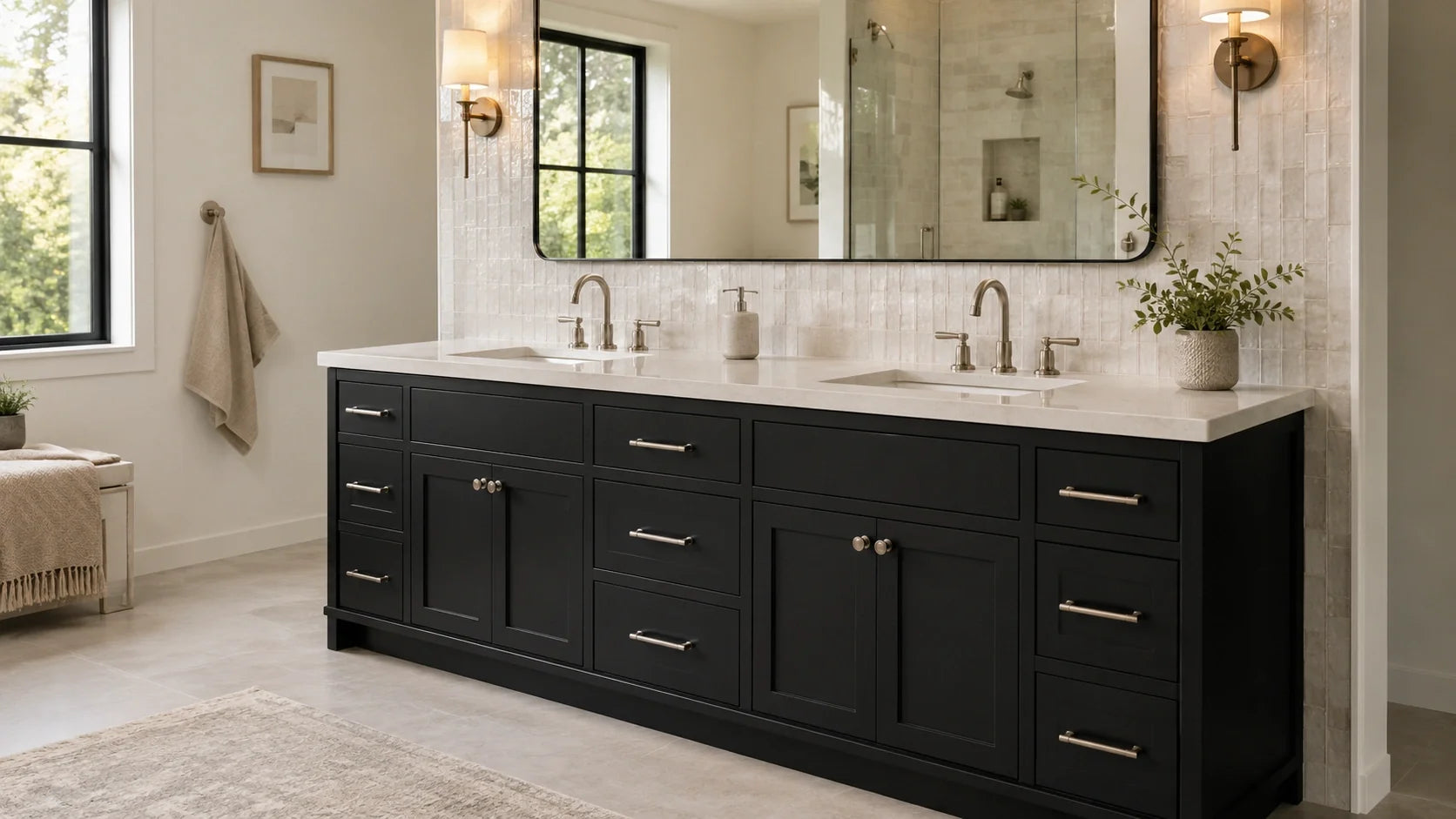
Matte black cabinet pulls are the safest first instinct on a black vanity. Against a matching door or drawer front, the hardware recedes and the cabinetry reads as one architectural block instead of a cabinet assembled from separate parts. We recommend this route in a modern or transitional bath where you want the vanity to feel more like furniture than a fixture.
Lighting changes the finish more than most buyers expect. Warm sconces and daylight give matte black depth, while cool LED strips can push the same hardware toward charcoal and make a slightly chalky coating easier to notice. The smart move is to hold one sample against the actual vanity in both daytime and nighttime light before you order the full set.
Finish construction matters more than the color name. Lower-cost coatings can wear first at corners and on the underside of a pull, where damp fingers land every morning. Some manufacturers use powder coating, electroplating, or physical vapor deposition, commonly called PVD, and each system has its own care limits, so ask how the finish is made and follow that maker's cleaning sheet rather than assuming every matte black part behaves the same.
If you're still deciding on the cabinet itself, lock that choice first. A soft satin black, a dry matte black, and a higher-sheen black can make the same pull look like three different finishes, which is why we prefer comparing hardware against the exact black bathroom vanity you're buying.
Brass Hardware on a Black Vanity: How Much Warmth Is Too Much?

Powered by AURA Modern Home Hotspot Builder
Reach for brass when the black cabinetry feels cold or visually heavy. Warm metal pulls pick up the creamy notes in honed limestone, warm white paint, and many Carrara marble slabs, which keeps the room from becoming a hard black-and-white composition. This pairing works especially well across farmhouse, transitional, and mid-century bathroom vanity styles.
Lacquered and unlacquered brass are different commitments. Lacquered brass has a clear protective layer intended to slow surface change, while unlacquered brass is exposed and develops patina through air, moisture, and hand contact. We recommend lacquered or satin brass in a busy family bath, and unlacquered brass when you genuinely want the darker edges and irregular touch marks that arrive with age.
The first weeks can surprise you. Raw brass often records fingerprints before the surface begins to mellow, so the hardware may look less even before it looks more settled. Avoid the mistake of polishing every mark away if patina is the reason you bought it.
Chrome vs. Brass on a Black Vanity: When Cool Contrast Wins

Chrome deserves more credit than trend photography gives it. On a black vanity, polished chrome reads cool, bright, and precise, especially beside white oak, pale stone, and clean white tile. We recommend it when you want a sharper contemporary bath rather than the softer, layered look brass creates.
Its trade-off is visibility. A reflective surface catches dried water and mineral residue quickly, so chrome asks for more frequent wiping near a busy sink. In a powder room that sees occasional use, that maintenance is minor. In a family bath with hard water, brushed nickel usually gives you a similar cool direction with less visible spotting.
Use the comparison below as a starting point, then let your room's light and your tolerance for upkeep make the final call.
| Finish | Best Use | Daily Reality | Pairs Naturally With |
|---|---|---|---|
| Matte black | Modern, transitional, minimalist baths | Hides light spotting, but touchpoints can gain sheen over time | White oak, honed marble, matte white walls |
| Unlacquered brass | Collected, farmhouse, transitional, mid-century baths | Shows early handprints, then develops an uneven living patina | Warm wood, cream walls, aged brass lighting |
| Polished chrome | Contemporary, coastal, crisp modern baths | Shows dried mineral marks readily and benefits from buffing dry | White oak, Carrara marble, cool white tile |
None of these finishes wins every room. Chrome earns its place when the bath has clean contrast and you don't mind wiping it dry. Matte black is the practical choice for a quieter look, while sealed brass gives you warmth without asking you to embrace patina.
Read the Undertone of the Black Before You Choose a Metal

Not every black is the same black. A neutral black accepts warm and cool hardware easily, while an off-black can lean brown, charcoal, blue, or even green under bathroom lighting. That undertone is the quiet reason a metal looks right in a product photo and slightly wrong after installation.
Brown-leaning black usually sits comfortably with unlacquered brass, champagne gold, and oil-rubbed bronze. Blue or charcoal black tends to sharpen beside polished chrome, nickel, or gunmetal. We recommend real contrast over an almost-match, because two finishes that are close but not equal often look like a purchasing mistake.
The test costs nothing. Hold one warm metal and one cool metal against the actual door in daylight, then repeat the test under the vanity lights after dark. Screens flatten undertone and sheen, so trust the room before you trust the product image.
Beyond the Big Three: Bronze, Champagne Gold, Gunmetal, and Nickel

Matte black, brass, and chrome cover most projects, but the quieter finishes often solve the room more gracefully. Oil-rubbed bronze brings copper-brown warmth to a soft black vanity without the brightness of brass. Champagne gold and satin brass give you warmth with less glare, which makes them easier beside creamy quartz and warm white walls.
Gunmetal and graphite are useful when straight matte black disappears too completely. Their metallic sheen separates the pull from the drawer front without turning it into a bright accent. The right call here is a cool-undertoned vanity and restrained lighting, because yellow light can make some gunmetal finishes look brown.
Satin nickel is the workhorse we recommend most often for a high-use family bath. It sits between chrome and brass in temperature, softens the contrast against black, and usually hides small dried marks better than a mirror-bright finish. If chrome feels icy and brass feels loud, start here.
Sizing Black Vanity Pulls, Knobs, and Going Handleless

Proportion is where good hardware goes wrong more often than finish does. A pull around one-third of the drawer width is a useful visual starting point, not a drilling standard. Slab-front drawers can carry a longer pull, while a narrow Shaker rail may need something shorter so the hardware doesn't crowd the frame.
Two measurements matter. Overall length is the visible end-to-end size, while center-to-center is the distance between the screw-hole centers. If you're replacing existing hardware, center-to-center must match the drilled holes unless you're willing to fill, refinish, and redrill the drawer front.
These ranges are BathGems design guidance for visible pull length. They help you mock up proportion, but they don't replace the manufacturer's center-to-center specification.
| Drawer Width | Visible Pull Length to Test | BathGems Guidance |
|---|---|---|
| 12" to 15" | 3" to 5" | Keep the pull clear of narrow rails and drawer edges |
| 18" | 5" to 6" | A balanced starting point for many single-vanity drawers |
| 24" | 7" to 8" | Longer pulls keep a wide drawer from looking under-scaled |
| 30" | 9" to 10" | Best suited to slab fronts or broad contemporary drawers |
Many cabinet knobs fall around 1 to 1.5 inches in diameter, but the door rail and the grip in your hand matter more than the nominal size. Tape paper templates to the vanity and stand back before drilling. Most buyers get this wrong because a pull that looks substantial in your palm can look tiny across a 30-inch drawer.
For replacement hardware, use the exact center-to-center measurement shown on the product listing. Hardware maker Berenson's center-to-center conversion chart is useful when the existing holes are measured in inches and the new pull is listed in millimeters.
Handleless doesn't mean hardware-free. Edge pulls, finger pulls, and routed grips still need enough finger clearance to feel comfortable with wet hands. They suit a floating bathroom vanity because the thin line of metal keeps the cabinet face calm, but test the grip before committing to a whole wall of drawers.
Match the Faucet to the Hardware and the Countertop Drilling

Your faucet is touched with wet hands every day, so it deserves its own decision. The safest move is to keep your bathroom faucet and cabinet pulls in the same named finish from the same manufacturer or collection. Two brands can both call a finish brushed brass and still deliver noticeably different color and sheen.
Mixing can work, but make it obvious. A brass faucet with black pulls reads as deliberate when black repeats at the mirror or sconces. A warm brass faucet beside slightly greener brass pulls usually reads as a failed match, which is why ordering one sample part before the full set can save a costly return.
Check the holes before the finish. A single-hole faucet uses one countertop opening. A centerset faucet is designed around closely spaced holes, commonly a three-hole layout on 4-inch centers, while a widespread faucet uses separate spout and handle pieces with the spacing specified by the model. Your vanity top or sink determines which configuration fits, so confirm the spec sheet before you buy.
This is the point where real combinations help more than another finish name on a screen.
Explore our Black Bathroom Vanity

80" Sheffield Double Bathroom Vanity in Espresso with Brushed Chrome Trim & Medicine Cabinet by Wyndham

72" Sheffield Double Bathroom Vanity in Espresso with Brushed Chrome Trim & Medicine Cabinet by Wyndham

80" Sheffield Double Bathroom Vanity in Espresso with Brushed Chrome Trim & 70" Mirror by Wyndham

80" Sheffield Double Bathroom Vanity in Espresso with Brushed Chrome Trim & 24" Mirror by Wyndham


Compare the cabinet sheen, included hardware, countertop color, and faucet drilling together. A black vanity with factory-installed brushed nickel trim may need a different plan than a plain black cabinet with no metal detail at all.
Build One Metal Story Across the Vanity Wall

You don't need one finish everywhere. You need a lead finish and enough repetition for the eye to understand the plan. As a practical rule of thumb, let one metal carry most of the faucet, pulls, mirror, and bath accessories, then let a second finish appear once or twice as a clear accent.
The diagram below shows the logic. The dominant finish repeats at the faucet, pulls, and mirror frame. The accent finish gets one focused moment at the sconces, so it reads as contrast rather than a last-minute substitution.
Towel bars, robe hooks, shower trim, and the toilet lever count too. They can join the dominant finish or repeat the accent, but a third unrelated metal usually makes a small bath feel busier. In a powder room, we recommend one finish across every visible fitting unless the lighting is the single intentional exception.
Watch sheen as closely as color. Brushed nickel beside polished chrome can look like an accidental near-match, while matte black beside polished brass has enough contrast to feel deliberate. The smart move is to mix finishes that are clearly different, then repeat each one so the choice has context.
This matters in listing photos too. A black vanity with a restrained metal story reads calm and finished, while three unrelated finishes pull the eye away from the cabinet. If resale is part of the plan, keep the permanent pieces quiet and let towels or art carry the more personal color.
Keep Each Finish Looking Like It Should

Finish names aren't care instructions. Two matte black faucets can use different coating systems, and the cleaner approved for one may damage the other. Start with the manufacturer's care sheet, then use the gentlest method that removes the residue.
For routine cleaning, a damp soft cloth followed by drying is the safest baseline. Mild liquid dish soap is commonly allowed, but rinse it away and don't let cleaner sit on the finish. Abrasive pads, metal polish, and harsh acids are the mistakes that do the fastest damage.
| Finish | Gentle Routine | Avoid Unless the Maker Approves It |
|---|---|---|
| Matte black | Damp microfiber, mild soap if permitted, rinse and dry | Scouring pads, abrasive powders, bleach, prolonged cleaner contact |
| Unlacquered brass | Soft cloth and minimal cleaner if you want natural patina | Metal polish or acids if you want to preserve the aged surface |
| Lacquered brass | Damp soft cloth, then dry immediately | Metal polish and abrasive pads that can cut the clear coat |
| Polished chrome | Mild soap and water, rinse, then buff dry | Gritty scrubbers and strong descalers without finish approval |
PVD can improve resistance to abrasion and discoloration, but it doesn't make every fitting immune to every chemical. Brand-specific guidance still controls. For a conservative baseline, Moen's finish-care guidance organizes cleaning instructions by finish type rather than treating all metal surfaces alike.
See the finish in your own light before you commit.
BathGems carries genuine James Martin finish, stone, and metal samples. Order the closest finalists, set them beside your tile and wall color, then look again after the sun goes down and the vanity lights take over. Check the individual sample listing for current price and availability.
Once your black bathroom vanity hardware is settled, carry the same contrast and warmth through the rest of the room. Our guide to black bathroom vanity ideas is the natural next step for choosing the mirror, wall color, stone, and lighting around it.
Frequently Asked Questions

Todd Harmon
Hardware is the last decision buyers make and the first thing I check when a black vanity photo doesn't quite land. A pull sized wrong for the drawer, or a chrome faucet fighting a brass mirror, can undo an otherwise strong room fast. With over two decades in e-commerce and product curation, Todd built BathGems on a simple idea: a bathroom should feel as collected and considered as the rest of the home. He sources every vanity and fixture in the BathGems catalog the way a designer pulls samples, weighing material, proportion, finish quality, and how a piece actually lives in a real room over time.