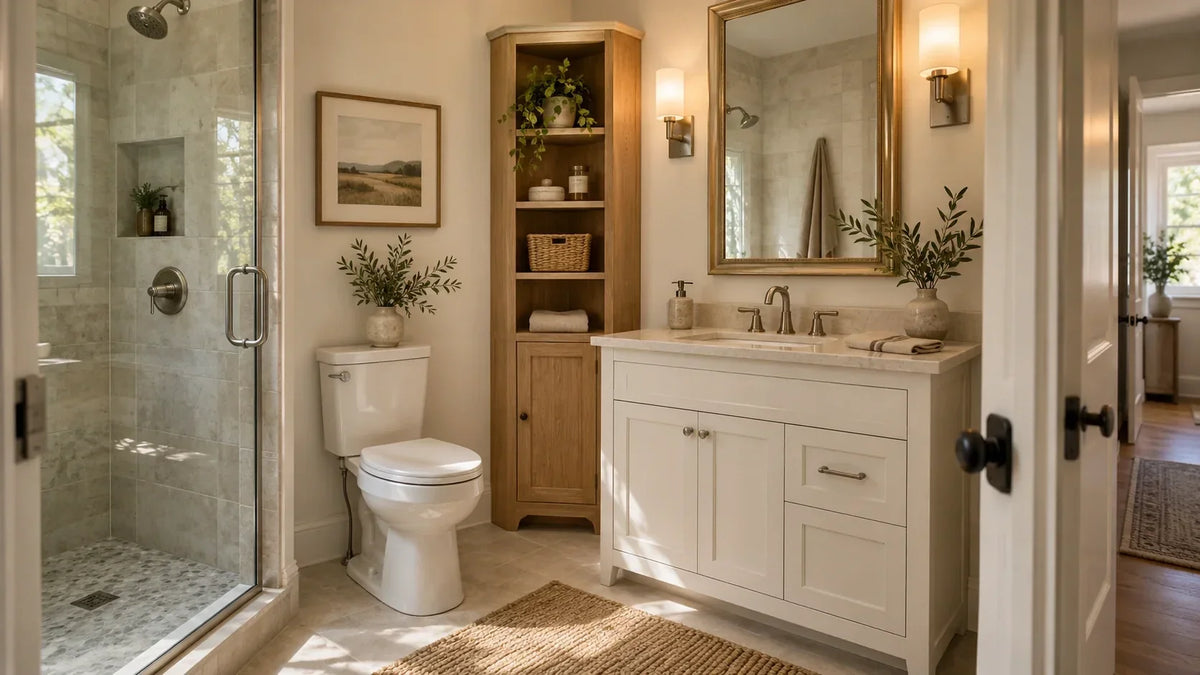
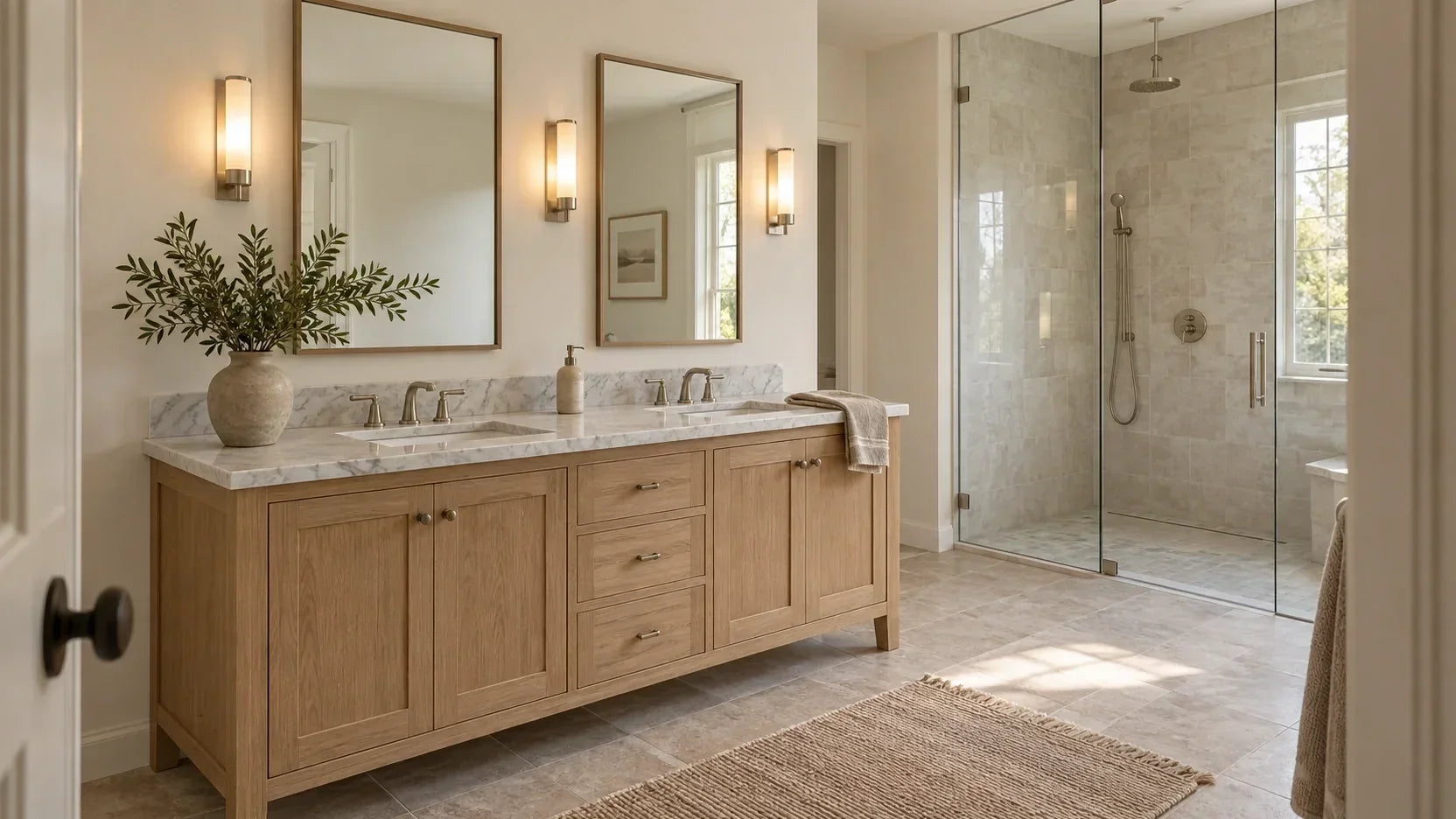
Solid Wood vs Engineered Wood Bathroom Vanities
The words “solid wood” can make a vanity feel decided before you know how it’s built. Our default is a clearly specified hybrid: genuine wood where grain, touch, and joinery matter, stable panel construction where broad sides and shelves need to stay flat, and careful finish work anywhere water can reach. The costly mistake is judging the cabinet by its prettiest drawer front while ignoring the sink-base floor, plumbing cutouts, and lower edges. Read the vanity as a material map, not one impressive label.
The BathGem's Blueprint
- Follow the grain. For a natural finish, distinguish solid wood, genuine wood veneer, and a printed wood-look surface.
- Follow the span. Ask what forms the broad cabinet sides, shelves, and sink-base floor as well as the doors.
- Follow the water. Check lower edges, seams, and plumbing cutouts before judging the finish from the front.
- Follow the room. Confirm the finished top dimensions, working storage, and ventilation before you pay for a material upgrade.
Put the sink-base floor on your inspection list even when the drawer fronts look convincing. A slow plumbing drip can stay hidden behind the towels you unpack on installation day.
Solid Wood vs Engineered Wood: What the Labels Actually Mean

“Solid wood” sounds precise, while “engineered wood” can sound like a compromise. Neither tells you enough until you know which vanity component the label describes.
What counts as solid wood?
Solid wood components are milled from lumber rather than assembled from bonded layers, fibers, or particles. A vanity may use oak, walnut, birch, or another species for its frame, doors, drawer fronts, legs, and rails.
That doesn't tell you what forms the cabinet sides, back, shelves, or drawer bottoms. Ask for those separately, particularly when a product title gives you one material but the specification lists several.
What counts as engineered wood?
Engineered wood is a category, not a single material. Separate the panel's core from its visible surface before comparing prices.
- Plywood consists of bonded wood veneers, usually with adjacent layers oriented in different directions.
- MDF consists of wood fibers pressed with a binder into a uniform panel.
- Particleboard consists of wood particles bonded into a panel.
- Wood veneer is a thin layer of genuine wood applied over a substrate, such as plywood, MDF, or particleboard.
The useful distinction with veneer is that you're describing the face, not the whole panel. Real grain alone won't tell you whether the surface is solid lumber or what sits underneath it.
Which Construction Actually Lasts Longer?

The material label alone won't tell you which vanity will last longer. We'd compare the construction details and warranty exclusions before paying more for a durability claim.
| Material or surface | Where it often makes sense | What we’d inspect |
|---|---|---|
| Solid wood | Frames, doors, drawer fronts, legs, and visible furniture details | Joinery, panel construction, finish coverage, and allowance for natural movement |
| Plywood | Cabinet boxes, broad sides, shelves, and structural panels | Panel type, thickness, exposed edges, plumbing openings, and finish coverage |
| MDF | Painted doors and panels where a smooth, uniform face matters | Exact grade, location, edge treatment, fastener areas, and direct-water exposure |
| Wood veneer over a substrate | Broad visible surfaces where genuine grain and a controlled pattern are wanted | Veneer species, substrate, edge detail, finish, and repair limits |
| Particleboard | Selected interior applications, depending on the cabinet design | Exact location, lower edges, sink-base use, plumbing cutouts, and finish coverage |
James Martin's residential limited warranty runs for 1 year from purchase and doesn't apply to products modified in any way. Wyndham Collection's 2-year residential limited warranty excludes failures caused by improper installation or modifications, including painting. Neither coverage period predicts the cabinet's service life. Before adding a coating or changing a plumbing opening, get the manufacturer's instructions for that model in writing.
Read the exclusions alongside the product description, not after something goes wrong. A longer warranty won't answer whether your planned field modification is allowed or whether installation labor is covered.
Where Solid Wood Earns the Spend

Natural grain gives a door or drawer front depth that a printed pattern doesn't have. Genuine veneer can give you that grain too, so don't pay a solid-lumber premium without confirming what you're looking at.
We'd put the wood budget into the doors, drawer fronts, legs, and edge details you see and touch. Ask how those parts are joined before comparing the species. Solid lumber changes dimension as its moisture content changes, which makes the construction around it part of the purchase. A wide panel fixed without appropriate movement allowance is a different proposition from a properly designed frame-and-panel door.
Don't buy on a blanket promise that solid wood can always be refinished. The coating, profile, and damage determine what a repair involves, and the manufacturer may restrict alterations.
Judge the finish under your actual sconces as well as daylight. We'd view the wood beside your tile and countertop together, because a warm cabinet, warm lighting, and cream stone can add up differently than three separate samples suggest.
Where Engineered Wood Can Be the Smarter Choice

A broad cabinet side needs to hold its shape; a painted door needs a face that takes the finish cleanly. Buy the panel for its job rather than treating every engineered material as the same compromise.
Plywood
Plywood's cross-oriented layers help restrain dimensional movement compared with solid lumber. That makes it useful for broad cabinet parts, but it doesn't make an exposed edge waterproof.
For APA-rated panels, APA's plywood guidance distinguishes adhesive-bond moisture resistance from structural strength and decay resistance. A cabinet specification that says only “plywood” hasn't identified all three. Ask for the panel type, thickness, and edge treatment rather than assuming a construction-panel rating applies to the vanity.
MDF
MDF's uniform fiber structure gives paint a smooth substrate without visible wood grain. On a painted modern bathroom vanity, that's a useful property, not evidence by itself of either good or bad bathroom construction.
The European Panel Federation says standard-grade MDF can be used for most bathroom-fitment applications and that surfaces and edges exposed to water or high humidity should be well sealed. It recommends moisture-resistant MDF where frequent wetting or prolonged high humidity is anticipated. That guidance doesn't support rejecting every MDF component, and it doesn't make every MDF cabinet suitable for the same exposure. Ask for the grade and its location before accepting either a sales claim or a blanket warning.
Our deciding question is what happens at the edges the photography doesn't show. A smooth painted face doesn't tell you how a plumbing opening or the underside was finished.
Wood veneer
Wood veneer is genuine wood, not a synonym for a printed surface. We like it where a carefully arranged grain pattern keeps a wide cabinet from looking busy.
The substrate, adhesive, and edge detail still need their own specification. Don't assume a veneered panel has the same sanding allowance as solid lumber; ask the manufacturer how that particular finish can be repaired before making refinishability part of your buying decision.
Particleboard
Find out exactly where particleboard is used rather than treating the word as a complete verdict. We'd scrutinize a sink-base floor or exposed lower edge more closely than a protected interior part, and we'd walk away from a description that won't identify the grade or location.
An emissions label isn't a moisture rating
Under EPA's TSCA Title VI formaldehyde standards, the panel-test limits are 0.05 parts per million (ppm) for regulated hardwood plywood, 0.11 ppm for MDF, and 0.13 ppm for thin MDF, defined as 8 mm thick or less. These are emissions limits, not allowable concentrations in your bathroom or a water-resistance grade. Ask for the applicable composite-wood compliance documentation separately from the cabinet's moisture and finish specifications.
Humidity Is Not the Same as a Plumbing Leak

Shower humidity and a leaking shutoff valve aren't the same exposure. Plan for room ventilation and direct-water inspection separately instead of expecting a material upgrade to handle both.
The USDA Forest Products Laboratory explains that wood tends toward equilibrium with surrounding humidity and changes dimension as its moisture content changes. Its guidance notes that protective coatings can retard dimensional changes but don't prevent them. That makes finish coverage useful without turning a wood cabinet into a waterproof enclosure.
Pacific Northwest National Laboratory's bathroom-exhaust guide cites the ASHRAE 62.2 benchmark of at least 50 cubic feet per minute (cfm) for intermittent exhaust or 20 cfm for continuous exhaust. Its guidance also explains that ductwork and installation may reduce measured airflow below the factory rating. Have your installer check delivered airflow and local requirements rather than relying on the number printed on the fan box.
The first-week plumbing check
- Keep the sink base empty through several days of normal use.
- Fill and drain each basin, then touch a dry paper towel to accessible supply connections, shutoff valves, the drain assembly, and P-trap joints.
- If you find moisture, stop using the affected sink and have the leak corrected before loading the cabinet.
Wyndham's furniture-care guidance warns that harsh or abrasive materials may damage the finish or remove protective sealants. Keep the cabinet's care instructions separate from the countertop's; a cleaner chosen for the basin isn't automatically appropriate for the drawer front beneath it.
The front sells you the vanity. The plumbing cavity tells you how carefully to inspect it.
Read a Bathroom Vanity by Component, Not by Marketing Label

Ask for a photo of the sink-base floor, back, and underside before spending more on the face. Those views can reveal whether a product description has left important construction details unanswered.
| Vanity component | What to ask or inspect | Why it changes the decision |
|---|---|---|
| Doors and drawer fronts | Solid wood, veneer, MDF, printed surface, and frame-and-panel construction | These details affect the grain you see, the edges you touch, and how the fronts move |
| Cabinet sides | Core material, panel thickness, substrate, and exterior finish | Broad surfaces need stable construction and may remain exposed at the end of a vanity run |
| Sink-base floor | Core material, seams, finish coverage, and removable shelf or liner details | This area can hide a slow plumbing drip behind stored products |
| Shelves | Material, thickness, edge banding, support, and adjustability | Bottles, towels, and appliances add weight across the panel span |
| Back and plumbing cutouts | Back-panel material, access, and whether field-cut edges are protected | A small raw opening can become the shortest path from a leak to the core |
| Drawer boxes and hardware | Box material, joinery, bottom panel, slide type, and usable clearance around plumbing | A drawer count doesn’t reveal usable storage or interference with the drain |
BathGems' 30-inch Beckett in Whitewashed Oak lists solid wood, plywood, MDF, and natural wood veneers. It specifies two functional doors, while this size is excluded from the range's working drawers. Don't mistake a drawer-like front for storage. The materials list still needs a component map before you can tell where each material is used.
The 66-inch Strada double vanity in White on BathGems specifies four functional doors and three functional drawers with fully extending undermount slides. That's a different storage arrangement, not simply more of the same cabinet. Sketch where your towels and hair tools will go, then check that the drawer travel and plumbing arrangement work together.
When you compare bathroom vanities, ask for a six-line construction map: door, drawer front, cabinet side, shelf, sink-base floor, and back. A seller who can answer by component gives you something you can actually evaluate.
The material-label mistake to avoid
Don't pay more for “solid wood construction” until you know which components it covers. Apply the same rule to “plywood box,” “wood veneer,” and “MDF doors,” particularly when the description never identifies the floor beneath the sink.
What Is the Best Wood for a Bathroom Vanity?

Settle the cabinet build before choosing the species. We'd choose the visible wood for the color and grain you want to live with, not as a substitute for protected edges or sound joinery.
White oak
White oak is our first look when you want visible grain without a strongly rustic room. We'd pair a natural or lightly stained finish with warm whites, honed limestone, and brushed nickel, then check the actual sample under your evening lighting.
Pay attention to the exposed cabinet side as well as the doors. From the bathroom entrance, that broad end panel may be the first wood surface you see, so ask whether its grain and finish match the front.
Walnut
We like walnut when the vanity should anchor the room rather than disappear into it. In a compact bathroom, we'd give its deeper color lighter walls or a quieter top instead of combining it with dark flooring and busy stone.
Birch, rubberwood, poplar, and other cabinet woods
Don't spend for a prestigious species in a hidden component without knowing what the upgrade buys you. For painted or concealed parts, ask about joinery, finish coverage, and the component's job before ranking the wood names.
Compare bathroom vanity colors with your tile, countertop, and metal samples in the same light. We'd rather reject an undertone while everything's still on the sample board than discover it across an installed cabinet.
Solid Wood, Engineered Wood, or Hybrid: What We’d Choose

A shared primary bath and a powder room don't ask the same thing from storage or access. Use the room's routine to decide which detail deserves the closest inspection.
For a natural-finish statement vanity
Ask to see the grain across the full front and any exposed end panel, not just a close-up swatch. We'd skip a piece whose material description sounds convincing but leaves the visible side unspecified.
For a painted vanity
Don't insist on solid lumber beneath paint merely because it sounds more valuable. We'd inspect the routed edges, door joints, and finish around the hardware, where the front gives you more information than a flat color sample does.
For a busy primary bathroom
Prioritize working drawers and a plumbing cavity you can inspect without unloading half the bathroom. If storage baskets conceal every connection, change the storage plan rather than treating the cabinet's material as protection against an unnoticed leak.
For a powder room
Without a shower, you can give more attention to the vanity's furniture character. We'd still leave the shutoff valves and trap accessible, especially in a room you don't use every day.
Compare wood-finish and painted options with those room-specific checks in hand. The collection below includes both, so read each product's construction and working-storage details rather than treating the collection name as an all-solid-wood specification.
Explore our Solid Wood Bathroom Vanities

30" Beckett Single Bathroom Vanity in Whitewashed Oak with Brushed Nickel Trim by Wyndham

66" Strada Double Bathroom Vanity in White with Brushed Nickel Trim by Wyndham

66" Strada Double Bathroom Vanity in Light Green with Matte Black Trim by Wyndham

66" Strada Double Bathroom Vanity in Light Green with Satin Bronze Trim & 58" Mirror by Wyndham


A Better Checklist Before You Buy

Use the finished countertop dimensions to check fit. BathGems' linked Beckett drawing shows a 30-inch-wide top over a cabinet measuring 29¼ inches wide, with a finished top depth of 22 inches. It also states a dimensional tolerance of ±¼ inch. For a tight alcove, have the installer check the drawing and required fitting allowance rather than ordering to an exact wall-to-wall nominal measurement.
In three separate Houzz discussions, owners describe gaps between newly installed vanities or their tops and the wall. Those are installation reports, not tests of wood quality. We'd use them as a reminder to check wall flatness, baseboard interference, and the top's overhang before ordering.
- Which components are actually solid wood, and which use a panel or veneer?
- Are the panel grade, thickness, and component locations specified?
- Are lower edges, seams, and plumbing openings protected, including any cuts your installer needs to make?
- Which fronts open, and what are the drawer boxes, joints, and slides?
- Can you inspect the sink-base floor, back, underside, and plumbing access in photographs?
- Does the dimension drawing cover your chosen countertop and sink configuration?
- Do the drain, supply lines, door swing, and full drawer travel clear one another?
- What do the warranty and care instructions say about installation, cleaners, and modifications?
Use the bathroom vanity sizes hub to narrow the width, then mark the finished depth and open drawers in your actual room. Check the bathroom door, plumbing rough-in, mirror, and sconce positions together before rewarding the material with a place on your shortlist.
The Choice We Would Make in a Real Bathroom

We'd choose the clearly specified mix that puts genuine wood where its grain matters and suitable panels where their construction earns its place. Before ordering, we'd want the component map, dimensional drawing, and care instructions for the exact configuration you're ordering.
Next, compare wood, lacquer, concrete, and stone in our modern vanity materials guide. Then return to your shortlist with the remaining questions marked on the drawing, especially the drawer travel and the plumbing openings.
Frequently Asked Questions

Todd Harmon
Todd looks at a wood vanity as a set of jobs: what carries the cabinet, what gives the room its grain, and what happens where water can get in. That component-by-component view is more useful than treating one material label as the quality verdict. With over two decades in e-commerce and product curation, Todd built BathGems on a simple idea: a bathroom should feel as collected and considered as the rest of the home. He sources every vanity and fixture in the BathGems catalog the way a designer pulls samples, weighing material, proportion, finish quality, and how a piece actually lives in a real room over time.