Modern Bathroom Vanity Materials: Wood, Lacquer, Concrete, and Stone Explained
The material you see isn’t always the material carrying the sink. A vanity can look like walnut, use a plywood box, wear lacquered MDF fronts, and arrive with a quartz top. All four descriptions can be true, which is why choosing modern bathroom vanity materials from the product photo alone is risky. Once you’ve committed to a modern bathroom vanity, read the piece in layers: cabinet structure, visible finish, top and sink, then hardware and support.
The BathGem's Blueprint
- Read the cabinet core first. Find out what the box, doors, drawer fronts, and shelves are made from because they may not match.
- Read the finish second. Lacquer, veneer, paint, and thermofoil change appearance and care, but they don’t tell you what sits underneath.
- Choose the top and sink together. Stone, quartz, concrete, porcelain, and solid surface create different joints, splash zones, weights, and support needs.
- Inspect what the photography hides. Plumbing cutouts, door edges, sink openings, and the cabinet base usually tell you more about bathroom readiness than the center of a sample.
The finish name is rarely the full material answer. What sits beneath it, what happens at the edges, and how the finished top is supported will decide how the vanity lives.
How Modern Bathroom Vanity Materials Work as a System

A bathroom vanity isn’t one material. The cabinet box carries the drawers and doors, the fronts create most of what you see, and the countertop takes the daily hits from water, soap, cosmetics, and faucet hardware.
The sink adds a cutout or joint. Hinges and slides manage repeated movement, while the floor or wall carries the completed assembly. If the vanity is wall mounted, the support question moves behind the drywall, so the cabinet material and the wall plan have to be resolved together.
| Vanity layer | Terms you may see | What to verify |
|---|---|---|
| Cabinet structure | Solid wood, plywood, MDF, engineered panel | Which components use each material, plus exposed edges and plumbing openings |
| Visible surface | Wood veneer, paint, lacquer, thermofoil | Substrate, sheen, edge treatment, finish coverage |
| Top and sink | Marble, quartzite, engineered quartz, concrete, porcelain, solid surface | Exact material, sink type, faucet drilling, seams, care |
| Hardware and support | Soft-close hinges, undermount slides, mounting rail | Hardware details, assembled weight, wall or floor support, installation requirements |
One good specification doesn’t rescue a weak one elsewhere. A stable plywood box can still have poorly protected plumbing openings, and a low-maintenance top can still create a difficult installation if the sink, drain, or wall support wasn’t coordinated.
Soft-close tells you how the drawer shuts. It doesn’t tell you what the drawer is made from, what the cabinet supports, or whether the P-trap lands in the space the top drawer needs.
Quick Comparison: Wood, Lacquer, Concrete, Stone, and Quartz

A wood-versus-lacquer vanity comparison sounds straightforward, but it often compares two different layers. Wood may describe a cabinet component or visible veneer. Lacquer describes the coating placed over a substrate.
Compare cabinet core with cabinet core, then finish with finish. It’s the fastest way to stop a good-sounding material label from hiding a mediocre specification.
| Material label | What it usually describes | Why you’d choose it | What creates friction | What to verify |
|---|---|---|---|---|
| Wood | Cabinet parts, fronts, or veneer | Grain, warmth, a softer modern room | Humidity response, finish wear, wet edges | Species, component placement, joinery, finish |
| Lacquer | Coating over MDF, plywood, or another panel | Smooth slab fronts, precise color and sheen | Fingerprints, streaks, chips, matching repairs | Substrate, coating system, finish coverage, care |
| Thermofoil | Formed surface over a substrate | Uniform color, clean slab-door appearance | Edge damage, manufacturer-specific heat limits, limited repairs | Substrate, edge construction, heat guidance, approved care |
| Concrete | Top, basin, or integrated surface | Tonal movement, substantial presence | Sealer-dependent care, weight, variation | Sealer, support, exact weight, repair guidance |
| Natural stone | Top or backsplash | Mineral variation and depth | Stone-specific etching, staining, seams | Exact stone, finish, cleaner, sealer guidance |
| Engineered quartz | Manufactured top or backsplash | Controlled pattern and simpler daily care | Water, toothpaste, and wiping marks may show more on some colors and finishes | Manufacturer, finish, approved cleaners, repair guidance |
| Solid surface | Top or integrated sink | Quiet profile and fewer basin joints | Material-specific scratching, heat limits, or repair methods | Manufacturer, sink construction, care guidance |
For most busy bathrooms, we’d choose clear documentation over an impressive material phrase. Clearly stated cabinet construction, a controlled factory finish, and a top with exact care instructions will usually serve you better than “solid wood,” “stone,” or “lacquer” with no detail behind it.
Wood: Choose the Construction Before the Species

White oak and walnut can make a modern bathroom feel warmer, but the species name is only the visible part of the decision. You still need to know what forms the cabinet box, doors, drawer fronts, shelves, and exposed edges.
Wood responds to changes in surrounding humidity, and protective coatings can slow that moisture exchange without stopping it. That matters most at joints, cut edges, and plumbing openings, where the finish system may be thinner or interrupted.
Solid Wood Has to Earn the Label
“Solid wood” sounds like a complete quality verdict. It isn’t.
A solid wood face frame or drawer front may be a useful detail, while a wide panel still needs construction and finishing that account for movement. We’d spend more when the species, component placement, joinery, and finish are clearly identified, not for the phrase alone.
Plywood, Veneer, and MDF Do Different Jobs
Plywood uses bonded veneer layers with grain direction crossing between plies, which can make it a sensible choice for cabinet boxes and structural components. Veneer can place real white oak or walnut grain over a stable panel, while MDF can create a smooth substrate for painted or lacquered slab fronts.
MDF isn’t automatically a bad bathroom material, and plywood isn’t automatically water-safe. The useful question is where each material appears, how its edges are protected, and what happens if a shutoff valve drips unnoticed for a week.
Moisture Problems Usually Start at an Edge
The center of a cabinet door is rarely where bathroom trouble starts. Look below the sink, around supply and drain openings, along door corners, and at the cabinet base near wet flooring.
A slow plumbing drip begins inside the cabinet, where damage can stay hidden. Good ventilation helps the room dry, but it won’t protect an exposed substrate from standing water.
We recommend inspecting the wet edges before you get distracted by grain matching.
Lacquer: The Finish Is Only as Useful as the Cabinet Beneath It

Lacquer is a coating system, not a cabinet core. It may cover MDF, plywood, or another engineered panel, and the word alone doesn’t establish bathroom durability.
A clean lacquered front can make the vanity feel almost architectural. The same uniform surface can make a chip or poorly matched repair more obvious.
Ask What Sits Under the Lacquer
A useful specification should identify the substrate, sheen, finish coverage, approved cleaners, and touch-up guidance. It should also clarify how door backs, drawer edges, and less visible cabinet surfaces are finished.
Skip a vague lacquer description when the substrate and care system can’t be confirmed. A coating may be well suited to bathroom use, but the finish name doesn’t prove it.
Matte Versus Gloss Is a Lighting Decision Too
Gloss doesn’t become high maintenance until the sconces come on. A reflective surface can look crisp in daylight, then show fingerprints, dried droplets, and wiping streaks under side lighting.
Matte softens reflection, but it isn’t automatically more durable or easier to clean. Sheen tells you what your eye will notice, not how the coating was built.
Test the Finish in the Room
- Stand the sample vertically, the way the cabinet front will actually sit.
- Place it beside the countertop, tile, paint, and hardware finish.
- View it in daylight.
- Turn on the proposed vanity lights and look from the doorway, not just inches away.
- Touch the surface, clean it as the supplier recommends, and look again.
White deserves the full test because nearby tile, paint, quartz, and marble can pull it warmer or cooler. Compare a white vanity finish with the actual room materials, not with another white sample across the showroom.
If you’re still deciding between painted neutrals and natural wood, the bathroom vanity colors and materials hub is a better next comparison than judging isolated swatches.
Thermofoil Needs Its Own Questions
Thermofoil is a formed surface over a substrate, not lacquer under another name. Ask where the surface wraps, where seams remain, which cleaners are approved, and what heat limits the manufacturer publishes.
That last point matters in a real bathroom because hair tools often land exactly where cabinet edges and drawer fronts live. Repair matters too. A clean, uniform door is less appealing when one damaged edge can’t be touched up or the matching front is no longer available.
We’d choose thermofoil only when the construction, care instructions, and replacement path are clear.
Concrete: Buy the Sealer and Support Plan, Not Just the Look

Concrete brings tonal movement and a quiet sense of weight. Its daily behavior depends heavily on fabrication and the sealer system.
The Concrete Countertop Institute treats stain resistance, acid resistance, wear, sheen, and maintenance as sealer-dependent questions. “Sealed concrete” is not a complete specification.
Ask the fabricator what counts as expected variation before delivery. “Natural variation” is too vague to settle a disagreement after the top is installed.
Confirm the sealer name, approved cleaners, maintenance instructions, exact installed weight, support requirements, and repair guidance. The completed top also has to clear the delivery path and make sense for the cabinet and mounting plan.
We’d use concrete in a powder room or primary bath where its variation is part of the design. We’d skip it when the goal is a surface you rarely have to think about.
Stone: Name the Material Before You Accept the Care

“Stone” is a design category. It isn’t a care instruction.
Marble, granite, quartzite, and limestone don’t belong under one cleaning rule. Engineered quartz is a manufactured surface, not natural stone, and it should follow its own manufacturer’s care instructions.
Natural Stone Needs Its Full Name
Calcareous stones, including marble and limestone, are sensitive to acidic solutions. A penetrating sealer may improve stain resistance, but it doesn’t make stone stain-proof or remove acid sensitivity.
The Natural Stone Institute’s care guidance starts with identifying the stone’s composition and then matching cleaning and sealing guidance to it. Your product information should do the same.
Ask for the exact stone, surface finish, supplier care sheet, approved cleaner, and sealer guidance. Avoid accepting a universal annual resealing schedule because the stone, sealer, use, and supplier instructions should control that decision.
Honed and polished finishes can also show daily use differently depending on the stone and color. View both beneath the actual sconces, because a finish that looks quiet on a horizontal sample can read much louder once it becomes the full vanity top.
Engineered Quartz Is the Practical Default, Not a Universal One
For a busy primary or family bath, our first call is often a documented engineered quartz top. It usually gives you a simpler daily-care routine than marble or limestone, but the manufacturer still controls the cleaner list and repair guidance.
Quartz isn’t identical across every manufacturer. Darker colors, strong textures, and certain sheens can also make dried water, toothpaste, or wiping marks more visible, so practical doesn’t mean invisible.
Choose the Sink With the Top
An undermount sink lets you wipe water directly from the counter into the basin, but the cutout edge and seal still need proper finishing. An integrated sink can remove the rim joint where soap and grime collect.
A vessel sink exposes more of the top but creates a joint around the bowl and changes the faucet and splash relationship. It can also consume the landing space you thought you were getting from the countertop.
We recommend choosing the sink, top, and faucet drilling as one decision rather than three separate orders. Solid surface earns attention here because it can create an integrated basin with fewer visible joints, which can matter more every morning than dramatic veining.
What We’d Choose for Different Bathrooms

The right material system depends on traffic, splash exposure, ventilation, lighting, installation, and how much visible aging you’ll accept.
| Bathroom use | What we’d choose | Why |
|---|---|---|
| Busy family bathroom | Clearly specified plywood or engineered cabinet, factory finish, engineered quartz or solid-surface top | Straightforward care and fewer ambiguous material claims |
| Shared primary bathroom | Wood veneer or satin lacquer with a clearly identified low-maintenance top | Warmth without turning every water mark into a project |
| Low-use powder room | Natural stone or concrete, when variation and care are part of the appeal | Lower traffic gives character materials more room to age |
| Guest bathroom | Simple factory finish and a top with clear care instructions | Guests shouldn’t need a cleaning briefing |
| Floating vanity | Any finish, after exact weight, mounting system, wall structure, and plumbing are confirmed | The support plan controls the material choice |
| Slow-drying bathroom | Simple documented finish and low-maintenance top, paired with corrected ventilation | No vanity material substitutes for a room that can’t dry |
For most households, we’d choose a clearly specified cabinet, a satin or low-sheen factory finish, and an engineered top with full care instructions. An undermount or integrated basin keeps the sink edge easier to manage.
If the vanity is floating, settle wall support and plumbing before tile or drywall closes the wall. The beautiful part is the cabinet. The expensive part is discovering later that the drain, blocking, or mounting rail wants the same space.
Natural stone and concrete make sense when their care and variation are part of what you want, not details you hope to ignore.
Explore our Modern Bathroom Vanities

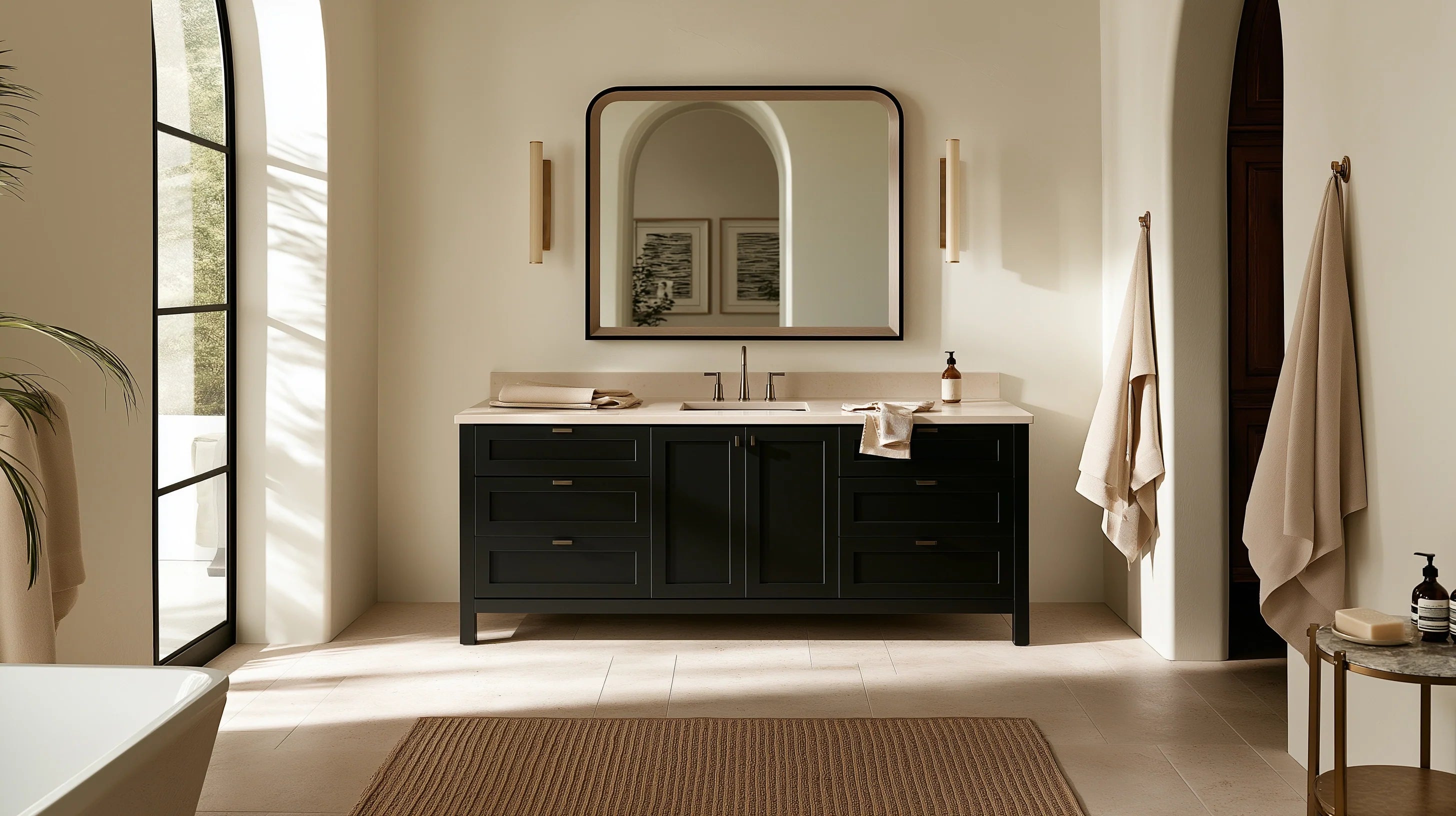
72" Double Sink Bathroom Vanity with Top in Chestnut - James Martin Marcello

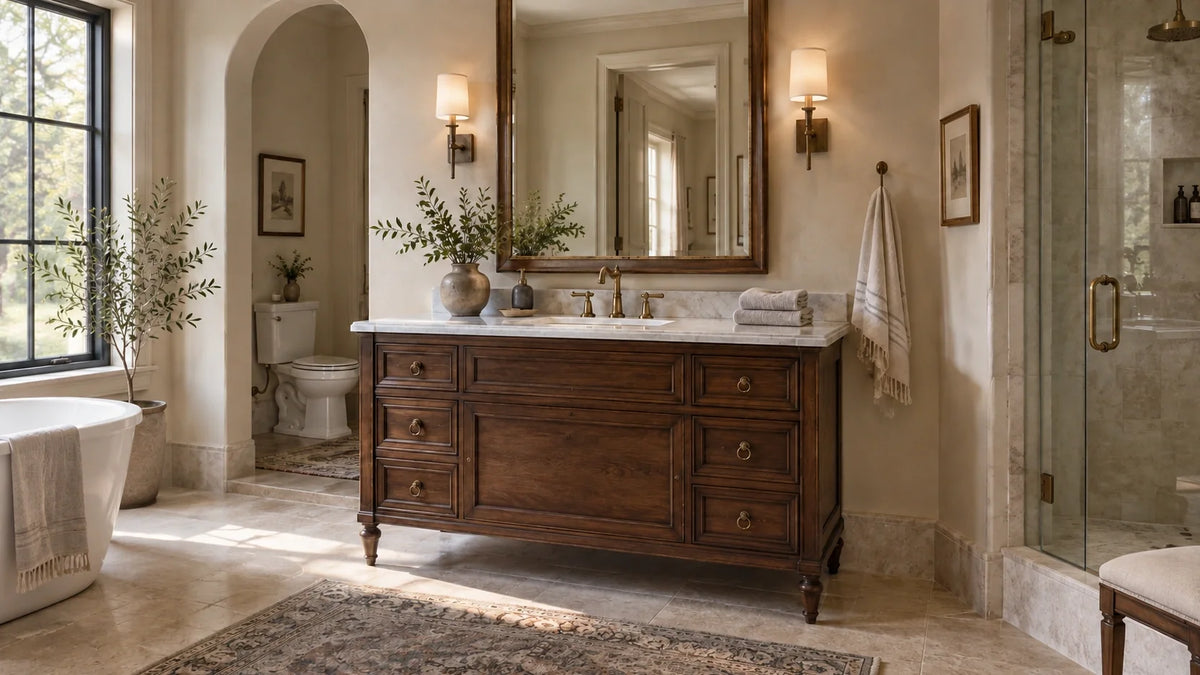
31.5" Auburn Single Sink Console in Weathered Timber by James Martin Vanities


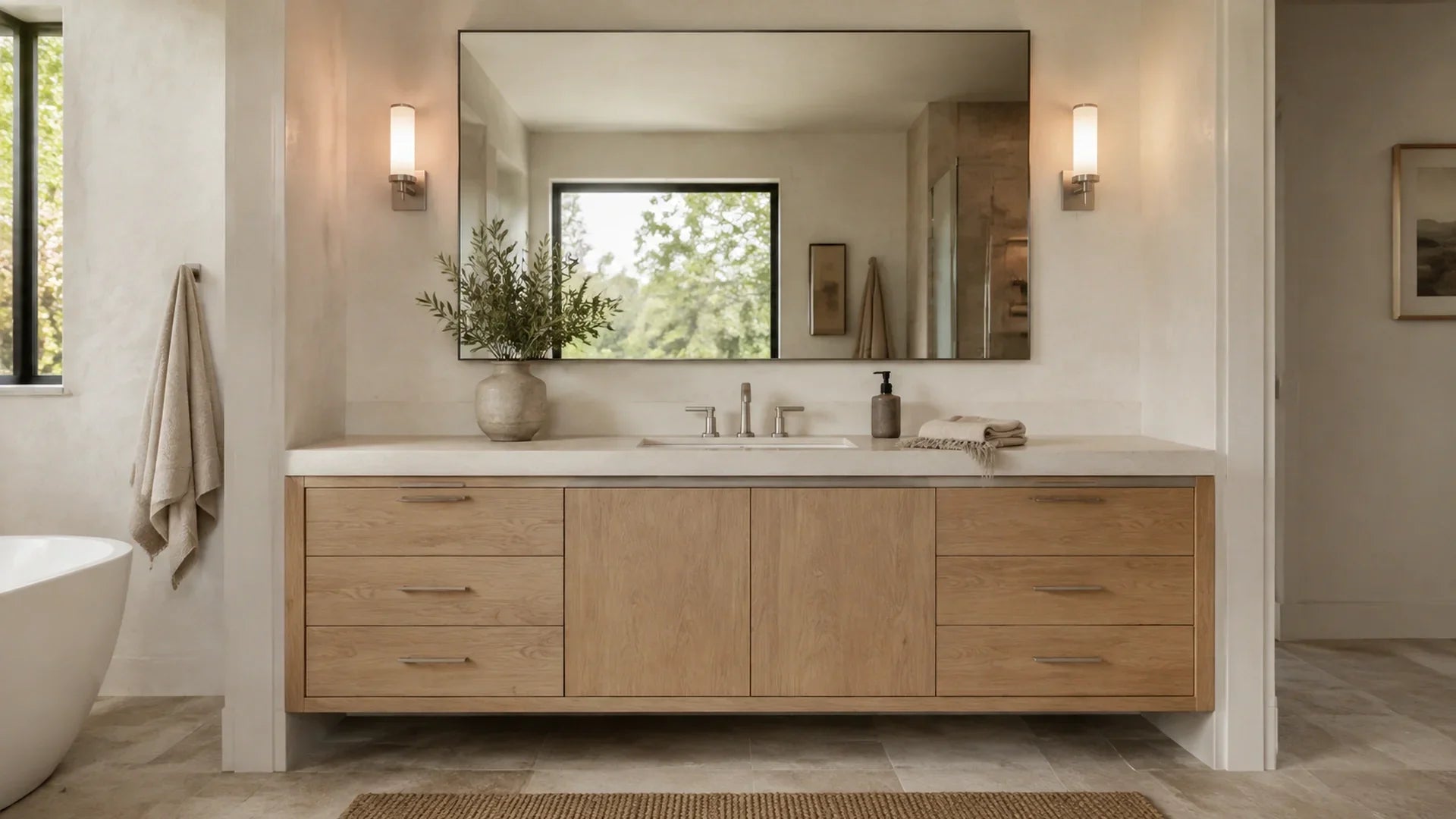
36" Laurent Single Vanity in Light Honey Oak by James Martin Vanities


The easiest vanity to live with is often decided by the sink joint, surface color, finish sheen, and bathroom light rather than the broad material label.
The Material Check Before You Order

Open three documents before checkout: the product specification, the care instructions, and the installation instructions. If the exact selected variant isn’t clear across all three, the order isn’t ready.
Confirm the Exact Variant
- Cabinet box material
- Door and drawer-front material
- Visible veneer, lacquer, paint, thermofoil, or wood finish
- Finish sheen and approved cleaners
- Edge and plumbing-opening treatment
- Exact countertop material and finish
- Included sink type and material
- Faucet-hole configuration
- Drain and supply locations relative to drawer cutouts or plumbing channels
- Backsplash or side-splash inclusion
- Assembled weight, packaged dimensions, and the tightest turn on the delivery path
- Mounting and wall-support requirements
- Hinge and drawer-slide information
- Touch-up, replacement-front, repair, and warranty guidance
Product photography can remain the same while the selected option changes the top, sink, drilling, or included components. Avoid relying on one phrase such as “solid wood vanity,” “lacquer cabinet,” or “stone top.”
Then measure the route into the bathroom, not just the empty wall. A vanity that fits the alcove but can’t clear a doorway, casing, stair turn, or tight hall corner is still the wrong size.
Why Modern Materials Read Differently from Antique Ones

Modern vanities usually depend on clean planes, restrained hardware, controlled sheen, and one dominant material gesture. An antique bathroom vanity can intentionally carry carved wood, patinated metal, shaped details, and more ornamental stone.
The mistake is asking every modern surface to perform. If the stone is doing the work, let the cabinet quiet down. If walnut grain leads, choose a simpler top and hardware that doesn’t compete.
Once you know what the vanity is made from, read our guide to floating vanities before approving the final weight, plumbing, finished height, and wall plan. Mounting isn’t a styling decision added at the end. It determines how the materials are supported and serviced.
Frequently Asked Questions

Todd Harmon
Todd reads a vanity by the jobs its materials perform: what carries the load, what meets the water, and what you’ll notice once the sconces are on. The cabinet core, finish, top, and sink tell you far more than one broad material label. With over two decades in e-commerce and product curation, Todd built BathGems on a simple idea: a bathroom should feel as collected and considered as the rest of the home. He sources every vanity and fixture in the BathGems catalog the way a designer pulls samples, weighing material, proportion, finish quality, and how a piece actually lives in a real room over time.