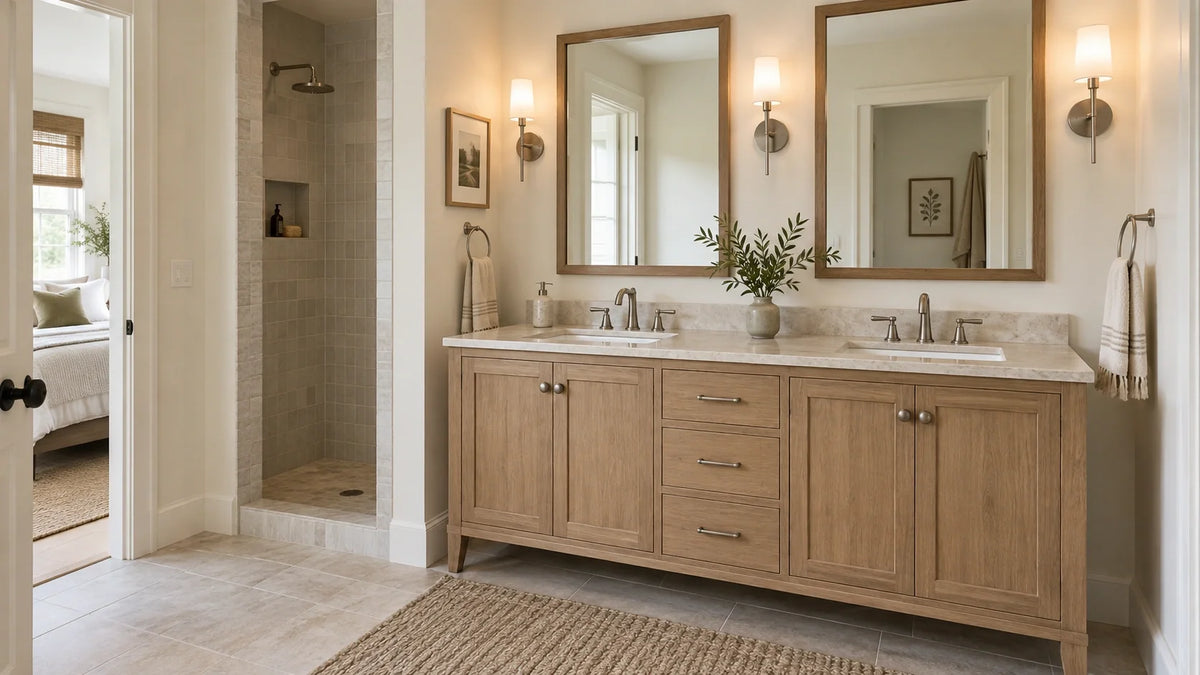

Solid Wood vs MDF Bathroom Vanity: What Actually Lasts in a Humid Room
A warm wood grain can settle a bathroom before you add the first towel, but the cabinet beneath that finish still has to live with steam, splashes, and the occasional hidden drip. In a shower-used bath, we’d choose a plywood box with hardwood or properly finished fronts, using MDF only in disclosed components with protected faces and edges. The costly mistake is shopping by the biggest material word on the page instead of checking the cutouts, seams, and bottom edges where water can enter.
The BathGem's Blueprint
- Classify the room first. A powder room without a shower asks less of a cabinet than a primary bath used twice every morning.
- Read the component map. Box, frame, doors, drawer fronts, drawer boxes, back, toe kick, and veneer core may all be different materials.
- Inspect the wet edges. Sink-base floors, plumbing cutouts, bottom door edges, countertop seams, and the side beside a tub matter more than the label on the front.
- For a full bath, put your money into a disclosed box, protected edges, a properly fitted top, and working exhaust before you pay for an all-solid-wood headline.
Solid Wood vs MDF Bathroom Vanity: The Honest Comparison

Online comparisons often place solid wood first and MDF last. Real vanities complicate that hierarchy: one cabinet can combine hardwood framing, plywood sides, veneer faces, and MDF fronts. BathGems product specifications show those combinations, while manufacturer warranties also make installation, maintenance, and environmental conditions part of the decision. A material ranking cannot tell you whether the plumbing opening arrives protected or needs attention during installation.
| Material | Where it earns its place | What moisture changes | What to verify |
|---|---|---|---|
| Solid hardwood | Face frames, doors, drawer fronts, legs, rails, and stiles | Wood gains and loses moisture with the room, with more movement across the grain than along it | Species, component location, joinery, and finish coverage |
| Plywood | Cabinet sides, bottoms, shelves, backs, and other wide structural panels | Alternating veneer directions restrain movement across the width of the panel | Panel location, edge quality, and protection around field-cut plumbing openings |
| MDF | Painted doors, drawer fronts, routed profiles, and selected lower-risk panels | High humidity or liquid can make compressed fibers swell, and expansion beyond the original dimensions may not fully recover after drying | Exact component, moisture-resistant designation when offered, and factory-finished faces and edges |
| Wood veneer | Natural grain across broad cabinet faces without requiring a wide solid board | The substrate beneath the thin wood face governs broad-panel behavior and wet-edge risk | Whether the core is plywood, MDF, or another panel, plus how the edge is finished |
Read the Vanity Component by Component

Solid wood is strongest where you see and touch it
Solid wood responds to the room around it. As relative humidity changes, moisture enters or leaves its cell walls and the board changes dimension, especially across the grain. A factory coating slows that exchange but does not make the board waterproof. Wide solid panels therefore depend on species, grain direction, joinery, and finish coverage, not simply the promise of hardwood.
Hardwood earns the spend at door rails and stiles that hold hinges, drawer fronts your hands touch daily, exposed legs that take the vacuum knocks, and frames where grain changes the room. A stained ash or acacia front gives small finish wear somewhere to live visually. We would not pay an all-hardwood upcharge merely to replace a stable plywood side panel with a wide solid board.
Plywood usually makes the smarter cabinet box
Plywood uses thin veneers with alternating grain directions. Those crossed layers restrain widthwise movement, which suits broad cabinet sides, shelves, and sink-base floors. That stability matters when drawer slides, shelf pins, and cabinet fasteners need a panel that stays square. Ask which components use plywood rather than accepting “all wood” as a complete construction description.
Plywood is not waterproof, and enlarging a plumbing opening can leave fresh plies exposed. Put the installation guide beside the cabinet before anyone cuts, then follow the manufacturer’s method for protecting permitted field-cut edges. Map the drain centerline against the drawer stack before ordering, too. A stable box does not help when the P-trap occupies the same space as the top drawer.
MDF earns its place on a painted front
MDF is made from wood fibers and resin pressed into a smooth, uniform panel. Without natural grain bands beneath the coating, painted slabs and routed Shaker fronts read as calm planes under side light. That is useful on wide modern bathroom vanities, where sconces rake light across every door, provided the finish protects the edges as carefully as the face.
Is MDF Good for a Bathroom Vanity?

Yes, when the room and component give it a fair job. A ventilated powder room or a full bath with MDF limited to factory-finished doors and drawer fronts can be a sensible fit. We would skip a vaguely described all-MDF sink cabinet in a splash-heavy family bath. A listing that omits the cabinet floor, toe kick, edge treatment, and plumbing cutouts leaves the most useful questions unanswered.
The Composite Panel Association explains that densified MDF fibers can swell with high humidity or water, and expansion beyond the original dimensions is not fully recovered after drying. A chip, worn bottom edge, drilled hole, or open seam gives liquid a route toward the core. Check the underside and rear edge of a door sample as carefully as the front. Paint offers protection only while its coverage remains intact.
MDF is acceptable when all four are true
- The product page identifies the MDF component instead of hiding behind “engineered wood.”
- Every face and edge arrives factory finished, with no planned site cut through the panel.
- The room has working exhaust and the cabinet is outside direct tub or shower spray.
- The sink-base floor, toe kick, and plumbing openings use a more forgiving substrate or have a documented protection detail.
Veneer Is a Surface, Not a Structure

Veneer names the visible wood layer, not the whole panel. Resawn acacia over marine MDF and ash over plywood can bring convincing grain to the room while using different substrates beneath it. Veneer carries natural grain across broad faces without requiring a wide solid board, but the substrate still governs the panel’s behavior, particularly where plumbing openings expose that underlying material. Ask for that core material and its edge protection before treating “wood veneer” as a construction specification.
BathGems examples compare materials, storage, and mounting. Dimensions below refer to the cabinet, not the finished assembly: Wyndham’s Beckett drawing distinguishes its smaller cabinet from the top. The 30-inch Beckett assembly includes a top wider than its 29.25-inch cabinet, so allow for that overhang beside walls or door casing. Match the exact size and finish when comparing product sheets, because a family name does not establish every component.
| BathGems example | Listed cabinet dimensions | Listed construction | What changes in the room |
|---|---|---|---|
| 30-inch Beckett, Whitewashed Oak | 29.25"W × 21.5"D × 34.25"H | Solid wood, plywood, MDF, and natural wood veneers with a listed sealed finish | Two doors and no drawers keep the center open for plumbing; selected tops include a 3-inch backsplash and reversible sidesplash |
| 36-inch Marcello, Chestnut | 35.9"W × 23.4"D × 17.9"H | Solid acacia with resawn acacia veneer over marine MDF | Wall-mounted with an interior English-dovetail drawer; mounting height determines finished counter height |
| 72-inch Lorelai, Whitewashed Oak | 71.88"W × 23.5"D × 32.875"H | Solid ash frame with ash veneers over plywood panels and listed moisture- and UV-resistant coatings | Two tip-outs, three drawers, and four doors divide storage around a double-sink layout |
Use the natural wood bathroom vanity collection to compare grain, mounting, and disclosed construction, then check the exact variant’s component list. For a floating model, verify mounting instructions and wall structure before tile closes the wall. For a double vanity, map both drain centers and full drawer extension before the rough-in is final.
Explore our Natural Wood Bathroom Vanities

30" Beckett Single Bathroom Vanity in Whitewashed Oak with Brushed Nickel Trim by Wyndham

72" Double Sink Bathroom Vanity with Top in Chestnut - James Martin Marcello

60" Janna Double Bathroom Vanity in White Oak with Matte Black Trim by Wyndham

84" Janna Double Bathroom Vanity in White Oak with Matte Black Trim by Wyndham


Where Vanity Swelling and Moisture Damage Start

Inspect bottom door edges, the corner beside the sink, the toe kick, the sink-base floor, and every plumbing opening. Standing water can work beneath a damaged coating, while a slow P-trap drip feeds one hidden point for hours. Humidity affects the room broadly; leaks concentrate liquid where you may not notice it. Consider a leak sensor or a monthly hand-and-flashlight check beneath the sink.
Across Lowe’s Everdene and Renzo review sets, three independent owners reported swollen drawer faces, warping, or peeling paint. Those accounts do not establish a failure rate or separate material from ventilation, cleaning, delivery damage, and installation quality. Use them to choose inspection points before the return window closes and after the plumber tests the connections. Photograph the cabinet interior before plumbing is connected so later changes have a clear baseline.
James Martin’s one-year limited warranty covers defects under proper installation and normal use, excluding damage tied to improper installation, certain chemicals and abrasive cleaners, and environmental conditions. Wyndham’s two-year limited warranty excludes improper maintenance, installation, modifications, and unintended conditions. Its furniture-care guidance says warm, soapy water or very mild detergents may be used sparingly; harsh or abrasive materials may damage the finish or remove protective sealants. Follow the exact care sheet instead of adding an unapproved oil, wax, or polyurethane over the factory coating.
The Vanity Top Is Part of the Cabinet’s Water Defense

The top controls where handwashing water settles around the sink opening, backsplash, sidesplash, wall joint, and front overhang. Compare bathroom vanity tops by actual dimensions, faucet drilling, sink type, and splash protection. Selected Beckett tops include a 3-inch backsplash and reversible sidesplash. The latter matters where one cabinet end meets a wall and a narrow joint collects water nobody remembers to dry.
For an undermount sink, follow the top and adhesive instructions for the sink joint, wall seam, and cure time. For a vessel sink, measure the landing space left after the bowl occupies the counter. Measure the top separately from the cabinet, including sink centers, faucet pattern, and backsplash thickness. A top that fits the box can still put a faucet handle into a mirror frame or leave a drawer fighting the supply valves.
Mark the cabinet footprint, bathroom door swing, casing, toilet edge, and full drawer extension with painter’s tape. A 23.5-inch-deep cabinet can fit the wall yet pinch circulation with an open drawer. The better measurement is the open door, not the empty wall. Check doorways, stair turns, and hallway corners along the delivery path.
Explore our Bathroom Vanity Tops
30" Beckett Single Bathroom Vanity in Whitewashed Oak with Brushed Nickel Trim by Wyndham

72" Rian Double Bathroom Vanity Toasted Walnut Satin Bronze Trim by wyndham

84" Rian Double Bathroom Vanity Toasted Walnut Matte Black Trim by wyndham

84" Rian Double Bathroom Vanity Toasted Walnut Satin Bronze Trim by wyndham


Ventilation Protects Every Wood-Based Material

The 2024 International Residential Code benchmark in Section M1505.5 is 50 CFM for intermittent bathroom exhaust or 20 CFM for continuous exhaust, rated at a minimum static pressure of 0.25 inch water column. The Home Ventilating Institute recommends 1 CFM per square foot for bathrooms up to 100 square feet and 20 minutes of fan operation after use. Your adopted local code and the fan manufacturer’s instructions control installation.
Rated airflow is not always the airflow delivered through the installed duct. Long runs, sharp turns, and restrictive terminations raise resistance, so a fan can sound active while surfaces stay wet. HVI advises undercutting the door for replacement air. We would use a timer or humidity-sensing control rather than relying on someone remembering to leave the fan running.
ANSI/KCMA A161.1-2022 provides specific cabinet test thresholds. Its shrinkage and heat-resistance test exposes a finished door to 120°F ± 5°F and 70% ± 5% relative humidity for 24 hours. Its detergent-and-water edge test requires 24 hours of sponge contact for doors without a seam touching the sponge, or 4 hours where a seam or edge banding touches it, with no delamination or swelling permitted. These tests do not establish that a particular vanity is certified; ask for the exact model’s certification or documented test results.
The Material Checklist We’d Use Before Buying

Read the specification in this order
- Name each component, including drawer boxes, back, shelves, toe kick, and veneer core.
- Match construction to the room’s shower use and splash exposure.
- Inspect plumbing holes, bottom edges, sink-base floor, and countertop seams.
- Find approved cleaners, excluded chemicals, touch-up instructions, and warranty terms.
- Measure cabinet and top separately, including faucet drilling and sink centers.
- Map drain, P-trap, and supply valves against drawer storage.
- Check open doors, drawer extension, toilet clearance, mirror edges, and delivery access.
- Verify exhaust airflow, exterior discharge, replacement air, run time, and local requirements.
A 17.9-inch-high floating cabinet needs a verified mounting height and suitable wall structure to reach the intended counter height. Marcello’s listing describes a 36-inch finished height with an optional 3 cm top; the installer must position the cabinet to achieve that height rather than assuming it. Draw supply valves, drain centerline, and P-trap on the back-panel diagram before anyone drills, checking access for future repairs as well as installation.
Buy the Construction, Not the Headline

For a shower-used bathroom, we would fund the disclosed box, protected wet edges, properly fitted top, and working exhaust before an all-solid-wood headline. Choose the visible material for the finish you want, with the component list beside you. In a powder room, protected MDF fronts can be a sound design choice.
Use our guide to caring for a wood bathroom vanity in a humid room to plan cleaning, ventilation, and inspection. Keep the exact care sheet with your remodel records and check supply and drain connections again after the first week. Installation photographs help you, your installer, and the manufacturer track a seam, finish, or fitting that begins to change.
Frequently Asked Questions

Todd Harmon
Material names start the conversation, but wet edges decide the outcome. Todd’s approach is to read a vanity component by component, then match that construction to the room’s real moisture load. With over two decades in e-commerce and product curation, Todd built BathGems on a simple idea: a bathroom should feel as collected and considered as the rest of the home. He sources every vanity and fixture in the BathGems catalog the way a designer pulls samples, weighing material, proportion, finish quality, and how a piece actually lives in a real room over time.