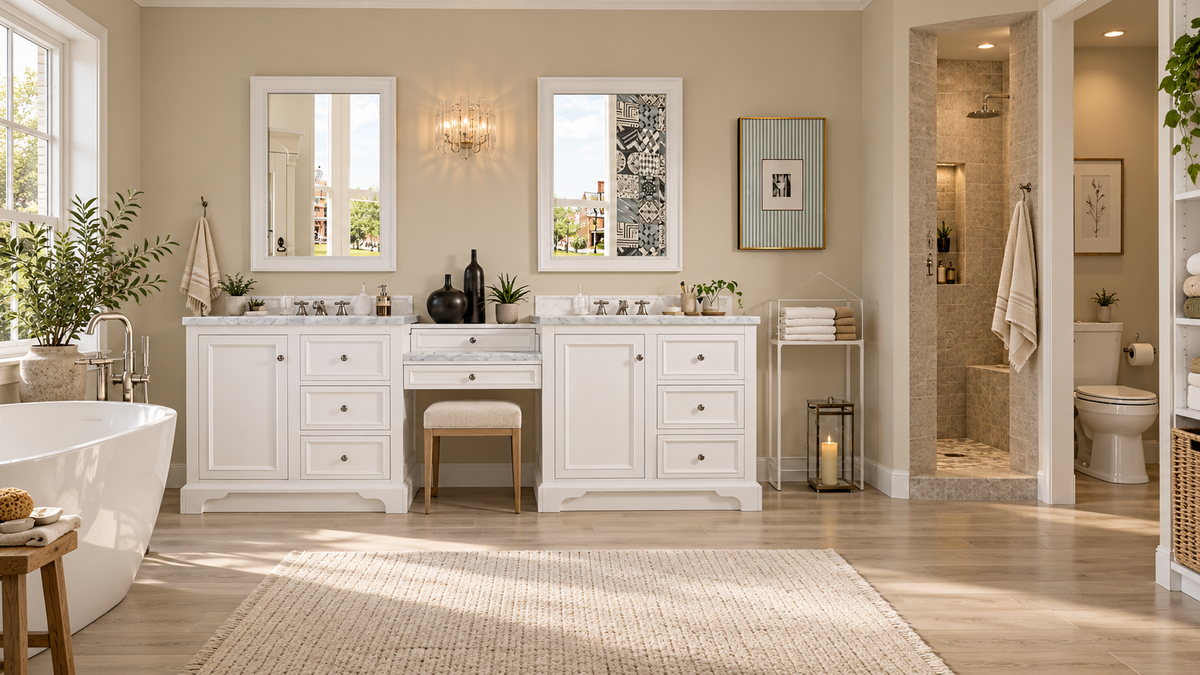

Bathroom Vanity Price Index: Cost by Width and Configuration (Updated 2026)
The useful bathroom vanity price isn't the smallest number on the collection page. It's the price of the configuration that fits your wall, clears the moving parts in the room, gives you the sink count you actually use, and includes the top, sink, and faucet drilling you expect. Our October 7, 2026 BathGems catalog snapshot shows why width alone is a poor budget rule: the 24-inch collection spans thousands of dollars, while several 60-inch Strada double-sink listings start below their single-sink counterparts. Use width to build the shortlist, then budget the exact configuration you intend to install.
The BathGem's Blueprint
- Measure the usable wall, finished depth, bathroom-door movement, drawer travel, and plumbing location before choosing a nominal width.
- Choose one sink or two from how the room is actually used. Two basins can consume the counter and drawer space you thought a wider vanity would give you.
- Compare the same package: cabinet, countertop, sink, faucet drilling, mirror or medicine cabinet, powered features, and hardware.
- Treat a collection-card “From” price as the start of the comparison, not the price of the exact configuration in your head.
How we built the 2026 price index
This snapshot uses BathGems collection and product pages reviewed October 7, 2026. The master vanity collection showed 1,977 listings, including 904 Single and 735 Double filter matches.
Countertop filters showed 1,209 Quartz, 1,455 Marble, 405 Solid Surface, and 1,428 No Top Included matches. Those facets overlap, so treat them as assortment signals rather than a census of mutually exclusive products.
Where the full set of collection-card starting prices was observable, we calculated the listed-start median. For other widths, we report the collection count, specific visible starting-price examples, and the collection price-filter ceiling rather than manufacturing a median from an incomplete distribution. A price-filter ceiling is a catalog control, not proof that the most expensive visible card starts at that amount. Prices, options, and collection counts can change, so confirm the selected variant and current price before checkout.
How Much Does a Bathroom Vanity Cost in 2026?

A single catalog-wide average hides the useful part of the answer. In the 31-listing 24-inch collection reviewed for this index, the median displayed starting price was $849 and the observed starting-price span ran from $723 to $6,480. At 96 inches, the collection contained two Bellshire double-vanity listings paired with 24-inch make-up counters, and both displayed a $6,622 starting price. One is a 31-product distribution; the other is a two-product snapshot that shouldn't be treated as a typical 96-inch market price.
The 60-inch category shows why configuration can overpower a simple size rule. Current Strada collection cards include double-sink versions from $1,599 and single-sink versions from $1,699. Adding a 58-inch mirror moves several Strada double configurations to $1,781. That doesn't establish that double vanities cost less overall; it shows how quickly the card-price hierarchy changes when included components change.
Several current cost guides organize vanity pricing by width and show higher bands as size increases. That's useful for broad market planning. We wouldn't use width as the shopping rule for one specific vanity because the BathGems catalog doesn't form a clean staircase. A 72-inch Sheffield double can start at $1,599, while several 60-inch Strada doubles undercut single-sink Strada cards.
Vanity Price by Size: The 2026 BathGems Width Index

| Width | Collection listings | Verified price signal | How we'd use it |
|---|---|---|---|
| 24 inch | 31 | Listed-start median: $849. Observed start span: $723 to $6,480. | Use $849 as the center of this dated BathGems snapshot, then inspect construction and inclusions before assuming compact means inexpensive. |
| 30 inch | 174 | Visible starts included $899 Beckett and $999 Sheffield. Collection price-filter ceiling: $4,864. Median not published. | Separate cabinet-only choices from top-and-sink packages before comparing the first two prices you see. |
| 36 inch | 211 | Visible Strada starts at $1,099. Collection price-filter ceiling: $6,144. Median not published. | At this width, spend your attention on useful drawers, door clearance, and documented construction before decorative add-ons. |
| 48 inch | 295 | Visible Strada single starts at $1,499; mirror configurations start at $1,653. Collection price-filter ceiling: $7,296. | Keep mirror bundles in their own comparison set so an accessory doesn't make the cabinet itself look artificially expensive. |
| 60 inch bathroom vanity | 375 | Strada double starts at $1,599; Strada single at $1,699; Bristol single at $2,716. Collection price-filter ceiling: $4,980. | This is the strongest BathGems width for comparing one-basin and two-basin configurations inside the same shopping set. |
| 72 inch | 217 | Visible Sheffield double starts at $1,599. Collection price-filter ceiling: $6,674. | Compare 72 against 60 on sink separation, storage, and finished depth before assuming the extra foot has to blow the budget. |
| 84 inch | 98 | Visible Sheffield double starts at $2,149; Strada double at $2,299; Palmilla at $2,399. Collection price-filter ceiling: $6,584. | Make the added cabinet width earn its floor space through better sink separation, storage, or uninterrupted counter. |
| 96 inch | 2 | Both visible Bellshire listings started at $6,622. Collection price-filter ceiling: $7,392. | Treat this as a two-product BathGems snapshot, not a typical 96-inch vanity price. |
The number we'd remember is the 24-inch spread: $5,757 separates the lowest and highest observed card starts. A similar wall footprint can still carry very different construction, materials, tops, and included components. If you budget only from inches, you can end up comparing furniture packages that share a footprint and little else.
If you're still deciding which widths belong on your shortlist, the bathroom vanity sizes hub is the better next filter. Measure the room first, including the open bathroom door and projected drawer path, then open the exact product drawing for each finalist. The empty wall is generous because nothing is moving yet; the installed bathroom is where a 1-inch conflict becomes irritating.
Double Vanity Cost: Price the Second Sink as a System

A double sink bathroom vanity doesn't automatically carry a higher product-card price than a single at the same nominal width. The 60-inch collection snapshot contained 164 Single and 145 Double filter matches, and several Strada doubles started at $1,599 against singles at $1,699.
That catalog observation doesn't prove double vanities cost less as a category. It does prove sink count alone can't explain the number on the card.
The second basin changes more than the stone cutout. It can add a second faucet and drain assembly, while the supply and waste arrangement has to work with the actual cabinet, bowls, and existing rough-in. Plumbing also occupies cabinet volume, so a double-sink layout can trade away drawers or force narrower storage without changing the outside width.
Check the exact product drawing and the existing rough-in before treating a $100 card-price difference as a $100 project-price difference. Two bowls that fit on paper can still leave you with less landing space for the things two people actually set down.
Across four independent Reddit remodeling and design threads reviewed for this update, owners comparing 60-inch vanities repeatedly reported preferring the extra counter or drawer space of one sink when two people rarely use the vanity at once. One owner described converting an accidental double-sink purchase after finding expected drawers were fake or reduced in width. Other commenters still preferred two sinks when simultaneous use mattered.
Our call is simple: pay for the second basin when the shared routine earns it, not because a 60-inch label makes two bowls feel obligatory.
Explore our 60 Inch Bathroom Vanities


60 Inch Vanity Price: Cabinet Size and Finished Size Are Different Numbers

The 60-inch category is where “From” pricing becomes easy to misread. BathGems showed 375 listings in this snapshot, with both one-basin and two-basin layouts. Individual product pages can also offer cabinet-only, stone-top, faucet-drilling, and powered variants.
A cabinet, a cabinet plus top, and a cabinet plus top and sink aren't the same bill of materials. Put the configuration beside the price or the comparison loses meaning.
James Martin model 620-V60S-WW makes the measurement problem concrete. Its Version 202404 manufacturer specification lists the Portland cabinet at 59-7/8 inches wide, 23-1/2 inches deep, and 33 inches high, with a suggested rough-in height of 21-1/2 inches. The manufacturer lists the vanity with top at 60 inches wide, 23-1/2 inches deep, and 34-1/8 inches high.
The same specification identifies Soft Maple and Yellow Poplar solids, Birch veneer, plywood panels, seven drawers, one basin with an optional 3 cm top, and a 6-foot-6-inch cord for the power component. If your mirror, outlet, or backsplash is already fixed, that extra finished height isn't a decorative footnote.
Before you compare two 60-inch prices
- Are you comparing cabinet dimensions or the completed vanity with its top?
- Is the countertop included, optional, or absent?
- Is the sink included with the selected top, and does any sink hardware ship separately?
- What faucet drilling does the selected top use?
- Is a mirror or medicine cabinet part of the displayed configuration?
- Does the cabinet include a powered component that has to coordinate with the manufacturer's installation requirements?
BathGems' live Portland page adds another planning fact: the cabinet includes an electrical component with power outlets and USB Type A ports. The manufacturer drawing shows the cord at 6 feet 6 inches and identifies a grommet opening for it.
That isn't a universal electrical prescription. It is a model-specific reason to settle the electrical path before finished walls and fixed drawers leave you fewer options.
Vanity Construction: “Wood Vanity” Isn't a Construction Specification

The bathroom vanity colors and materials you see across the room don't tell you how the cabinet is assembled. BathGems' dedicated natural-wood collection contained 394 products in the audited snapshot, but a wood appearance can sit over different documented material combinations.
If construction is one reason you're spending more, read the materials and storage lines on the exact product page. The finish photograph is allowed to make you want the vanity; it shouldn't be allowed to write the specification for you.
The live BathGems Chicago pages show how much can change inside one collection. The 36-inch Smokey Celadon model is listed at 35.88 inches wide, 23.25 inches deep, and 32.63 inches high, with two doors, an adjustable shelf, a top-row tip-out, and solid kiln-dried Poplar.
The 72-inch Walnut Whisper model is 71.88 inches wide at the same 23.25-inch depth and 32.63-inch cabinet height. It uses two double-door cabinets plus three drawers, including one double-deep drawer. Both can accept optional 3 cm tops, so the useful comparison is construction plus storage plan plus top, not a shorthand label such as “wood vanity.”
The 60-inch Palmilla documents a different build on its BathGems page: solid wood, plywood, and MDF, along with two functional doors, four functional drawers, and deep dovetailed drawers. Countertop choices listed for that model include quartz and cultured-marble paths, and the top-and-sink configuration is drilled for an 8-inch widespread 3-hole faucet mount.
We'd reject any comparison that turns “solid wood” into a yes-or-no quality badge. Cabinet materials, joinery, drawer access, and the actual package all need to survive the same comparison.
Countertop Material Changes the Package and the Care

The master BathGems filters in the audited snapshot showed 1,209 Quartz matches, 1,455 Marble matches, 405 Solid Surface matches, and 1,428 No Top Included matches. Those facet totals overlap, so they're useful for understanding assortment rather than counting unique products.
The budget question is simpler: does your selected price include a top, and are you willing to live with the care that material asks for? A missing top may make a card cheaper while moving fabrication, sink cutouts, and installation to another invoice.
James Martin's current countertop guidance says Carrara marble has a porous surface, can become stained more easily than manufactured tops, and needs to be sealed a few times a year. We'd choose Carrara when the natural variation matters enough to you that periodic sealing feels reasonable.
If you know recurring stone care will be ignored after month six, compare quartz or another manufacturer-documented surface on the same cabinet instead. The better material is the one whose care routine still makes sense after the renovation photos are finished.
Cabinet-only can still be the smart route when you're already working with a fabricator or need a top the packaged choices don't provide. Price the countertop material, fabrication, edge work, sink cutout, sink, backsplash, and installation before calling the difference a saving. Moving a cost to a different invoice changes the checkout screen, not the project scope.
Black and White Are Assortment Choices, Not Proven Price Tiers

BathGems' dedicated black vanity collection showed 42 products when this index was checked, while the dedicated white collection showed 533. The master collection's cabinet-color facet uses different tagging logic and showed 30 Black and 611 White matches.
Those counts don't prove a black surcharge or a white discount because width, brand, sink count, construction, and countertop aren't controlled. If you want to know whether a finish costs more, compare it inside the same family and configuration.
Finish still changes the room even when it doesn't explain the price. A black cabinet reads as a stronger block against pale tile, so hardware, countertop contrast, and the cabinet outline become more noticeable. A white cabinet can recede and leave the stone or mirror to do more visual work.
Online swatches also sit under a screen's light, not your sconces. Put the finish sample under the bathroom's actual lighting before you use color as the tie-breaker.
What the Vanity Price Doesn't Cover

The product price isn't the finished-room price, and manufacturer warranties make the boundary easier to see. James Martin's current one-year limited product warranty applies to qualifying residential use and says its remedy does not include installation or labor charges except where mandated by law; it also excludes damage from improper installation and specified abrasive or hazardous cleaners. Wyndham's current limited warranty provides two years for qualifying consumer projects but shortens the warranty period to 6 months for commercial and/or public projects. Wyndham also makes the customer responsible for removal and reinstallation costs when a covered product is repaired or replaced.
A warranty can protect a qualifying product defect without paying to reconstruct everything around that product. Keep faucets, drain assemblies, supply connections, project-specific plumbing, electrical work, and installation labor on separate budget lines until the exact vanity is chosen.
A second sink can change several lines at once, while an electrical feature adds another coordination point behind a cabinet. This is also where measuring only the empty wall gets expensive: the cabinet may fit the rectangle and still fight the bathroom door, a shower door, a baseboard, or its own drawer path. Price the correction you can prevent at the measuring stage at zero.
Two Standards Worth Checking Before You Finalize the Package

If faucet efficiency is part of the brief, EPA WaterSense gives you a usable threshold for covered private lavatory faucets. The current Version 1.0 specification limits maximum flow to 1.5 gallons per minute at 60 psi and requires at least 0.8 gallons per minute at 20 psi.
EPA's proposed 1.2 gpm Version 2.0 remains paused rather than replacing the current limit. EPA says the 1.5 gpm maximum is 30 percent or more below the 2.2 gpm standard-flow reference. Flow rate is a fixture criterion, not a promise about your household's total water use because run time still matters.
Accessibility needs more care because one vanity dimension never proves compliance. Under the 2010 ADA Standards, §606.2 requires clear floor space complying with §305 for a forward approach plus the applicable knee and toe clearance, and §305.3 sets that basic clear floor space at 30 inches by 48 inches minimum.
Section 606.3 generally limits the front of the higher of the lavatory rim or counter to 34 inches maximum above the finished floor, while §606.4 and §606.5 address controls and exposed pipes. Those requirements work as a system, so an open-looking cabinet doesn't establish an accessible lavatory by itself.
The U.S. Access Board notes that private residential housing generally isn't covered by the ADA, while government housing, certain privately operated facilities, and other project types can be subject to ADA requirements. Multifamily housing may also be governed by the Fair Housing Act.
If accessibility is part of your purchase criteria, identify the project type and governing rules before choosing the vanity. We'd rather see you confirm the applicable standard with the project professional than buy a cabinet around one remembered number.
How to Turn the Price Index Into a Real Remodel Budget

Start with the room, not the sale tag. Measure usable wall width, finished depth, bathroom-door movement, nearby shower-door movement, drawer projection, and the existing plumbing rough-in. Then decide whether a second sink earns the counter and storage it consumes in your daily routine.
The better measurement isn't how much vanity fits against the wall; it's how much bathroom still works once the vanity is there. A drawer that clears on the plan but clips casing in real life will remind you every morning.
Next, build the exact configuration you intend to buy. Confirm cabinet-only versus finished dimensions, top inclusion, sink inclusion, faucet drilling, manufacturer-documented construction, drawer and door layout, power features, and installation requirements. Price anything outside that package on its own line, including the second faucet or fabrication that disappeared from a cheaper cabinet-only card. A fair comparison has the same scope on both sides.
For this October 7, 2026 snapshot, width works best as the first filter and configuration as the budget. The catalog doesn't price vanities in a neat staircase, and the Strada examples make that visible without pretending one average can describe 1,977 listings.
Once room fit is settled, put the money where you'll notice it every morning: storage you can reach, a countertop you're willing to care for, and a sink layout that matches how the room is shared. If you're deciding among the most common shared-bath widths, continue with our 60 vs. 72 vs. 84 inch double vanity guide before you mark the rough-in.
Frequently Asked Questions

Todd Harmon
Vanity pricing gets useful once the number is attached to the cabinet, top, sink layout, and room it has to fit. A nominal width is only the beginning of that comparison. With over two decades in e-commerce and product curation, Todd built BathGems on a simple idea: a bathroom should feel as collected and considered as the rest of the home. He sources every vanity and fixture in the BathGems catalog the way a designer pulls samples, weighing material, proportion, finish quality, and how a piece actually lives in a real room over time.
 Pick BathGems as a preferred source and Google will show you more of our design guides in Top Stories and AI results. Takes one tap while signed in to Google.