
Article: Bathroom Vanity Countertop Materials Compared: Quartz, Marble, Granite and Porcelain
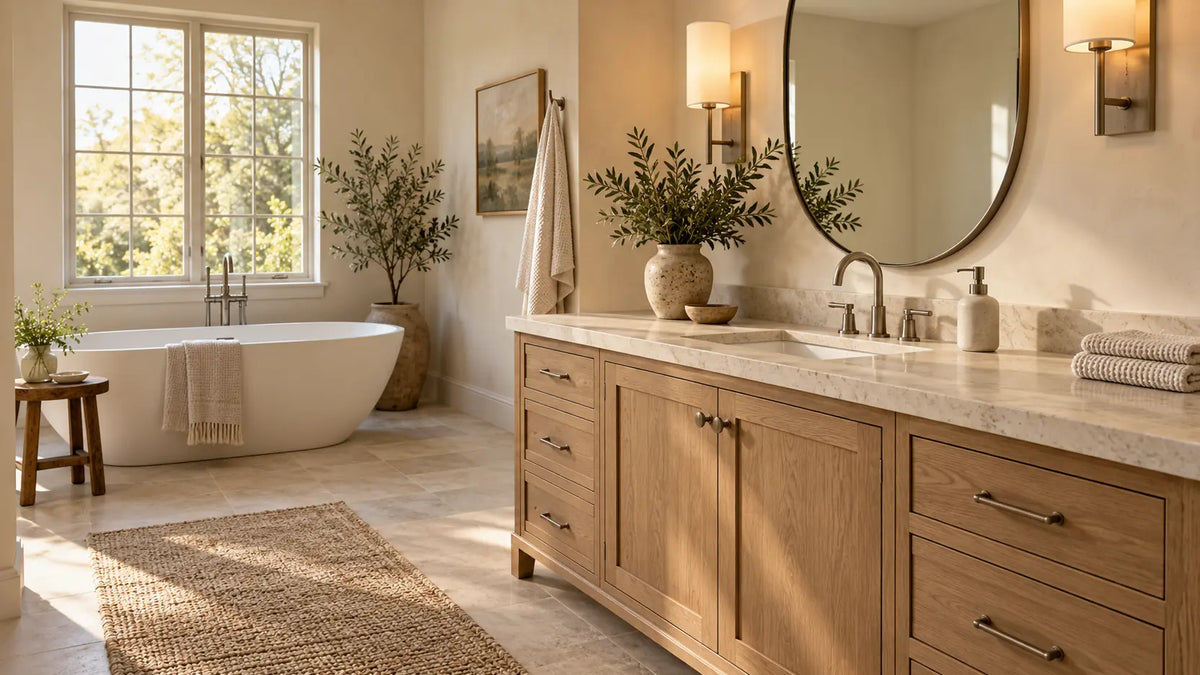
Bathroom Vanity Countertop Materials Compared: Quartz, Marble, Granite and Porcelain
A bathroom countertop is easiest to love before the toothpaste, hand soap, and curling iron arrive. The best countertop for a bathroom vanity isn't necessarily the one with the prettiest veining. For a busy shared bath, we'd choose a named engineered-quartz top whose cleaning instructions, basin, and faucet drilling all work for the room. Natural marble makes more sense when you want its individual character and won't resent caring for the finish.
The BathGem's Blueprint
Decide what you can live with around the sink before deciding what looks good across the room.
- Name the material precisely. Quarried Carrara, Carrara-look cultured marble, engineered quartz, and an integrated composite sinktop aren't interchangeable.
- Find the wet zone. Count the bottles, hot tools, and cleaning products that will actually sit within reach of the faucet.
- Buy the configuration, not the photograph. Confirm finished depth, bowl count, faucet holes, backsplash, and installation requirements together.
Which bathroom vanity countertop material is best?

We'd choose differently for a family bathroom and a guest powder room. In the first, wiping around an undermount basin without worrying about every drop matters more than dramatic veins. In the second, a piece of natural marble can have room to be the focal point, provided you're comfortable with possible changes to its polished sheen.
The 30-inch Beckett Single Bathroom Vanity in Whitewashed Oak with Brushed Nickel Trim by Wyndham makes this unusually clear. Its BathGems listing offers Carrara Cultured Marble, White Cultured Marble, Giotto Quartz, White Quartz, and a cabinet-only option. The two cultured-marble selections are manufactured materials, not quarried Carrara, and their maintenance shouldn't be borrowed from a natural-marble guide.
There's another buying mistake hiding in the word “top”: some listings let you select a compatible surface, sink, and drilling, while others sell the cabinet without a countertop. The correct comparison holds those choices constant. We'd settle the sink and faucet at the same time as the surface, especially if you're replacing an existing vanity rather than moving the plumbing.
| Material | Everyday trade-off | Our buying call | Verified BathGems example |
|---|---|---|---|
| Engineered quartz | Named Silestone surfaces resist routine stains; hot tools and prolonged contact with incompatible chemicals still need attention. | For daily-use bathrooms, check the exact quartz finish and its care sheet. | 60-inch Bristol Single Vanity in Bright White by James Martin Vanities, with White Zeus Silestone available |
| Natural marble | Absorbed stains and acid etching are different problems; sealing won't make marble acid-proof. | Choose for genuine veining in a room where finish care feels reasonable. | 60-inch Bristol Single Vanity in Bright White by James Martin Vanities, with Carrara White Marble available |
| Granite | Stone treatment and absorption differ; don't assume a universal resealing calendar. | Good for a dark, furniture-like vanity if its support and care are clear. | 28-inch Cirque Wall Sink Chest in Dark Walnut by Ambella Home, Imperial Black granite |
| Cultured marble | A manufactured surface that may resemble Carrara; finish-specific cleaners and repair rules apply. | Choose it knowingly for the look and package, never because you think it's natural marble. | 30-inch Beckett Single Bathroom Vanity by Wyndham, cultured-marble selections |
| Integrated solid surface or composite | The basin and top form one visual element; repairability depends on the actual composition and coating. | We'd prioritize a clean sink junction, but verify whether it's through-color acrylic or a coated composite. | 72-inch Linear Single Vanity in Whitewashed Walnut by James Martin Vanities, Glossy White integrated-basin option |
These are product-specific illustrations, not a controlled performance test or a universal price ranking. BathGems' material collections can also include vanities with several configurable top options, so confirm the selected surface before treating a product photograph as the finish you're buying.
Quartz versus marble: The difference you'll notice on a Tuesday morning

Quartz: Take the easy-clean route, without treating it as indestructible
A light quartz top leaves room for your soap dispenser, toothbrush cup, and whatever a second person puts down during the morning rush. Its appeal isn't that it tolerates every chemical. It's that a documented quartz finish can offer stone-like movement without natural Carrara's sensitivity to acidic spills. Read the exact surface's maintenance instructions before committing.
On BathGems, the 60-inch Bristol Single Vanity in Bright White by James Martin Vanities offers both White Zeus Silestone and Carrara White Marble, along with faucet-mount choices. Holding the cabinet design constant makes this a meaningful material comparison. The listing gives overall dimensions of 60 inches wide, 23.5 inches deep, and 33.75 inches high. Confirm the selected top and any backsplash in the installation drawing, then choose the finish and drilling together rather than relying on the default image.
Cosentino advises neutral soap and a damp microfiber cloth for routine Silestone cleaning, followed by removing soap residue and drying. Its maintenance guidance says prolonged bleach exposure from 2 hours can damage Silestone, and sudden temperature changes can affect it. That's reason enough to keep a heat-resistant mat beside the outlet instead of placing a straightener directly on the counter. Soap film can also interrupt reflected light around a polished faucet, so rinsing and drying often do more than adding another cleaner.
Across three independent homeowner cleaning threads, including this r/CleaningTips discussion, posters reported stubborn hair-dye marks on bathroom counters described or suspected to be quartz. The exact material was not always confirmed. Those posts aren't laboratory evidence, and the suggested internet cleaning remedies shouldn't override a manufacturer's instructions.
They do reveal a useful shopping question: are hair coloring and strong cosmetics part of your household's routine? If they are, we recommend treating immediate spill removal and approved cleaning methods as non-negotiable even with a stain-resistant top.
Marble: Decide how you feel about patina before you fall for the veining
Natural Carrara has a softness of pattern that a photograph rarely captures. Against a pale oak cabinet, its grey movement can make the counter feel more like furniture than a fitted fixture. We'd put marble in a design-led powder room or a quieter private bath, rather than a sink where acidic products are used casually every day.
A spill can discolor marble if the liquid migrates into the stone. An acidic product can instead react with calcium carbonate and alter the sheen of the surface; the result may be a dull mark even after the liquid is gone. The Natural Stone Institute's marble-care guidance distinguishes those effects and explains why a stain-repellent sealer isn't an anti-etch coating.
On a polished marble counter, side lighting can make a faint change in reflectivity more conspicuous than it looked under store lighting. We'd compare the sample beside your cabinet finish and under the sconces you plan to install. Keep cosmetics on a washable tray, lift it when you clean, and follow the stone supplier's product-specific sealing guidance. A tray organizes spills, but it can't guarantee protection from etching.
Granite, cultured marble, and integrated tops: Don't mix their care instructions

Granite: Ignore the blanket annual-sealing advice
Some bathroom-countertop guides tell you to reseal granite every year. The Natural Stone Institute takes a more precise position: most granite countertops do not need to be sealed, although many can benefit from the added protection. We'd ask about the particular stone and any factory treatment before accepting a calendar-based maintenance promise.
The 28-inch Cirque Wall Sink Chest in Dark Walnut by Ambella Home pairs Imperial Black granite with curved dark-walnut cabinetry and brass trim. The sink is porcelain, not granite, and one working drawer sits below it. Its 28-inch width, 22.5-inch depth, and 22-inch body height suit a compact wall-mounted composition, but the 22 inches are not the finished height above the floor. Metal cleats are included, yet the wall still needs an installer-approved support plan.
Ambella says to clean its granite and marble with mild dishwashing detergent and warm water, rinse, and dry with a soft cloth. It warns that scouring powders or creams may scratch the stone and instructs owners not to use products containing lemon, vinegar, or other acids. On a dark polished top, the final dry cloth also clears the water film that catches the sconce light. We wouldn't use an acidic toilet or tile cleaner on the counter just because it's already in the bathroom.
Cultured marble: Buy the actual finish, not the word Carrara
The name Carrara Cultured Marble describes a manufactured option on the Beckett, not quarried Italian marble. That can be an attractive route when you like a pale marble-inspired look but don't need the variations of a natural slab. We'd confirm the top's surface finish, cleaner compatibility, and any coating restrictions before deciding what maintenance it will need. A natural-stone polishing method is not a safe default for a manufactured top.
The Beckett listing also offers Giotto Quartz and White Quartz, with a 3-inch backsplash and a reversible sidesplash described for the 30-inch configuration. Its overall listing is 30 inches wide, 22 inches deep, and 35 inches high. Importantly, this size has two doors and no drawers, so the countertop may end up holding items that a larger vanity could hide in shallow storage. If your daily routine involves several bottles, plan storage before choosing a top that looks clear in the hero photograph.
Integrated sinktops: Inspect the junction, then the composition
An integrated basin can remove the visual break between a separate undermount sink and the surrounding top. We like that for a restrained bathroom with few accessories, especially when the cabinet's wood grain is doing the design work. The 72-inch Linear Single Vanity in Whitewashed Walnut by James Martin Vanities lists a Glossy White option with an integrated basin and a footprint of 72.5 inches wide by 18.75 inches deep. That comparatively shallow footprint is worth examining when a standard-depth vanity would press into circulation space.
Don't assume every product called solid surface is the same formulation. James Martin identifies Arctic Fall as an acrylic-based, through-color solid surface whose marks can be buffed out using appropriate methods, while its separately documented glossy mineral composites can have a gelcoat finish. BathGems lists Arctic Fall - Buy A Sample, but the sample isn't evidence that a full Arctic Fall top is available for the Linear. We'd request the selected Glossy White top's repair guide before trying to renew a mark.
Porcelain slab is another legitimate category for a fabricated vanity top, especially if you want a crisp edge and a restrained pattern. But a porcelain basin inside a granite or quartz top doesn't make the whole top porcelain. We haven't verified a specific BathGems porcelain-slab vanity top to recommend here, so we'd compare it only after a fabricator confirms the exact slab, cutout, edge, and installation package.
If you want a vanity offered with its countertop and basin, start with the available top-and-sink configurations rather than a cabinet-only photograph. Check the selected material and sink option on each listing before comparing package prices; the collection includes products with multiple configurations.
Explore our Bathroom Vanities with Top Included


Stains, etching, and water film need different responses

A dull ring on marble isn't necessarily dirt, and a colored mark isn't always an absorbed stain. Before you reach for an abrasive cream, identify what the material is and what touched it. We'd start with the selected manufacturer's routine-cleaning instructions, then ask for material-specific advice if the mark remains.
What the mark tells you
- Cloudy film near the tap: check for soap or mineral residue and use only the surface maker's approved method.
- Darkened or colored patch: note the substance and how long it sat; don't assume a generic stain remover is compatible.
- Dull spot on natural marble: suspect altered sheen or etching before adding stronger cleaner.
- Scratch or mark on a coated composite: stop before sanding; the finish layer may need its own repair procedure.
One mechanism worth remembering: an impregnating stone sealer reduces the movement of some liquids into pores, but acid etching changes the mineral surface itself. The same care method can't solve both. Where hair dye or strong cosmetics are involved, wipe spills promptly, avoid mixing household cleaners, and follow the instructions for the actual countertop rather than a remedy posted for a different material.
If hair coloring is part of your routine, compare the documented quartz-top options with their maker's care sheets in hand. The collection includes configurable vanities, so verify that the option you select actually includes quartz, your preferred basin, and the right drilling.
Explore our Quartz Bathroom Vanity Tops

30" Beckett Single Bathroom Vanity in Whitewashed Oak with Brushed Nickel Trim by Wyndham

84-inch Dovessan Modern Double Bathroom Vanity in Aged Dark Brown Oak by Vellora


Countertop price and weight: Compare what's included

A price for an entire vanity tells you little about the cost of a slab. The cabinet, top, sink, drilling, backsplash, delivery, and installation can all change what the quote covers. Compare two configurations with matching basin and faucet holes before ranking material cost. For the Bristol, that means comparing the current Carrara White Marble selection against the White Zeus Silestone selection on the same cabinet, not against a separate fabricator's raw slab price.
Weight has the same trap. BathGems displays 110 lb in the specification text for the Cirque, but the listing doesn't establish whether that figure means shipping weight, top-only weight, or the final mounted assembly. For a floating vanity, the installer needs the verified total assembly load, wall construction, fastening method, and manufacturer's mounting instructions.
Ask for one matched specification with every quote
- Exact material, finish, and whether the item is cabinet-only or includes the top.
- Finished top width, depth, thickness, overhang, and edge profile.
- Basin quantity, material, mounting method, and cutout dimensions.
- Faucet hole count and spacing; backsplash and sidesplash inclusion.
- Actual installed assembly weight and required wall or cabinet support.
- Delivery, fabrication, installation, and the applicable warranty for each component.
James Martin's published limited warranty describes 1 year of coverage for specified defects under normal residential use and says quartz stone tops have a separate manufacturer warranty. The distinction matters when you're comparing a top-and-cabinet package, because the cabinet's document won't necessarily control the selected quartz. We recommend requesting the actual top warranty alongside the cabinet paperwork before buying.
Measure the countertop, basin, and faucet as a single purchase

Width is only the first measurement
Mark out the vanity's full depth with painter's tape, then open the bathroom door and any adjacent shower door. A cabinet can fit the wall beautifully and still crowd the route past the sink. If the room is narrow, the 18.75-inch depth listed for the Linear is worth comparing with the Beckett's 22 inches and the Bristol's 23.5 inches.
The Bristol's single-sink arrangement is also a good reminder that 60 inches of cabinet doesn't automatically require two basins. One bowl leaves more landing space for hair tools and bottles, while two sinks give separate washing stations at the cost of usable counter between them. We'd draw the actual bowl outlines on the top plan rather than deciding from cabinet width alone.
Faucet drilling and backsplash are not finishing touches
A single-hole faucet and an 8-inch widespread faucet don't use the same drilling pattern. The Bristol lists both choices across its top configurations, and the Beckett lists one-hole and three-hole undermount-sink options. Put the faucet decision on the same order sheet as the counter. Confirm the hole pattern on the particular selected combination, not from another image in the product gallery.
Backsplash dimensions affect mirror placement and the bottom edge of wall tile. BathGems lists the Beckett at 35 inches high and describes a separate 3-inch backsplash on the configured tops; confirm the finished sink-rim and splash elevations on the installation drawing. We'd mark the splash line and sconce wiring on the elevation before deciding how low to hang the mirror.
For an accessible lavatory where the 2010 ADA Standards for Accessible Design apply, section 606.3 limits the front of the higher sink rim or countertop to 34 inches above the finished floor, subject to the standard's exceptions. That isn't a blanket legal rule for every private residential bath, but it means a 35-inch freestanding configuration can't simply be assumed to meet an accessible design brief. Start that conversation before purchasing the cabinet, not after the installer has placed it.
The faucet choice has a second useful specification: the EPA's WaterSense bathroom-faucet criteria set a maximum flow of 1.5 gallons per minute at 60 psi and a minimum of 0.8 gallons per minute at 20 psi for labeled bathroom faucets. These are performance criteria for a faucet, not a countertop rating. Once the drilling is fixed, use the label and the spout's reach to shortlist a compatible faucet; an impressive spout that lands water near the back edge of the bowl is a nuisance no surface choice can fix.
Choose the cabinet finish and countertop in the same light

A white countertop can look creamy beside a bright-white cabinet and cool beside white oak, depending on its undertone. Polished surfaces also reflect the color and angle of sconces, which can exaggerate water film around a tap. We'd put the counter sample beside the cabinet finish, faucet, and wall tile rather than approving four whites separately. The room needs to agree, not the individual sample cards.
For a bathroom vanity color decision, we like quiet veining above darker painted cabinetry when the hardware already has character. Warm walnut can take either a restrained pale stone or a dark granite top, but test the combination under the light that will actually be installed. A small sample can disappear against the cabinet; a full 60-inch run makes the same undertone much more obvious.
The countertop can also make a deep cabinet feel visually heavier than it looks in the showroom. If you're comparing proportions and storage at the same time, our modern vanity material guide helps you evaluate the cabinet below the stone. We'd choose the counter-cabinet pairing before pulling together the final metal finishes.
The best choice by bathroom routine

Use your daily habits to narrow the material, then use the actual product specification to close the decision. The aim isn't to give every room the same top. It's to avoid purchasing a surface that asks for a different routine than the people using it will follow.
| Your bathroom | Our direction | The deal-breaker to check |
|---|---|---|
| Shared primary bath | A documented quartz option on a properly configured vanity | Routine hair dye, hot tools, and chemical exposure |
| Quiet powder room | Carrara White Marble for its natural variation | Unwillingness to accept possible etching |
| Compact floating bath | Granite on a verified wall-hung configuration | Unconfirmed structural support or mounting height |
| Small bath with limited storage | Cultured marble or quartz paired with a storage plan | Crowded counter because the cabinet lacks drawers |
| Contemporary bath with clean sink lines | An integrated Glossy White top with documented care | Unknown coating, repair method, or final basin clearance |
Once you've chosen the surface you'd enjoy maintaining, compare finished footprints through the bathroom vanity sizes guide and inspect the exact linked BathGems vanity configuration. Bring the top sample, cabinet finish, and faucet specification into the same decision before ordering; it'll do more for the finished room than chasing a material ranking.
Frequently Asked Questions

Todd Harmon
The best vanity countertop isn't only a material sample; it's the surface, basin, and cabinet behaving as one piece in your room. Small differences in depth, drilling, and finish care decide how easy that combination is to live with. With over two decades in e-commerce and product curation, Todd built BathGems on a simple idea: a bathroom should feel as collected and considered as the rest of the home. He sources every vanity and fixture in the BathGems catalog the way a designer pulls samples, weighing material, proportion, finish quality, and how a piece actually lives in a real room over time.

