Using an Antique Dresser as a Bathroom Vanity: What Actually Works
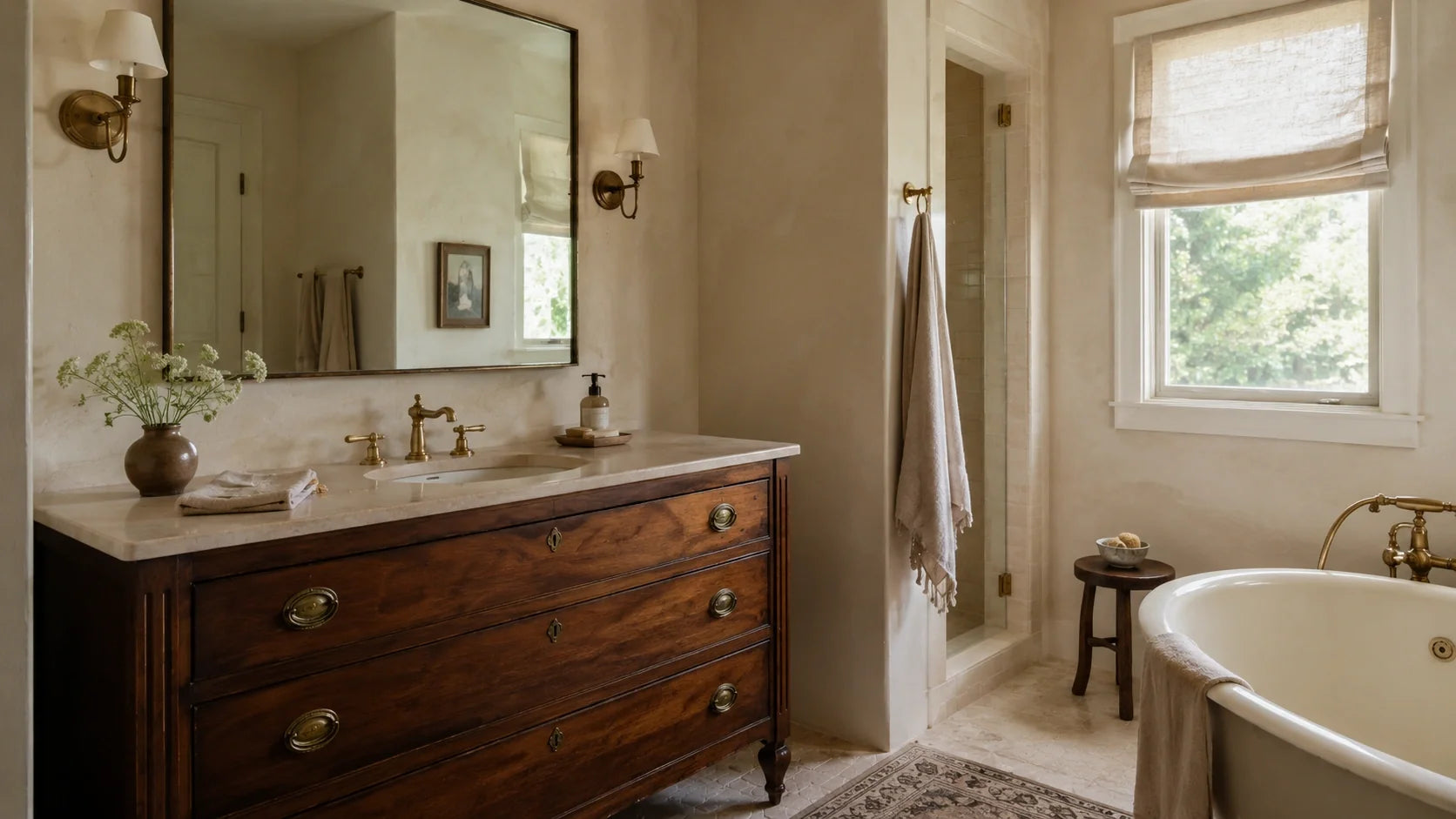
An antique dresser bathroom vanity can give a bathroom the kind of character you can't order by finish name alone. You get old wood, furniture proportion, worn brass, maybe a drawer front that's slightly imperfect in exactly the right way. But once you add a sink, faucet, drain, standing water, and daily use, the dresser has to work as bathroom furniture, not just look convincing in a photo. An old dresser earns its place in a bathroom on character. It keeps that place on geometry.
The BathGem's Blueprint
- Measure the finished sink height. The useful number is floor to basin rim, not floor to dresser top.
- Trace the sink footprint. Know how much original top you're giving up.
- Map the drain through the drawers. Find the storage loss before the first cut.
- Mark every wet zone. Fresh cuts and plumbing penetrations matter as much as the visible top.
- Decide what you're actually after. If one particular old dresser is the point, a conversion can be worth the work. If it's the antique or vintage look you love, we'd usually start with a new vanity already designed for a bathroom.
That last distinction matters. A dresser conversion can be a satisfying project, but you don't have to convert old furniture to get furniture-style character. New antique-style and vintage-style bathroom vanities can give you warm wood, traditional proportions, turned feet, framed drawer fronts, and aged-looking details without asking a bedroom cabinet to accommodate a sink and drain after the fact.
If the look is what pulled you into this idea, we'd compare a purpose-built antique bathroom vanity before buying a dresser for conversion. You may find that the finished piece gives you exactly the collected feeling you wanted with fewer compromises in sink height, storage, and plumbing.
Will Your Antique Dresser Actually Work as a Bathroom Vanity?

Start With the Room, Not the Furniture
The dresser should fit the room before it fits the mood. Start with wall width, but don't stop there. Check cabinet depth, the open bathroom door, nearby casing, the toilet, and the space you need to stand comfortably in front of the sink.
Old dressers can project farther into a small bathroom than you expect after years of seeing them against a bedroom wall. A piece can fit perfectly between two walls and still make the room irritating every morning because the deepest drawer meets the casing or the cabinet crowds the walkway.
We'd reject a dresser that compromises the room before trying to rescue it with a clever sink. A repurposed bathroom vanity should make the bathroom more useful, not turn every drawer pull into a clearance test.
Check the Structure Before the Style
Open every drawer, check for wobble, look closely at the joints, inspect the back, and pay attention to splits or loose veneer around the top. The outside may have exactly the patina you want, but the interior construction is what has to survive cutting and plumbing.
An antique washstand vanity can sometimes give you proportions that already feel closer to bathroom furniture, but age and style aren't enough. The sink and drain still get the final vote.
This is also where a new furniture-style vanity has an advantage that isn't especially glamorous, but matters every day. The cabinet starts with plumbing, sink placement, and bathroom storage in the plan. You aren't spending the first half of the project figuring out which parts of the furniture have to disappear.
Antique Dresser Bathroom Vanity Height: Measure the Sink Too

This is one of the easiest mistakes to make because the dresser looks right before the sink arrives.
Measure the vanity you end up with, not the dresser you started with.
A vessel sink on antique dresser furniture can be especially tricky because the bowl sits above the top. A dresser that feels comfortable as furniture can become awkward once you add the basin and faucet.
The smart move is to choose the sink early and mock up the finished height before you commit. Set a box, bowl, or template on the dresser at the intended height and stand in front of it. Your body will tell you more than the listing photo will.
A lower dresser generally gives you more flexibility with an above-counter basin. A taller piece may work better with a sink that sits partly or mostly below the counter surface. Sink style isn't a finishing detail here. It can determine whether the dresser works at all.
If you're mostly chasing the furniture look, this is one reason we'd lean toward a new antique-style vanity instead. The sink and cabinet proportions have already been designed together, so you're choosing the look rather than engineering around it.
Sink Choice Changes the Whole Dresser to Vanity Conversion

A dresser to vanity conversion gets much easier once you stop treating the sink as a decorative choice. The sink affects the amount of cutting, finished height, faucet position, drawer space below, and how much of the original top survives. If you're picturing an antique vanity with sink already in place, work backward from that finished configuration.
Explore our Antique Bathroom Vanity


Vessel Sink
A vessel sink usually leaves more of the original dresser top visible because the main basin sits above it. That's useful when the wood top is part of what made you love the piece.
The trade-off is height and landing space. A wide bowl can quietly swallow the area you expected to use for soap, skincare, a glass, or a toothbrush cup. The sink may preserve more wood while leaving you less usable countertop.
Faucet placement matters too. A taller deck-mounted faucet needs enough room behind or beside the bowl, and that rear clearance can be tighter on an old dresser than it looked on paper.
We'd choose a vessel sink when the dresser is low enough to support it and the original top is worth showing.
Drop-In Sink
A drop-in sink requires a larger opening in the top, but its rim covers the cut edge and the basin sits lower than a vessel. That can produce a more comfortable working arrangement on a taller dresser.
You give up more of the original top, and the bowl still occupies space inside the cabinet. For many conversions, this is the practical middle ground between preserving the dresser and asking too much of it.
Undermount Sink
An undermount sink usually makes more sense when you're willing to replace the dresser top with a countertop designed for that sink configuration. That changes the furniture more visibly, but it can simplify the wet area and leave a clean surface around the basin.
We wouldn't force an undermount sink into an original antique top simply because the sink style looks cleaner online. The cabinet, countertop, sink, and faucet have to work as a system.
Plan the Plumbing Before You Sacrifice the Drawers

The plumbing doesn't care how pretty the drawer fronts are.
This is where a promising dresser can turn into a frustrating project. The drain assembly needs interior space, and that space often lands directly behind the top center drawers, which are usually the drawers you assumed you'd keep.
A six-drawer dresser may not behave like a six-drawer vanity once the sink is installed. Depending on the plumbing position, you may end up with a false front, a shortened drawer, a U-shaped drawer, or no functional top drawer at all.
Drawer architecture can matter more than exterior style. A quieter dresser with a forgiving interior layout may produce a better vanity than the ornate piece you fell for first.
Before you cut: Remove the drawers and map the sink centerline, drain path, and faucet penetrations. If the plumbing claims the exact storage you bought the dresser for, you want to know while the piece is still intact.
Check the back panel at the same time. Older dressers weren't designed around plumbing penetrations, and the cleanest path through the cabinet may run through a drawer runner, frame member, or more substantial section of the back.
Existing wall plumbing matters too. If the rough-in doesn't line up with the dresser's natural sink position, you may have to modify the furniture more aggressively or expand the plumbing work. We recommend solving that path on paper before solving it with a saw.
That storage math is one of the strongest arguments for a purpose-built vintage-style vanity. Furniture details can still give you the old-piece feeling, while the drawer boxes and cabinet openings are already arranged around the plumbing they need to live with.
Sealing Wood for Bathrooms Means More Than the Top

Sealing wood for bathrooms is often reduced to one instruction: coat the dresser. That's too simple for a conversion.
The visible top matters, especially around the sink and faucet, but the conversion creates new exposed areas. The sink opening, faucet holes, plumbing penetrations, cut drawer boxes, back-panel openings, and other fresh edges deserve the same attention as the surface everyone sees.
Every new hole is another place where the original finish stops and your workmanship begins.
Wood exchanges moisture with the surrounding air as humidity and temperature change, a relationship documented by the USDA Forest Products Laboratory. A surface finish can be part of the protection strategy, but the cabinet is still living in a different environment than it did in a bedroom.
The existing finish matters too. An antique dresser may already have lacquer, shellac, varnish, wax, paint, oil, or a later refinishing layer you can't identify confidently by sight. Preparation and coating compatibility depend on the existing surface, so we wouldn't prescribe one universal can of finish for every old dresser.
If what you love is warm grain rather than the conversion itself, a natural wood bathroom vanity gives you that material presence in a cabinet intended for bathroom use. That's often the smarter route when you want the warmth of furniture without inheriting an unknown old finish and a new list of cut edges to protect.
Explore our Natural Wood Bathroom Vanity

30" Beckett Single Bathroom Vanity in Whitewashed Oak with Brushed Nickel Trim by Wyndham


72" Double Sink Bathroom Vanity with Top in Chestnut - James Martin Marcello

60" Janna Double Bathroom Vanity in White Oak with Matte Black Trim by Wyndham


Ventilation Is Part of the Wood Strategy
A converted dresser doesn't live in a dry bedroom anymore. It sits around splash, damp towels, shower steam, and changing humidity, so the room itself has to do its share of the work.
The U.S. Environmental Protection Agency notes that ventilation helps control indoor humidity and that bathroom exhaust is used to manage moisture in those rooms. If the bathroom stays damp long after showers, we'd solve that condition instead of expecting another layer of finish to carry the whole burden.
Should You Keep the Original Wood Top?
If the top is one of the dresser's best features, keeping it preserves more of the furniture quality that made the piece special. It also puts that original surface directly in the splash zone.
Replacing the top with stone, quartz, or another appropriate vanity surface changes the look, but it can simplify sink integration and daily maintenance. The cabinet still carries the old furniture character while the countertop handles the harder bathroom duty.
We'd keep the original top when it matters visually and the sink configuration supports it. We wouldn't preserve it just to say the dresser stayed original.
Know What You're Cutting Before You Make It Permanent

A dresser conversion isn't a reversible styling project.
Once you cut a sink opening, drill faucet holes, shorten drawer boxes, alter the back, or replace the top, you've permanently changed the piece. That may be exactly what you want, but make the decision before the first irreversible cut.
This matters more if the dresser has family significance or may have collectible value. You don't need to treat every old chest like a museum object, but you also don't want to discover what mattered about it after the original top is already gone.
If preserving the furniture matters as much as using it, assess the piece first. If preserving an old dresser isn't part of the goal at all, we'd question why you're taking on the conversion rather than choosing a new vanity designed to give you the same visual language.
The Case for a New Antique-Style or Vintage-Style Vanity

Convert the dresser when the dresser itself is the point. Choose the new vanity when the antique look is the point.
That's the line we'd use in our own decision. A genuine dresser conversion makes sense when you've found a particular cabinet you love enough to work around its dimensions, drawer layout, sink height, finish, and plumbing limitations.
But if what you want is the feeling of an older furniture piece, warm wood, traditional feet, framed drawers, aged-looking metal, and a cabinet with more personality than a flat modern box, you don't need an actual antique dresser to get there.
A new antique bathroom vanity can deliver that furniture-style look while starting with bathroom function in the plan. You aren't sacrificing drawers to discover where the P-trap fits, guessing how high the vessel sink will land, or introducing fresh sink cuts into an unknown old finish.
For most readers who arrived here because they love the look, not because they already own a meaningful dresser, this is the option we'd recommend first.
Our stop point on a conversion is simple: if the sink has to sit too high, the plumbing eliminates the storage you wanted, the dresser is too deep for the room, or major modification is required just to make the cabinet usable, stop solving problems that a purpose-built vanity has already solved.
You still get the furniture feeling. You just get to spend more of the project choosing the right finish, mirror, faucet, and lighting instead of rebuilding the cabinet around the sink.
Finish the Room Without Making Everything Look Antique

A furniture-style vanity already gives the room a strong point of view, whether it's a converted dresser or a new vintage-style cabinet. Resist the urge to make every other piece compete with it.
If the vanity has carved details, heavy grain, aged-looking hardware, or a lot of visual movement, we'd usually choose a quieter mirror. A simpler cabinet gives you more room to use an expressive frame.
If the vanity is already talking, the mirror doesn't need to raise its voice.
Mirror proportion matters more than vintage credentials. Look at how the mirror sits over the sink, how much wall remains for sconces, and whether its frame feels visually heavier than the cabinet below it.
That makes bathroom mirrors part of the vanity decision rather than an accessory you choose at the end. The goal isn't to make every piece look as if it came from the same antique shop. It's to make the vanity feel intentional in the room.
The same restraint applies to metal finishes. Aged-looking brass pulls don't automatically require an ornate brass faucet, brass sconces, and a brass mirror. Sometimes one warm metal detail is enough. Give the vanity room to be the interesting piece.
So, Should You Convert the Dresser?

If you already own a dresser you love, its proportions work, the plumbing leaves useful storage, and you're comfortable modifying and protecting the wood, the conversion can absolutely earn its place.
If you're still shopping for a dresser because you want an antique-looking bathroom vanity, we'd change the order of operations. Look at new antique-style and vintage-style vanities first. You may get the same furniture character with a better sink height, more useful drawers, cleaner plumbing, and far less improvisation.
The dresser route is special when the dresser is special. If the look is what matters, we'd put the energy into choosing the right purpose-built vanity and let the bathroom work the way a bathroom should.
If you're deciding how much authentic age versus antique-style character you want in the finished room, our guide to antique versus antique-style bathroom vanities is the natural next read.
Frequently Asked Questions

Todd Harmon
Todd's view is that furniture character and bathroom function shouldn't have to compete. The right vanity can carry the warmth and detail of an older piece while still getting proportion, storage, sink placement, and daily use right. With over two decades in e-commerce and product curation, Todd built BathGems on a simple idea: a bathroom should feel as collected and considered as the rest of the home. He sources every vanity and fixture in the BathGems catalog the way a designer pulls samples, weighing material, proportion, finish quality, and how a piece actually lives in a real room over time.