What Countertop Goes With a Black Bathroom Vanity?
A black vanity is a commitment. It reads as architecture instead of furniture, and it sets a tone the moment you walk in. So the surface you set on top of it has a real job to do, either sharpening that drama or quietly muddying it.
The BathGems Brief
Choose a black bathroom vanity countertop by contrast first, then material. The room will tell you whether the right move is crisp, softened, or dark and monolithic.
- Read the undertone. Warm, brown-black cabinets work best with cream and gold-veined stone; true blue-blacks want a cooler, crisper white.
- Start with white quartz. It is bright, forgiving, non-porous, and it keeps a black vanity from feeling heavy in modest light.
- Match vein to metal. Cool gray veining suits chrome and brushed nickel; warm gold or taupe veining suits brass.
- Mind the finish. The black cabinet, not the counter, is the surface you wipe daily, so choose a satin or lacquer that cleans up without showing every touch.
Choosing a black bathroom vanity countertop comes down to one question most people skip: how much contrast do you actually want? Go bright and you get a crisp, fresh bathroom. Stay dark and you get something enveloping and moody. Both can work, but your room, your light, and your daily patience should make the final call.
Start With the Undertone of Your Black Vanity

Powered by AURA Modern Home Hotspot Builder
Not all black is the same black. Some cabinets lean warm, with a brown or charcoal base that softens under lamplight. Others are a true, cool, near-blue black that stays sharp and precise. You can only see it by holding a white card and a stone sample against the door at the same time.
This matters more than any trend, because your counter has to agree with that undertone. A cool, blue-white quartz on a warm charcoal vanity can look slightly off, like two different blacks arguing. Warm the white to a soft cream or a gold-veined stone and that same cabinet suddenly looks collected. The reverse holds too: a true blue-black wants a crisp, cool white, not a buttery one.
Sheen is the other half of it. A matte black vanity finish drinks light and reads soft and modern, which loves honed, low-sheen counters. A high-gloss or lacquered black bounces light and can carry a polished stone without looking busy. The counter and the cabinet should agree on how much they shine, or the vanity reads slightly mismatched even when the colors are right.
Designer tip
Judge the undertone in the actual room, never in the showroom. Set the vanity door beside your counter samples under your real bathroom light for a full day. North light, warm bulbs, and late-afternoon sun each pull the black a different direction, and your phone screen flattens all of it.
The counter is the volume knob on a black vanity. Turn it bright and the room reads crisp; keep it dark and the whole thing goes quiet and deep.
The Best Countertop Colors for a Black Vanity

Powered by AURA Modern Home Hotspot Builder
Once you know your undertone, the field narrows fast. Here are the surfaces that consistently work, and what each one asks of you in return. These are the counters I reach for first when a client starts with a black bathroom vanity and wants to know where to go next.
Explore our Black Bathroom Vanity

80" Sheffield Double Bathroom Vanity in Espresso with Brushed Chrome Trim & Medicine Cabinet by Wyndham

72" Sheffield Double Bathroom Vanity in Espresso with Brushed Chrome Trim & Medicine Cabinet by Wyndham

80" Sheffield Double Bathroom Vanity in Espresso with Brushed Chrome Trim & 70" Mirror by Wyndham

80" Sheffield Double Bathroom Vanity in Espresso with Brushed Chrome Trim & 24" Mirror by Wyndham


White Quartz on a Black Vanity: the Safe, Bright Default
If you want one answer that almost never misses, it's white quartz. The crisp white quartz black vanity pairing is the classic high-contrast look for a reason: it's clean, it feels fresh, and quartz is engineered to behave. It's non-porous, so it shrugs off toothpaste, makeup, and water with no sealing, ever.
White quartz is not one color, though, and the version you choose changes everything. A near-solid white looks modern and graphic and lets the black cabinet be the only star. A Carrara-look quartz, with fine feathery gray veining, softens the contrast just enough to feel timeless. A bolder Calacatta-look, with wider gray or gold veins, turns the top into a quiet piece of art.
Temperature is the tiebreaker. Warm, gold-veined patterns flatter a brown-black cabinet and brass hardware; cool, gray-veined whites suit a true black with chrome or nickel.
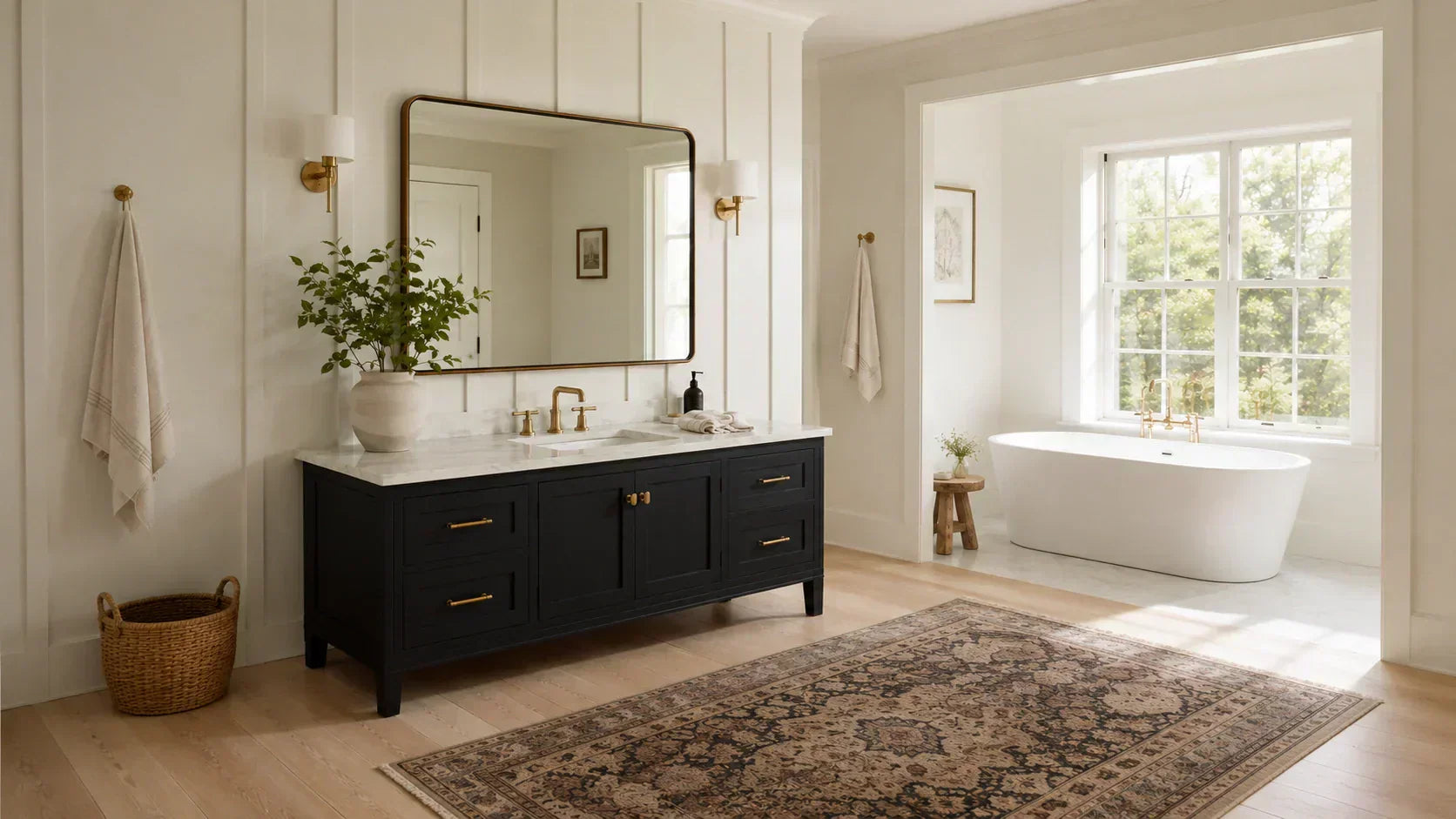
A black vanity white counter pairing does something practical, too. The light top bounces daylight back up, so the vanity anchors the room without swallowing it, which is a real advantage in a windowless or compact bath.
Marble, Quartzite, and the Marble Look Without the Worry
A marble top black vanity is the more romantic route. Carrara gives you soft, fine gray veining on a cool white ground; Calacatta runs whiter with bolder, more dramatic veins. Against black, either one feels layered and old-world in a way engineered stone only imitates.
Marble is the higher-maintenance partner in the quartz vs. marble vanity top debate. It can absorb stains, and acids in some cleaners and skincare products can leave dull etch marks even when the stone is sealed. Sealing helps with staining but does not stop etching, so reseal when water stops beading rather than following a fixed calendar. Honed marble disguises wear better than polished marble, which is why we recommend it for a bathroom.
If you love the veining but not the upkeep, two swaps get you close. Marble-look quartz keeps the pattern without sealing, while natural quartzite gives you real stone that is generally harder and less prone to etching than marble. Ask your fabricator to test the exact slab, because some stones sold as quartzite behave more like marble.
Porcelain and Sintered Stone: the Sleek, Tough Modern Pick
This is the option most pairing guides forget, and it's a strong one for a black vanity. Porcelain and sintered-stone slabs are highly heat-resistant, low-absorption, UV-stable, and difficult to scratch in normal bathroom use. Many marble-look patterns also hold up well visually beside a black cabinet.
They also solve a design problem. Because the slabs come thin, around 6 to 12 mm, you can get a razor-slim edge that looks tailored on a modern floating vanity, or build the edge up with a miter for a chunky look. The honest trade-offs: those thin edges can chip under a sharp knock, the material needs a skilled fabricator, and on some slabs the pattern is only surface-deep. For a clean contemporary black vanity, though, it's hard to beat.
Black-on-Black: Moody, Monolithic, Done Right
A dark counter on a dark cabinet turns the vanity into one solid, sculptural block. Soapstone is our favorite way to do it because it does not need sealing, handles bathroom heat well, and carries a soft matte warmth that keeps black from feeling flat. It will scratch, but light marks can often be softened with fine sanding, and mineral oil can even out the darkening as the surface develops a patina. Honed black granite or matte black quartz will also do the job.
The trick with black-on-black is to give it texture and a way to breathe. Choose a stone with some movement or veining so the top doesn't read as a flat hole, then lift it with a warm brass faucet, a lighter backsplash or mirror, and good, layered light. Skip all three and a dark-on-dark vanity can tip from dramatic to gloomy.
One to skip: the wood top
A black vanity with wood top looks warm and inviting in photos, and it's a fair question, so here's the straight answer: around a bathroom sink, wood is a headache. Standing water, toothpaste, and daily splashes work past even a good seal, and the finish eventually darkens, cups, or grows a water ring. If you adore the warmth, get it from a wood-framed mirror or open shelf and keep stone on the wet surface.
Black Bathroom Vanity Countertop Options, Compared

Here's how the main countertop options for a black vanity stack up on the things that shape your daily experience. Fabrication, sink cutouts, edge details, and local labor can move a quote more than the slab choice, so compare installed bids rather than material prices alone.
| Surface | The Look on Black | Upkeep | Budget Position |
|---|---|---|---|
| White quartz | Crisp, bright, high-contrast | Low. Non-porous, no sealing | Mid to high |
| Marble (Carrara / Calacatta) | Soft, veined, romantic | High. Can stain and etch; seal as needed | High |
| Quartzite | Natural marble look, tougher | Medium. Seal occasionally | High |
| Porcelain / sintered stone | Sleek, heat- and UV-resistant | Low. Low-absorption; edges can chip | Mid to high |
| Soapstone | Warm, matte, architectural | Low. Oil optional; light marks can be softened | High |
One rule of thumb keeps most of these decisions honest. In a small or windowless bath, lean light on the counter so the room breathes; save the black-on-black and dark-stone looks for a bathroom with a real window or generous layered light, where the drama has room to land instead of closing in.
Thickness is a quieter lever, and worth a thought. A chunky 3 cm top with a mitered edge suits a heavier freestanding black vanity, while a slim 2 cm profile keeps a wall-mounted piece looking light. Match the counter's visual weight to the cabinet's, and the whole vanity reads deliberate instead of accidental.
Get the Room Right, Not Just the Counter

The best countertop can still look wrong under the wrong light, and this is where black vanities catch people out. Black shows its true depth only under quality light. Fit high-CRI LEDs (look for a rating of 90 or above) so the cabinet reads as a rich black and your white counter reads as actual white; cheap, low-CRI light makes black go flat gray and whites go dingy. A warm-to-neutral color temperature, roughly 2700K to 3000K, flatters both black cabinetry and brass.
The wall behind the vanity matters just as much. A light backdrop, soft white, greige, or a warm beige, lets the black stand out as a deliberate feature. The classic mistake is setting a black vanity against a dark wall, which closes the room in and flattens the cabinet until it disappears into the background. Keep floors on the lighter side too, at least in a smaller bath, to hold the openness a black vanity can otherwise eat into.
Styling by Look: Modern, Floating, and Everyday Contrast

The same black vanity behaves differently depending on the style you're building around it. A few notes on the most common directions.
The Modern Look, and the Black Vanity Gold Hardware Question
For a clean, contemporary bath, white quartz or a marble-look porcelain with a squared edge is the workhorse, and it's the pairing you'll see again and again across the modern bathroom vanity category. Skip the waterfall countertop on a vanity, by the way. That full stone panel running to the floor is really a kitchen-island move, and it rarely earns its keep in a bath, where a clean squared or mitered edge does the modern job better.
Hardware is where a black vanity gold hardware combination earns its keep. Warm brass or satin gold against black quartz or white stone reads considered and a little luxe, without tipping the room into glam. Tie it back to the counter: if your stone has warm, gold-toned veining, brass sings; if the veining is cool and gray, brushed nickel or chrome is the cleaner match. Whatever you pick, keep it to one metal and repeat it on the faucet and the mirror so it looks deliberate.
The Floating Variation
Black works especially well on a wall-mounted piece, because lifting the cabinet off the floor exaggerates its clean lines and shows more of your (ideally light) floor. A floating bathroom vanity in black with a thin-profile white quartz or porcelain top looks light and modern at once, and the exposed floor beneath it keeps a small room from feeling heavy.
The Trade-Off Nobody Warns You About

Everyone agonizes over the counter. Almost nobody thinks about the finish on the black itself, which is the surface you actually touch and wipe every single day.
The catch with any black vanity
A light counter hides water and dust; the black cabinet shows more of everything, and which black you pick changes how much. A high-gloss or lacquered black looks rich but reveals water spots, dust, and fine scratches. A matte or satin black hides fingerprints and scuffs far better, but can pick up a dull mineral haze from hard water if you let splashes dry on it.
This is exactly where finish quality earns its money. A well-made satin or lacquered black wipes clean and holds its color, while a cheap flat finish smears and can go patchy over the years. For a busy family bath, lean toward a satin black over both dead-flat matte and high-gloss, wipe splashes with a damp microfiber (skip the abrasives), and keep a cloth in the vanity. When we curate a black piece, that wipeable, hold-its-color finish is one of the first things we check.
Finishing Touches: Sink and Backsplash

The counter is the big decision, but two smaller ones lock the look in, starting with your black vanity sink options. A white undermount keeps a light counter visually clean and wipes out quickly. An integrated basin fabricated in quartz or solid surface removes the rim where grime collects, which makes it our lowest-maintenance pick. A black or graphite sink looks sharp and tonal, but it will show mineral spots more readily.
A black vanity backsplash can go two ways, and both are good. The builder default is a short four-inch stone strip, but running the same stone up as a fuller slab hides the wall-to-counter seam and looks noticeably more custom. Simple white or marble tile keeps things classic and lets the black cabinet stay the focal point, at the cost of grout lines to keep clean. If you went monochrome with a dark counter, a black or deep-charcoal backsplash pushes the drama all the way up.
Pro tip
Tint the caulk, not just the counter. Ask your installer for a color-matched silicone at the counter-to-backsplash and counter-to-wall joints instead of stark white. It's a few-dollar upgrade that makes the seams disappear and the whole vanity read custom rather than builder-grade.
Not sure how a white counter will read against your exact black?
Black is one of the trickiest colors to judge on a screen. Order a free finish sample, 100% refundable with purchase, and hold it against your tile, your wall paint, and your real bathroom light before you commit. Want a second opinion on contrast or clearances? Send us your measurements and we'll walk through the pairing with you before anything ships.
Frequently Asked Questions

Todd Harmon
A black vanity lives or dies by the surface you set on it, so Todd looks at undertone, sheen, and daily upkeep as one decision rather than three separate finishes. With over two decades in e-commerce and product curation, Todd built BathGems on a simple idea: a bathroom should feel as collected and considered as the rest of the home. He sources every vanity and fixture in the BathGems catalog the way a designer pulls samples, weighing material, proportion, finish quality, and how a piece actually lives in a real room over time.