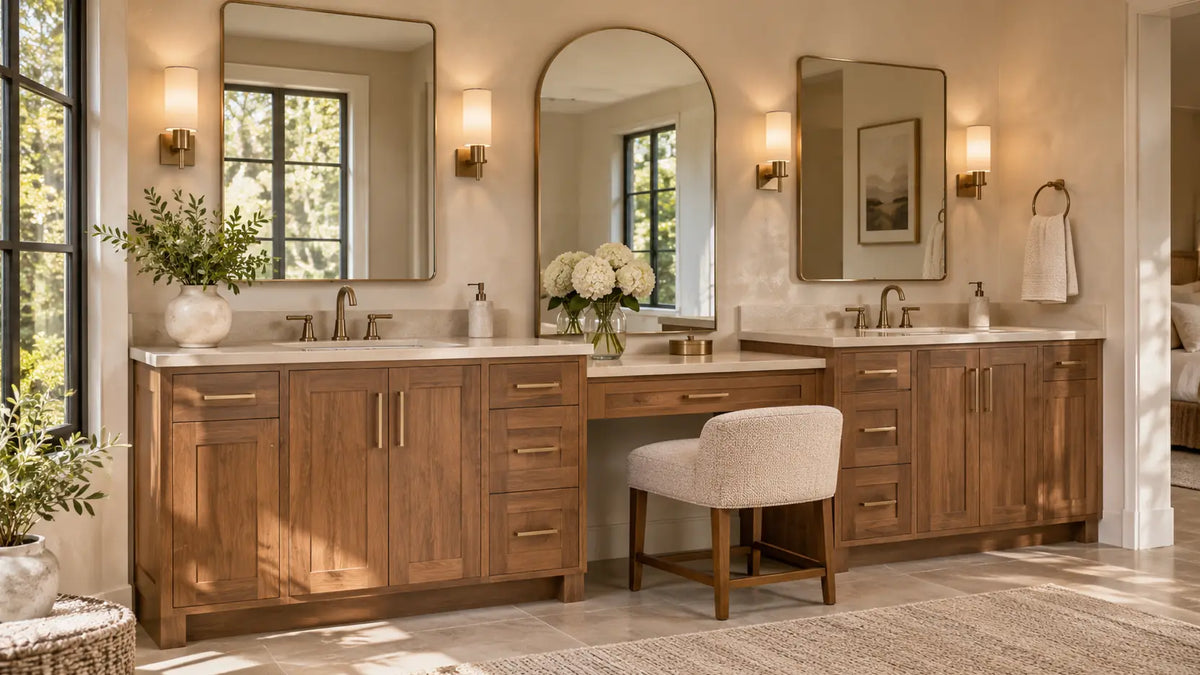

What Makes a Bathroom Vanity High Quality: Construction, Materials and Details to Check
A vanity can look just right in a photograph while leaving its most important details out of view. We recommend judging bathroom vanity quality by five things you can verify: cabinet construction, drawer joinery, operating hardware, finish care and installation fit. The distinction matters when two similar cabinets conceal very different storage layouts or materials behind their painted fronts. You should be able to explain what you're buying from the exact configuration's specifications, not just its finish.
The BathGem's Blueprint
Before choosing a color or hardware finish, work through the cabinet in this order:
- Identify each material by location: frame, side panels, back, drawer boxes, cabinet floor and sink-adjacent edges.
- Inspect the whole drawer system: corner joints, bottom support, slide extension and door hinges.
- Follow the water path from the sink and countertop seam to the plumbing cutouts and cabinet floor. Then read the maker's care exclusions.
- Match the selected top, sink arrangement and open-drawer footprint to your actual drain, supplies, wall trim and bathroom door swing.
The question that changes the comparison is often the one a product photograph can't answer: where, exactly, are the plywood and MDF used?
What Makes a Vanity High Quality? Five Things to Verify

A quality vanity needs to survive more than a showroom inspection. You touch its doors every day, load its drawers unevenly, splash water around the basin and occasionally need access to the plumbing behind it. We care more about a precise component specification than a long feature list, because the construction determines what you can inspect and the layout determines what you can actually use. A good-looking cabinet that blocks its own drain access is still the wrong cabinet for your bathroom.
Consider BathGems' 48-inch Wyndham Beckett in Green with Brushed Gold trim, SKU WCG242448DGDCCUNSMXX. Its listing specifies a 48 × 22 × 35-inch vanity with two doors and three drawers. Those facts establish the listed size and storage arrangement, but they don't give you usable drawer-interior dimensions or a documented waterproof performance rating. We would use the listing to narrow the shortlist, then ask for the exact assembly drawing and any component details that remain unclear.
Five signals worth checking, not assuming
Open a drawer and inspect its bottom support, corner joint, full travel and alignment, then check whether the cabinet doors leave practical access to the drain. Inspect the cabinet's upper rim and the edges around the sink, where a glossy door photograph tells you very little. Online, request open-drawer photographs and the installation sheet instead of treating every styled image as a picture of the selected option.
What high-end bathroom vanity brands can and cannot prove
A recognizable maker can make documentation easier to find, but many buying guides still treat solid wood, dovetail joints and soft-close hardware as a three-part quality verdict. Those are useful clues; they don't tell you how an exposed cut edge is protected, whether the drawer bottom is supported or whether the P-trap fits behind the drawer stack. Ask for a model-specific test result whenever a seller makes a performance claim, and don't substitute price for that evidence.
Plywood vs MDF Vanity: Read the Cabinet by Component

The plywood versus MDF debate becomes much more useful when you separate side panels, drawer boxes, doors, backs and sink-base floors by job and by their exposure to water. We wouldn't dismiss a mixed-material vanity just because MDF appears in its specification, and we wouldn't assume plywood is waterproof. Ask for the component map and the finish treatment at any exposed or field-cut edge before paying for an impressive material label.
A solid wood frame doesn't make every panel solid wood
James Martin Vanities' Laurent manufacturer specification distinguishes its Honey Oak and Light Natural Oak versions. The 545-V60D-HNO sheet identifies poplar solids with plywood panels; the Light Natural Oak version identifies ash solids and ash veneer. That's a meaningful distinction if you expected a finish name to describe the same construction in every color. An "oak" appearance doesn't, by itself, establish that every cabinet component is solid oak.
Wyndham Collection's description of the Beckett Green/Brushed Nickel/Giotto Quartz configuration, SKU WCG242448DGEGTUNSMXX, names solid wood, plywood and MDF. It doesn't assign a percentage of the cabinet to each material in the reviewed description. That isn't the same configuration as the Green/Brushed Gold Beckett above, so we wouldn't transfer an undisclosed component claim from one SKU to the other. The smart move is to request the panel-by-panel breakdown for the exact finish-and-top combination you're ordering.
Ask where the material is used
As you compare natural wood bathroom vanities, separate the wood you see from the substrate underneath it. Veneer names a surface layer; a solid wood frame describes the frame, not necessarily the side panels or drawer bottoms. The more detailed solid wood versus MDF bathroom vanity guide examines material behavior in a humid room; here, we want to know how those parts work together in one cabinet.
EPA TSCA Title VI sets formaldehyde emission limits of 0.11 ppm for standard MDF and 0.05 ppm for hardwood plywood. Those are emissions thresholds, not water-resistance tests, and they don't prove that any particular vanity has been independently certified. If a seller points to TSCA Title VI when you're asking about wet cabinet edges, the answer is addressing a different question.
Cabinet Joinery and Dovetail Drawers: Check the Whole Drawer Box

A neatly cut dovetail makes a good first impression when you pull out a drawer. Its interlocking shape helps connect the box corners, but it doesn't tell you whether the bottom is properly supported or how the loaded drawer rides on its slides. You're going to fill that space with bottles, brushes and towels, not leave it empty to admire the joint. We recommend inspecting the drawer box, bottom and slide as three different parts.
Dovetail drawers are one detail, not the entire test
James Martin's Laurent 545-V60D-HNO specification lists English dovetail joints and 12 mm plywood drawer boxes, but it doesn't establish a tested carrying capacity or lifespan. Look for a supported or captured drawer bottom, ask whether the drawer can be removed for cleaning and confirm the specific slide used. A tall bottle that fits beneath the closed front can still catch on the drawer opening if you never check the usable interior height.
Drawer count isn't usable storage
The BathGems Laurent Light Natural Oak double listing measures 59.88 × 23 × 33 inches and describes two tip-out compartments plus four drawers. A tip-out beside a basin can be handy for small essentials, but it isn't a substitute for a deep drawer that holds taller items. Ask for internal drawer measurements and an open-drawer view, especially near the sinks. A wide drawer face can promise space that the plumbing behind it has already claimed.
For a 60-inch double-sink vanity, we'd put the Laurent beside other verified 60-inch configurations and compare the actual drawer-box and interior-storage specifications. The point of this collection comparison is to find the layout that keeps the drawer space useful around two drains, not to assume every listed model has dovetail joints.
Explore our 60 Inch Double Sink Vanity


Soft Close Hardware: Slides and Hinges Worth Verifying

A softly closing drawer is satisfying in a shared bathroom, particularly during a busy morning. Yet soft-close describes how the closing motion is slowed, not how far the drawer opens or what load the slide is rated to carry. Full extension describes drawer travel, and undermount only describes where the runners sit, so we wouldn't pay more for a bundle of terms without checking their actual specifications.
Undermount slides, full extension and soft-close do different jobs
The 48-inch Green/Brushed Gold Wyndham Beckett listing specifies full-extension undermount soft-close drawer glides and concealed soft-close door hinges. Full extension can make items at the rear easier to reach, while placing runners underneath changes which parts of the mechanism are visible when the drawer is open. The description doesn't give you a tested drawer-load rating, so keep capacity as a separate question for the seller. For a 48-inch double-sink layout, also confirm that the central drawers and both sink drains can coexist in your planned plumbing positions.
We'd begin the hardware comparison with documented 48-inch double-sink configurations, then verify the selected model's drawer slides, hinge specifications and cabinet drawing rather than assuming every item in a collection is built alike.
Explore our 48 Inch Double Sink Vanity

48" Avery Double Bathroom Vanity Dark Walnut Polished Chrome Trim by wyndham

48" Avery Double Bathroom Vanity Honey Oak Brushed Gold Trim by wyndham

48" Avery Double Bathroom Vanity Honey Oak Polished Chrome Trim by wyndham

48" Avery Double Bathroom Vanity Honey Oak Matte Black Trim by wyndham


Hinges, adjustment and the test benchmark
Check hinge adjustment and clearance before ordering, because a door that strikes a sidewall can cut off access even when it looks perfectly aligned from the front. ANSI/KCMA A161.1-2022 specifies 25,000 door-operation cycles and 25,000 drawer-operation cycles with a uniformly distributed 15 lb/ft² drawer load. Those test requirements are a benchmark to ask about, not evidence that the vanities named here have passed or carry KCMA certification.
Sealed Finish, Wet Edges and the Way Color Wears

The broad painted door is the easiest part of a vanity to admire, and often the least revealing part to inspect. Follow the water from the faucet to the sink opening, cabinet-to-top joint, nearby edges and the floor beneath the plumbing. A damaged coating or unfinished cut can give water access to material beneath the visible surface, while a slow leak can wet the same hidden spot repeatedly. We'd put edge coverage and accessible plumbing ahead of a generic "sealed" label.
Wyndham Collection's furniture-care guidance says harsh or abrasive materials may damage the finish or remove protective sealants. James Martin's wood-care guidance says abrasive cleansers and scouring pads can remove the finish; its warranty terms also make installation, cleaning methods and environmental conditions relevant to coverage. Those manufacturer cautions are more useful than treating a water-resistant description as permission to leave standing water against a cabinet edge. Follow the care sheet supplied for the exact model and finish rather than applying an unapproved protective coating yourself.
In at least three independent Reddit discussions, including r/BathroomRemodeling, r/homeowners and r/homeimprovementideas, owners described bubbling, peeling or swollen-looking vanity surfaces. One owner questioned whether an affected corner had been exposed to water, while commenters offered competing explanations. These are owner reports, not material diagnoses, controlled tests or evidence of a defect rate. They give you practical inspection points: the sink-side corners, lower door edges and surfaces around repeated splashes.
What a sealed finish doesn't establish
A factory coating doesn't answer how the maker treats every seam or cutout, so ask which back-panel modifications are permitted and what the instructions require at the fresh edges. We would also check for a way to see the P-trap after installation, because a concealed leak can be more consequential than the splashes you immediately wipe from the top. Keep the approved cleaner and care directions with the installation documents.
Check a black vanity and a white vanity in the room's light
Hold a black vanity finish sample upright beside your planned countertop under the sconces you'll actually use. Light grazing a painted surface can make sheen differences and small marks more visible than they looked in a catalog photograph. For a white bathroom vanity, compare the cabinet sample with both the sink and the tile; two whites that seem identical alone can disagree when they meet at the backsplash. We would choose the shade only after seeing it with those neighboring materials.
If you're leaning toward a white cabinet, start with white-finish models and bring their exact material and care details into the comparison. The color label helps narrow your choices, but it doesn't establish that every cabinet uses the same finish system or construction.
Stone Top Thickness, Sink Selection and Installation Fit

The countertop sets sink positions, faucet reach and usable landing space, and James Martin's Laurent sheet describes an optional 3 cm top rather than one included with every cabinet-only order. Confirm the selected top material, the sink type, the faucet-hole pattern and whether a backsplash or sidesplash is supplied. An attractive photograph may show a sink-and-top combination that isn't the one you've chosen.
The stone top thickness has to belong to the selected option
The Laurent 545-V60D-HNO drawing gives a 59-7/8-inch cabinet width, 23-inch depth, 33-inch height and a suggested rough-in height of 21-1/2 inches for that model, not for every bathroom. Set the cabinet-only drawing beside your wall measurements, then add the selected countertop's actual dimensions and overhang. Even a small top projection can matter when a vanity sits beside a door casing or a tight return wall.
Measure the plumbing behind the drawers
BathGems lists the James Martin Brookfield Honey Oak FreePower double, model 547-V60D-HNO-FSFR, at 59.88 × 23.38 × 34.75 inches, with two doors and four drawers. Its nominal 60-inch label therefore doesn't give it the same depth or height as the Laurent Light Natural Oak double, listed at 59.88 × 23 × 33 inches. Before comparing those figures, confirm whether the selected configuration's measurements describe the cabinet alone or the completed top-and-cabinet assembly. Then map the drain and supply valves against the actual drawer-back clearance, not merely the width of the empty wall.
The drawer has to clear the plumbing when it's closed, while its open front needs room beyond the bathroom door and nearby fixtures, so tape out both the cabinet depth and full drawer extension before approving the layout. If you don't have an internal layout drawing, ask for it before the rough-in is finalized. For more size comparisons, use the bathroom vanity sizes hub alongside your measured plan.
Installation guidance is model specific
Cabinet-to-top joints, sink adhesives, fastener locations and permitted cutouts aren't interchangeable across models. Ask for the instructions covering the chosen SKU and countertop, and have your installer follow their specified sealant and cure requirements rather than copying a figure from another Beckett or Laurent configuration. For a wall-mounted vanity, verify the required structural support and mounting height before the wall is finished. For a freestanding cabinet, verify leveling, access to shutoffs and clearance to remove drawers after the plumbing is connected.
The Pre-Purchase Quality Inspection Checklist

Picture the vanity installed with the bathroom door open, one drawer pulled out, the faucet fitted and the drain taking up space inside the cabinet. That view exposes conflicts a polished front photograph can hide. Before you order, compare the exact product sheet and installation drawing with the measurements of the room you're actually working with.
Ask for these answers before you pay
- Confirm the exact SKU, finish, cabinet size, selected countertop, sink count and faucet drilling. Check that the order matches the option pictured.
- Identify the materials in the frame, panels, drawer boxes, cabinet floor and sink-adjacent edges. Ask how any required plumbing cutouts should be protected.
- Check dovetail corners, drawer-bottom support, slide extension, hinge adjustment and usable interior drawer dimensions. Don't substitute drawer-front count for storage capacity.
- Read the finish-care instructions and warranty exclusions. Inspect where splashes, standing water and plumbing leaks might reach the cabinet.
- Measure the wall, existing drain and supplies, door swing, casing, top overhang and open-drawer projection. Check the route into the room as well as the final location.
- Request the relevant evidence behind claimed test performance or certification. Confirm the model and configuration covered instead of accepting a general brand claim.
Don't place an order while a missing drawing leaves a real plumbing or clearance conflict unresolved; you need enough documentation to make the chosen cabinet installable and usable. Once those details check out, bring your actual finish samples together under the bathroom lighting before settling on the color. That sequence keeps the visual decision tied to the room rather than to a photograph.
What counts as proof?
A product listing describes what the seller says is supplied; a technical standard states how a test is conducted. A certification or test result must be traceable to the applicable product and evaluation, while a general reference to EPA emissions rules or KCMA cycle tests cannot establish waterproof performance. Keep copies of the model sheet, selected top details, care instructions and final measurements with your renovation records. Those are the documents you'll want beside you if the installer finds a mismatch.
Frequently Asked Questions

Todd Harmon
The joinery you can inspect, the wet edge you can protect and the drawer that clears the plumbing tell you more than a finish photograph. Those details make the chosen vanity feel right after it's installed, not only on the day you order. With over two decades in e-commerce and product curation, Todd built BathGems on a simple idea: a bathroom should feel as collected and considered as the rest of the home. He sources every vanity and fixture in the BathGems catalog the way a designer pulls samples, weighing material, proportion, finish quality, and how a piece actually lives in a real room over time.
 Pick BathGems as a preferred source and Google will show you more of our design guides in Top Stories and AI results. Takes one tap while signed in to Google.