Wood Bathroom Vanity vs MDF: What Survives a Bathroom
A vanity rarely starts failing in the middle of its best-looking door. Water usually finds an edge, plumbing cutout, cabinet floor, or toe kick first. For a daily-use bathroom, we'd choose plywood for broad cabinet panels, solid wood for frames and fronts, and MDF only where the grade, placement, and edge protection are clear. The useful question isn't simply wood versus MDF; it's which material is sitting in the wet zone when something splashes, drips, or stays damp.
The BathGem's Blueprint
- Map the cabinet by component: door, drawer front, side panel, shelf, sink-base floor, back, and toe kick.
- Favor plywood on broad box panels and solid wood where joinery, touch, and visible grain matter most.
- Treat MDF as location-specific. A sealed painted panel in a lower-splash room is a different risk from an exposed edge below a sink.
- Inspect the hidden wet zones before you pay for the finish. The center of the door is usually the least interesting place to look.
The Material Name Isn't the Construction

Solid wood, plywood, MDF, and wood veneer can all appear in one vanity, so a single material label doesn't tell you what the cabinet is doing. BathGems' 30-inch Wyndham Beckett measures 30 inches wide by 22 inches deep by 35 inches high and lists solid wood, plywood, and MDF in the cabinet. The same page specifies two functional doors and describes the finish as highly water-resistant and low-VOC. Ask for the component map before you treat "wood vanity" as a construction grade.
| Material | Where it makes sense | Wet-zone weak point | What to verify |
|---|---|---|---|
| MDF | Painted doors and panels where exposure is controlled | Unsealed edges, holes, chipped coatings, standing water | Grade, edge sealing, component location |
| Plywood | Cabinet sides, shelves, bases, broad panels | Raw cut edges and poorly sealed penetrations | Panel specification, finish coverage, cut-edge treatment |
| Solid wood | Frames, rails, doors, drawer fronts, joined parts | Moisture movement at joints and unfinished surfaces | Species, joinery, finish, care exclusions |
MDF Fails at the Edge Before the Label Does

MDF isn't automatically disqualified by bathroom humidity, but direct water is the sharper test. The Composite Panel Association says MDF can swell when exposed to high humidity or water, and expansion beyond the panel's original dimensions is not fully recovered after redrying. That mechanism is why a screw hole, chipped coating, plumbing cutout, or unfinished underside matters more than the middle of a smooth painted face. If the seller can't tell you what protects those edges, we'd stop treating the finish as proof of moisture resistance.
Several current buying guides still rank plywood and solid wood above MDF for bathroom durability. The direct-water concern behind that consensus is real, but the ranking gets too blunt when it ignores MDF grade, component location, and edge sealing. We'd use the consensus as a reason to inspect the wet zones, not as the buying decision.
Moisture-resistant MDF is a real classification, but it isn't a synonym for waterproof. ANSI A208.2-2022 is the current U.S. MDF standard for interior applications, and its physical-property tables use ASTM D1037-12(2020) Part A test methods. Georgia-Pacific states that, for an MR10 designation, product samples must demonstrate 24-hour thickness swell of 5.5% or less. The smart move is to ask for the MDF grade before paying extra for a painted cabinet that will sit beside a tub or below a sink.
Owner reports point to the same location problem without proving a universal lifespan. Across five independent Reddit threads we reviewed, owners described swelling, bubbling, or peeling after a slow leak, repeated splash, or direct water reached a vanity side, sink-base floor, laminated edge, drawer front, or floor-level foot. A separate owner reported an MDF vanity still serviceable after more than 27 years in a dry, well-aired bathroom. Read those as reports about use conditions, not as laboratory evidence about every MDF vanity.
Plywood Is Useful Because Broad Panels Need Restraint

Plywood's advantage comes from construction, not from being "real wood." APA describes plywood as thin layers of cross-laminated veneer bonded under heat and pressure, with alternating grain directions that improve dimensional stability across a broad panel. APA also classifies wood structural panels as hygroscopic, so plywood still responds to humidity and direct wetting. We'd ask how the edges and plumbing penetrations are finished before we assume a plywood box can ignore water.
The 36-inch James Martin Lorelai gives you the kind of material map worth looking for: 35.88 inches wide by 23.5 inches deep by 32.875 inches high, with a solid Ash frame and Ash veneers over plywood panels. Its BathGems product page also specifies moisture- and UV-resistant coatings, one tip-out drawer, two standard drawers, and one door. That tells you which material is doing which job instead of hiding the cabinet behind one broad label.
Solid Wood Is Strong, but It Still Moves

Solid wood earns its keep at frames, rails, doors, and drawer fronts, where joinery and visible grain matter. USDA Forest Service guidance says wood moisture content tends toward equilibrium with the surrounding relative humidity, and moisture changes can produce dimensional changes. Good cabinet construction manages that movement through joinery, panel design, finish coverage, and reasonable room conditions. We wouldn't pay more for "all solid wood" until the maker explains how wide panels and joints are handled.
Warranty language is useful because it shows what the manufacturer refuses to treat as a defect. James Martin's one-year limited warranty does not cover damage from listed external causes including environmental conditions or the use of adverse or hazardous chemicals or abrasive cleaners containing alcohol or other solvents. Wyndham's furniture-care guidance says to avoid bleach-, ammonia-, or solvent-based cleaners and notes that harsh or abrasive materials may damage the finish or remove protective sealants. Care instructions aren't a durability score, but they tell you where the finish system has limits.
Inspect the Three Places Water Finds First

The wet-zone check
- Toe kick and cabinet feet: look for exposed substrate where mop water, tub splash, or an overflow can sit.
- Sink perimeter and cutouts: check for raw edges, coating chips, and field cuts close to the basin or faucet.
- Plumbing cabinet: inspect pipe penetrations, the cabinet floor, and seams where a slow supply or drain leak could stay hidden.
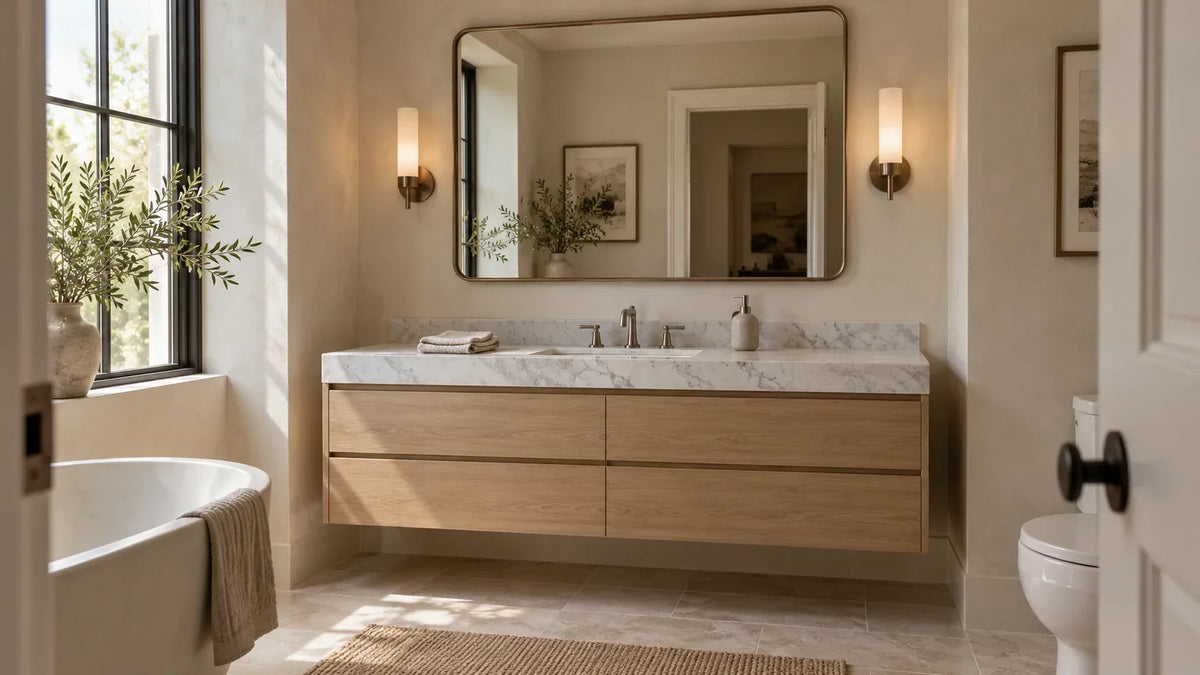
The toe kick is where material marketing meets mop water. A floor-standing cabinet puts its lowest edge close to splash and cleaning water, while a floating vanity removes that floor contact point but does nothing for a slow leak inside the plumbing cabinet. Around the sink, a small coating failure matters because it can expose the substrate exactly where water lands most often. Under the sink, accessible shutoffs and a simple moisture alarm can protect more cabinet than a better-sounding material label.
Measure this before installation, too. A plumbing cutout made on site can expose fresh material even when every factory edge arrived sealed, and an oversized hole gives splashed or leaking water more unprotected surface to reach. Ask your installer how cut edges will be sealed before the cabinet is pushed tight to the wall. The hidden cut is part of the finish system.
Ventilation Helps With Humidity, Not Leaks

Bathroom ventilation reduces humid air around wood-based panels, but it can't rescue a cabinet from standing water or a leaking shutoff. ANSI/ASHRAE Standard 62.2-2025 uses 50 CFM, or 25 L/s, for demand-controlled local exhaust in a bathroom or toilet room. Home Ventilating Institute guidance says 20 CFM continuous ventilation may be used in place of a 50 CFM intermittent fan and recommends 1 CFM per square foot for bathrooms under 100 square feet, with a 50 CFM minimum. HVI also recommends a control that keeps ventilation running for at least 20 minutes after use, which matters because the cabinet keeps seeing humid air after the shower stops.
Use those numbers to control the room, then handle liquid water at the cabinet. Sealed edges, sound plumbing, and prompt cleanup deal with the splash or drip that ventilation can't remove. Humidity is a room problem. A leak is a cabinet problem.
What We'd Buy for Different Bathrooms

For a busy primary or family bathroom, our first call is a clearly specified plywood box with solid-wood framing or fronts and a documented finish system. In a lower-splash powder room, properly sealed MDF can be reasonable when the manufacturer identifies the grade, the component location, and the edge treatment. For a floating vanity, we'd spend less time arguing about MDF versus wood and more time confirming the mounting system, plumbing path, and how field cuts will be sealed. We'd walk away from vague material descriptions, raw-looking sink-base cutouts, or a seller who can't identify the toe-kick substrate.
Scale makes the construction map more useful. BathGems' 60-inch James Martin Breckenridge measures 59.88 inches wide by 23.5 inches deep by 33 inches high, offers 3 cm top options, and includes four full-extension drawers. If you're comparing a 60 inch bathroom vanity, ask what forms the wide sides, shelves, and sink-base floor before the hardware finish wins your attention. A wide cabinet gives broad panels and plumbing more room to expose weak detailing.
Take the Wet-Zone Test to Your Shortlist

We wouldn't reject every vanity containing MDF, and we wouldn't pay more for "solid wood" without a component map. For daily shower use, we'd still put plywood on the broad box panels, solid wood where frame strength and visible grain matter, and MDF only where its grade and edge protection match the exposure. If you want the broader construction vocabulary behind those labels, our solid wood vs engineered wood bathroom vanities guide goes one layer deeper. Once the material map passes, compare bathroom vanity sizes against door swing, plumbing, and walking room before you choose the finish.
Frequently Asked Questions

Todd Harmon
Vanity material matters most at the edges water can actually reach, so Todd's approach is to read the cabinet as a system of panels, joints, cutouts, and finishes rather than trust one material label. With over two decades in e-commerce and product curation, Todd built BathGems on a simple idea: a bathroom should feel as collected and considered as the rest of the home. He sources every vanity and fixture in the BathGems catalog the way a designer pulls samples, weighing material, proportion, finish quality, and how a piece actually lives in a real room over time.